


Audio By Carbonatix
President John Mahama has begun consultations with the Council of State following the submission of three petitions seeking the removal of the Chief Justice, Gertrude Sackey Torkornoo.
According to a statement from Minister for Government Communications, Felix Kwakye Ofosu, the three petitions have been forwarded to the Council of State, in line with the constitutional process outlined in Article 146 of the 1992 Constitution.
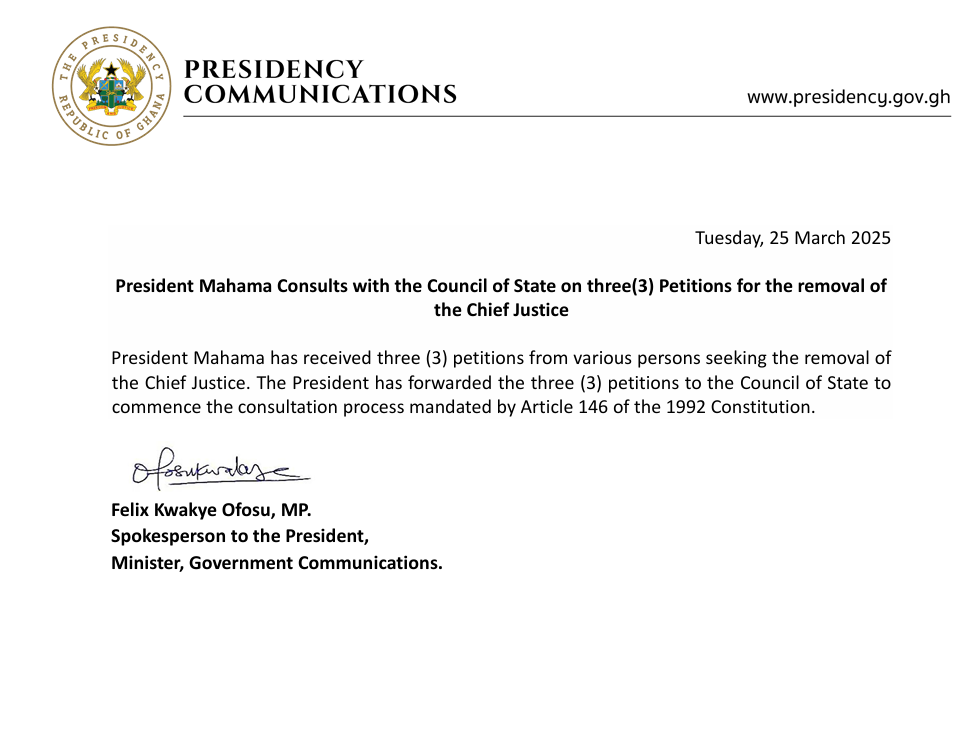
While details of the petitions remain undisclosed, this development signals the beginning of a formal process that could lead to significant changes within Ghana’s judicial system.
The Council of State is expected to examine the petitions and advise the President on the next steps in accordance with constitutional provisions governing the removal of a Chief Justice.
In January this year, former President Akufo-Addo dismissed a petition seeking the removal of Chief Justice Gertrude Sackey Torkornoo.
The former President, after thorough consultations with the Council of State, concluded that the petition, filed by Prof Stephen Kwaku Asare, lacked merit and did not disclose a prima facie case warranting further investigation.
The petition accused Chief Justice Torkornoo of misconduct and incompetence, citing alleged panel reconstitution, issuance of practice directions, and constitutional breaches. However, the President’s review identified key shortcomings.
The law that surrounds the removal of the Chief Justice is enshrined in Article 146 of the constitution.
Article 146 - Removal Of Justices Of Superior Courts And Chairmen Of Regional Tribunals
1) A Justice of the Superior Court or a Chairman of a Regional Tribunal shall not be removed from office except for stated misbehaviour or incompetence or on ground of inability to perform the functions of his office arising from infirmity of Body or mind.
(2) A Justice of the Superior Court of Judicature or a Chairman of a Regional Tribunal may only be removed in accordance with the procedure specified in this article.
(3) If the President receives a petition for the removal of a Justice of a Superior Court other than the Chief Justice or for the removal of the Chairman of a Regional Tribunal, he shall refer the petition to the Chief Justice, who shall determine whether there is a prima facie case.
(4) Where the Chief Justice decides that there is a prima facie case, he shall set up a committee consisting of three Justices of the Superior Courts or Chairmen of the Regional Tribunals or both, appointed by the Judicial Council and two other persons who are not members of the Council of State, nor members of Parliament, nor lawyers, and who shall be appointed by the Chief Justice on the advice of the Council of State.
(5) The committee appointed under clause (4) of this article shall investigate the complaint and shall make its recommendations to the Chief Justice who shall forward them to the President.
(6) Where the petition is for the removal of the Chief Justice, the President shall, acting in consultation with the Council of State, appoint a committee consisting of two Justices of the Supreme Court, one of whom shall be appointed chairman by the President, and three other persons who are not members of the Council of State, nor members of Parliament, nor lawyers.
(7) The committee appointed under clause (6) of this article shall inquire into the petition and recommend to the President whether the Chief Justice ought to be removed from office.
(8) All proceedings under this article shall be held in camera, and the Justice or Chairman against whom the petition is made is entitled to be heard in his defence by himself or by a lawyer or other expert of his choice.
(9) The President shall, in each case, act in accordance with the recommendations of the committee.
(10) Where a petition has been referred to a committee under this article, the President may-
(a) in the case of the Chief Justice, acting in accordance with the advice of the Council of State, by warrant signed by him, suspend the Chief Justice;
(b) in the case of any other Justice of a Superior Court or of a Chairman of a Regional Tribunal, acting in accordance with the advice of the Judicial Council, suspend that Justice or that Chairman of a Regional Tribunal.
(11) The President may, at any time, revoke a suspension under this article.
Latest Stories
-
Iran war lands ‘triple blow’ to flood-ravaged Sri Lankans
21 minutes -
Gunmen kill at least 11 people at Afghanistan picnic spot
34 minutes -
Woman, 25, in court for stealing baby at Bogoso
35 minutes -
Trump unveils giant gold-accented victory arch design for US capital
38 minutes -
We spoke to the man making viral Lego-style AI videos for Iran. Experts say it’s powerful propaganda
43 minutes -
Hungarians vote in big numbers on whether to end Orbán rule and elect rival
44 minutes -
At least 30 feared dead in crush at Haitian tourist site
44 minutes -
Boxing: Abdul Ahmed wins WBA Africa Cruiserwight title after dispatching Nigeria’s Eradeye
58 minutes -
Nearly 2,000 displaced, schools damaged as windstorm wreaks havoc in Gushegu
1 hour -
Ghana’s Derrick Kohn to work under Marie-Louise Eta as she becomes first woman to coach men’s Bundesliga team
1 hour -
Accra Open Championships conclude with strong performances ahead of African Championships
1 hour -
Ghana to begin camping with 12 athletes after Accra Open Championships – Bawa Fuseni
2 hours -
Anthony Joshua declines showdown with Tyson Fury but admits they ‘probably’ clash next
2 hours -
Tyson Fury dominates Makhmudov, calls out Joshua next
2 hours -
I have supported highway authority financially to fix roads in my constituency – A Plus
3 hours