

Audio By Carbonatix
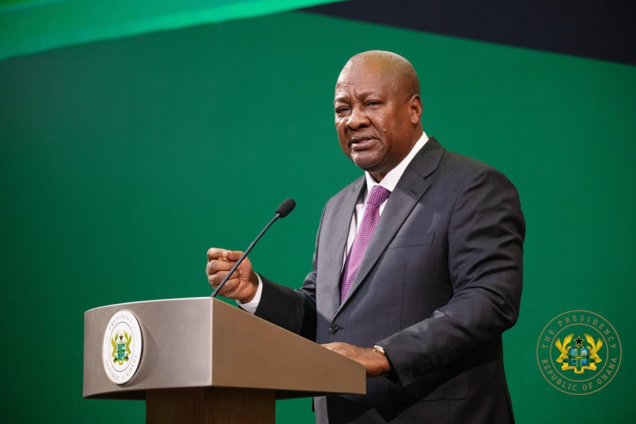
President John Mahama has directed the State Interests and Governance Authority (SIGA) to ensure that all chief executive officers of State-Owned Enterprises (SOEs) comply with the Assets Declaration Law.
He noted that the Auditor-General would submit a list of those who had complied by an agreed cut-off date, and those who failed to comply would be sanctioned, including possible removal from office.
President Mahama gave the directive during a meeting with chief executive officers (CEOs) of SOEs on Thursday at the Kempinski Hotel in Accra.
The Public Office Holders (Declaration of Assets and Disqualification) Act, 1998 (Act 550) mandates public officials to declare their assets and liabilities upon their assumption of office.
The law aims to prevent corruption, detect illicit enrichment, and address conflicts of interest by requiring officials to disclose their assets and liabilities.
“As I said yesterday, you are among the category of public officers obliged to declare your assets upon assuming office, and also upon leaving office,” the President said.
“A lot of your predecessors have failed to declare their assets, including ministers and CEOs who have left, and so the Auditor General must follow them and get them to comply.”
President Mahama reiterated the clarity of his vision for reform, anchored on performance, accountability and national interest.
He said under his leadership, specified entities would be transformed into engines of growth, aligning with their goal of a 24-hour economy that expanded job opportunities and drove industrialisation.
At the centre of that transformation was SIGA, which would evolve from a passive observer into an empowered enforcer of national interest.
SIGA, the President said, would act as a command centre and be equipped with executive authority to negotiate and enforce performance contracts with heads of entities, and conduct regular in-depth assessments of SOE finances, ensuring transparency and exposing mismanagement.
In addition, it would issue binding directives, implement compliance mechanisms and intervene directly in underperforming entities.
SIGA would also commission independent audits to identify inefficiencies and financial leakages, and set and monitor performance metrics, with tangible consequences for non-performance.
He warned that loss-making SOEs would no longer be tolerated; saying “They will be swiftly reformed, mixed, privatised or shut down. The heads of SOEs cannot be asking for salary increment while their agencies are making losses.”
President Mahama said corruption, procurement fraud, and financial mismanagement would be prosecuted strictly, and boards that rubber-stamped poor decisions would be replaced.
“The practice also of, in a few cases, using entity resources and funds to indemnify board members from accountability must cease immediately,” he said.
SOEs must deliver strategic value, particularly in energy, transport, manufacturing, agriculture and finance, to support Ghana’s industrialisation and the 24-hour economy initiative.
President Mahama charged entities like the Electricity Company of Ghana, the Ghana Grid Company, Ghana Water Company, Ghana Cocoa Board, Ghana National Petroleum Corporation, MetroMass Transit, Ghana Ports and Harbors Authority, Agricultural Development Bank, National Investment Bank and Telecom SOEs to play the pivotal roles in ensuring that Ghanaians had stable electricity, water supply, production efficiency, transportation, digital banking and a cashless economy that operated 24-7.
He said additionally, SOEs must be at the forefront of Ghana’s economic transformation; “they must play a vital role in implementing our administration’s key initiatives to reset Ghana”.
Those, he said, include the 24-hour economy policy to stimulate job creation, enhance industrial productivity and optimise national output and the Accelerated Export Development Council, which had commenced work to promote exports as part of the broader strategy for economic transformation.
The President touched on the Women’s Development Bank, which had received initial seed funding and would soon be operationalised.
He appealed to SOEs to embrace research and development to boost productivity and reduce reliance on public funding.
Dr Cassiel Ato Baah Forson, the Finance Minister, reiterated the requirement of the Public Financial Management (PFM) Act, 2016 (Act 921) that SOEs must submit audited financial statements to the Minister within four months after the end of the financial year.
“Moving forward, the Ministry of Finance will work closely with SIGA to ensure strict enforcement of these statutory requirements.” Dr Forson said.
Professor Michael Kpessa-Whyte, the Director-General of SIGA, said the Authority would work hard to ensure that the nation’s SOEs operated with the highest standard of governance, transparency and accountability.
Latest Stories
-
Agri-Impact Group Founder Daniel Acquaye appointed Chairman of CSIR–Crops Research Institute board
34 minutes -
Gold Fields Ghana gifts Mehuntem Community with 40,000-litre water system
41 minutes -
King Charles’ brother, Andrew arrested on suspicion of misconduct in public office as King says ‘law must take its course’
44 minutes -
CDD calls for independent anti-corruption commission in the one-year review of Mahama administration
49 minutes -
Ecobank rewards over 4,000 customers in ‘5-Star Enjoyment’ Promo grand finale in Kumasi
57 minutes -
Police arrest alleged drug kingpin in Bono Region narcotics operation
1 hour -
CDD flags bail and pre-trial detention controversies in assessment of Mahama’s one-year administration
1 hour -
Drivers’ union tours Kinbu-Tudu Street; commends Accra Mayor for traffic relief efforts
1 hour -
CDD flags violence, governance gaps and legal loopholes in assessment of one-year of Mahama administration
2 hours -
CDD warns of ‘backdoor’ criminal libel; slow pace on key accountability reforms
2 hours -
The Myth of Benevolence: Deconstructing the benefits of colonialism in Ghana
2 hours -
NAM 1 tells court BoG guided Menzgold operations
2 hours -
CDD raises red flag over GH₵20,000 gift threshold in ministers’ code
2 hours -
Deputy CEO of EPA rides to work, sparks debate on safety and clean transport
2 hours -
NSA and UNFPA unveil work readiness programme to train 150,000 graduates annually
2 hours