

Audio By Carbonatix
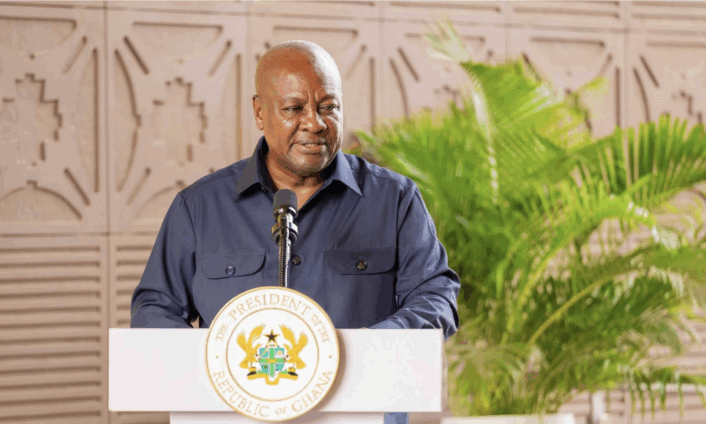
The Centre for Democratic Development (CDD-Ghana) has raised concerns about persistent violence, institutional weaknesses and unresolved legal gaps in Ghana’s presidential transition process, in its one-year assessment of the Mahama administration.
In its review of developments, CDD-Ghana observed that transitions in the Ghana Fourth Republic—particularly between the New Patriotic Party (NPP) and the National Democratic Congress (NDC)—have historically been marred by violence, political reprisals and governance disruptions.
According to the report, the 2025 transition was “not different from previous ones”. It cites contestation and violence surrounding parliamentary results in several constituencies, including the destruction of Electoral Commission result sheets, assaults on poll workers and what it described as an ineffective police containment strategy.
The period leading up to the inauguration of President John Dramani Mahama was characterised, CDD noted, by fear and uncertainty.
As has become typical during transitions, the think tank said marauding groups of party-affiliated vigilantes illegally entered public institutions in attempts to remove outgoing political appointees or secure employment allegedly promised by the incoming administration.
One of the most striking incidents cited was the storming of the offices of Ghana National Gas Company on December 10, 2024, by NDC supporters. The situation reportedly required a combined deployment of police and military personnel, who fired warning shots to disperse the group.
CDD-Ghana further noted that such incidents continued even after President Mahama was sworn into office.
On January 15, 2025, the organisation issued a public statement urging the new government and the NDC to disband vigilante groups and allow the police to maintain law and order.
“Typical of the history of presidential transitions, almost no one has been held accountable for clearly criminal acts,” the report stated.
Legal and Constitutional Gaps
Beyond the violence, CDD-Ghana highlighted long-standing constitutional and legal weaknesses that continue to undermine effective state transitions.
Although the Presidential (Transition) Act, 2012 (Act 845) was enacted to sanitise and formalise the handover process, CDD argues that it has only partially achieved its purpose.
While transitions at the apex of government have become more orderly—with structured transition teams and cordial engagements between outgoing and incoming administrations—the same cannot be said for the broader machinery of state.
A major recurring issue, the report notes, is the practice of last-minute appointments, contracts and financial commitments by outgoing governments. In the 2025 transition, disputes arose over payments and recruitment undertaken during the transition window.
The incoming administration subsequently revoked what it termed “last-minute appointments” made after January 7, 2025, a move that significantly affected many newly recruited public sector workers, particularly unemployed youth.
Governance Disruptions at Local and Corporate Levels
CDD-Ghana also pointed to structural governance gaps created by mass dismissals and abrupt directives during transitions. Metropolitan, Municipal and District Chief Executives (MMDCEs) were instructed to hand over to District Coordinating Directors upon the assumption of office by the new President. Similar directives were issued to boards and chief executives of public corporations.
While these actions are common during political transitions, CDD argues that they create operational paralysis.
The removal of MMDCEs, for instance, disrupts the functioning of District Security Councils and other local governance mechanisms. Likewise, dissolving boards and removing chief executives of state-owned enterprises can halt even purely commercial operations, sometimes with contractual and financial consequences.
In some cases, replacing a board, appointing a chief executive or confirming a new MMDCE can take six months to a year, compounding governance uncertainty.
Council of State and Presidential Appointments
Another area of concern is the sequencing challenge created under the Presidential Office Act, 1993 (Act 463), which requires presidential staff appointments to be made in consultation with the Council of State.
Incoming presidents typically prefer to constitute their own Council of State before making substantive appointments, meaning that key presidential staff often serve in an interim capacity for extended periods.
CDD-Ghana believes these overlapping legal requirements contribute to avoidable governance delays at critical moments of state transition.
Proposed Reforms
The organisation endorsed recommendations put forward by the Constitutional Review Committee (CRC), including proposals to amend Chapter Eight of the Constitution to restrict certain actions during the transition period—such as urgent appointments, contracts and financial commitments.
The CRC has also proposed fixed-term appointments for certain key officials that would not be coterminous with the President’s tenure, thereby reducing politicisation and disruption during transitions.
Additionally, the report recommends revising the Presidential (Transition) Act to extend its scope beyond the Presidency to encompass public and civil service and local government structures.
Further proposals include strengthening oversight of state enterprises through the State Interests and Governance Authority (SIGA), to ensure continuity and accountability.
A Call for Institutional Maturity
CDD-Ghana warned that unless structural reforms are undertaken, Ghana’s democratic transitions will continue to be accompanied by instability, economic risk and erosion of public confidence.
Latest Stories
-
Ghana risks EU gas market access over methane emissions – Expert warns
18 minutes -
Salt Pond’s $200m warning: Why Ghana cannot afford to exclude Fisheries Commission from future decommissioning
20 minutes -
Venezuela frees 39 political prisoners after post-Maduro talks
57 minutes -
EU unlocks humanitarian aid for crises worldwide
60 minutes -
Tenth woman’s body found as South Africa police probe killings
1 hour -
Black woman found hanging from tree was dead before body was ‘staged’, police say
1 hour -
Final day: 3rd Republic Bank-JoyNews Habitat Fair clinic underway at Junction Mall, Nungua
1 hour -
Nor’easter brings flooding as New York and New Jersey declare emergency
1 hour -
Africa’s richest man helps fund $660m fuel pipeline between Ethiopia and Djibouti
2 hours -
Security lapses at Utah campus where Charlie Kirk was killed, review says
2 hours -
White House bars CNN from travelling with Trump on Air Force One
2 hours -
Pope praises young people’s ‘energy and commitment’ at huge open-air Mass in Paris
2 hours -
Nyankamam residents benefit from free medical screening, healthcare outreach
2 hours -
Ghana, Boeing explore setting up regional aircraft maintenance hub
2 hours -
Bangkok roads submerged as flood disaster declared
2 hours