

Audio By Carbonatix
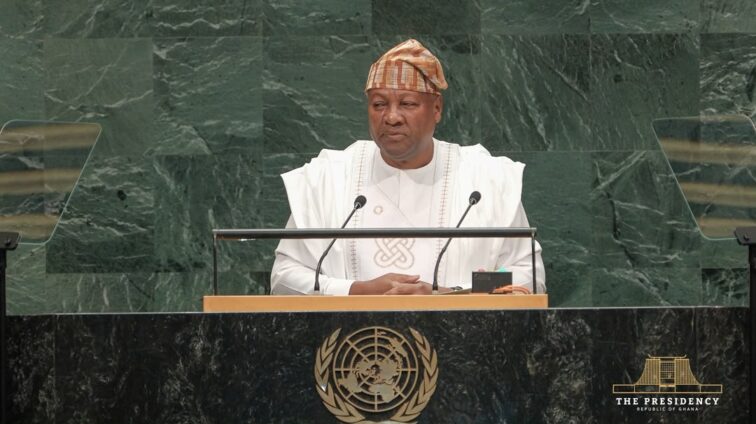
Addressing the 81st Session of the United Nations General Assembly in New York on September 24, 2026, Ghanaian President His Excellency John Dramani Mahama delivered an expansive speech calling for systemic international reform, global justice, and a renewed commitment to human dignity.
Speaking from a podium historically graced by Pan-African leaders, President Mahama challenged the assembly to confront historical atrocities, restructure global governance and finance, address environmental degradation, and recognise the shared humanity of all global citizens.
Roots, Identity, and the Concept of Belonging
President Mahama opened his address by drawing upon Ghana’s national anthem, highlighting its call to be bold in defending the cause of freedom and right while cherishing fearless honesty. He reflected on his personal origins in Damongo, capital of the Savannah Region, describing his heritage as a reflection of Ghana’s rich cultural tapestry.
Highlighting his ability to speak several languages, including Gonja, Akan, Ga, Hausa, English, and a working understanding of Ewe, he noted that language creates genuine kinship among diverse peoples.
While acknowledging that belonging serves as a vital source of dignity and pride, Mahama cautioned against its weaponisation into nativism, chauvinism, xenophobia, and prejudice. He re-anchored his address in the founding principle of the United Nations, reminding world leaders that every human being belongs to the human family regardless of race, faith, language, or origin.
Historic Acknowledgment, Resolution A/RES/80/250, and Reparatory Justice
A central theme of the address was the pursuit of full international recognition and repair for historic atrocities. President Mahama highlighted the passage of Resolution A/RES/80/250 on March 25, 2026, marking the International Day of Remembrance of the Victims of Slavery and the Transatlantic Slave Trade.
Tabled by Ghana and supported by 123 nations, the resolution formally affirmed that the transatlantic slave trade and chattel enslavement were the gravest crimes against humanity in human history. Mahama acknowledged positive moves by countries such as the Netherlands, Germany, and France to join conversations on reparatory justice and restitution.
However, the President emphasised that true repair extends beyond gestures and requires dismantling exploitative structures, including unfair global trade regimes, predatory resource extraction, discriminatory credit ratings, unsustainable debt burdens, and the continuous export of raw materials without local value addition.
Demands for Systemic Global Reform
President Mahama outlined significant disparities in current global governance and financial systems. Highlighting that Africa represents over 18 percent of humanity with 1.5 billion people and constitutes the largest regional voting bloc in the General Assembly, Mahama demanded permanent African representation on the UN Security Council with full veto powers, arguing that current structures reflect outdated post-war geopolitical realities.
He criticized lending practices that force developing nations to borrow at interest rates up to eight times higher than industrialized nations, forcing governments into a tragic choice between servicing predatory debt or serving their populations. Rejecting any new scramble for Africa, Mahama declared that critical minerals required for the global green transition must be processed within the continent to build local industries, create jobs, and retain value.
He pointed to the African Continental Free Trade Area, headquartered in Accra, as the primary engine for intra-African trade and structural industrialization.
Conflict, Multilateralism, and International Law
Reiterating that the UN Charter must prevail over unilateralism and the doctrine that might makes right, Mahama addressed several ongoing global security crises. In Gaza, he called for an immediate end to human carnage, collective punishment, enforced starvation, and mass displacement.
He reaffirmed Ghana's recognition of the sovereign State of Palestine and support for a Two-State solution, while explicitly condemning acts of terrorism by Hamas. Regarding Sudan, cited as the world's worst humanitarian crisis, he urged elevated global solidarity, while also pledging support for nations combating terrorism, particularly the Alliance of Sahel States.
Furthermore, Mahama reiterated calls for an immediate lifting of the decades-long economic, commercial, and financial embargo imposed on Cuba. Across all global disputes, he insisted on a uniform standard of respect for sovereign integrity, protection of civilians, unhindered humanitarian access, and accountability for war crimes.
Climate Justice and Global Health Security
On environmental issues, President Mahama noted that while Africa contributes less than 4 percent of global greenhouse gas emissions, it suffers disproportionately from climate devastation. He cited a severe event on June 29, 2026, when coastal West Africa and Ghana experienced over 160 millimeters of torrential rainfall within 24 hours across seven regions, resulting in 39 deaths.
He demanded that developed nations fulfill climate finance commitments through predictable, non-debt-creating grants rather than loans. In global health, Mahama advocated for the implementation of the Accra Reset, demanding regional manufacturing of vaccines and therapeutics, stronger epidemic surveillance, and resilient public health infrastructure throughout the Global South.
Domestic Renewal: The Resetting Ghana Agenda
Turning to domestic governance, President Mahama stressed that African leaders must govern with transparency, fight corruption, and ensure accountability. He outlined key domestic initiatives under his administration, describing macroeconomic stabilization measures as a Ghanaian miracle validated by international financial institutions and rating agencies through restored growth, reduced inflation, a stabilized national currency, and lowered public debt.
He detailed major infrastructure and industrial initiatives, including the Big Push Programme, the 24-Hour Economy and Accelerated Export Development Programme, and the New Ghana, New Economy policy aimed at driving round-the-clock commercial operations and industrial growth.
In social protection, Ghana officially launched a Free Primary Health Care Programme offering community-level care at zero cost, alongside the National Health Insurance Scheme and the specialized Ghana Medical Trust Fund, popularly known as MahamaCare, which subsidizes treatment for Non-Communicable Diseases like renal failure, cancer, cardiovascular diseases, and diabetes.
Future Horizons: Looking to 2027
President Mahama concluded by highlighting two major milestones ahead for Ghana. In March 2027, Ghana will celebrate its 70th Anniversary of Independence as the first sub-Saharan African nation to break colonial rule, and in January 2027, Ghana will assume the Chairmanship of the African Union.
Mahama pledged to use the AU Chairmanship to drive continental integration, accelerate the AfCFTA, promote peace, and ensure that Africa speaks with a unified voice on the global stage. Expanding on Kwame Nkrumah’s historic 1957 declaration, Mahama concluded that the freedom, prosperity, and peace of any single nation remain insecure unless linked to the total liberation and shared justice of all humanity.
Latest Stories
-
NSA regional director Emmanuel Reagan files nomination to contest NDC Ashanti Regional Organiser position
43 seconds -
Obuasi SHTS: Number of students alleging sexual abuse rises to 16
6 minutes -
Ghana’s economy grows by 7.4% in July 2026
17 minutes -
NDC member challenges Dennis Yeboah Twumasi’s eligibility for Bono Regional Secretary elections
27 minutes -
Popular Nigerian gospel singer Toluwanisings dies
38 minutes -
Spio-Garbrah proposes debt swaps to fund reparative justice in Africa and Caribbean
45 minutes -
Alban Bagbin calls for governance reforms and coordinated action to address Africa’s debt crisis
48 minutes -
AAK Academy Ghana trains 22 chocolate and confectionery companies in production techniques
49 minutes -
Adwumawura Programme trains second cohort of young entrepreneurs in Bono East
50 minutes -
Destroying Jimi River for gold could cost us our lives – Asantehene
57 minutes -
Sammy Gyamfi didn’t say BoG has ceded its forex role to us – GoldBod
2 hours -
High Court sets November 4 for ruling on Wontumi’s bail application
2 hours -
Tetteh Kwetey files nomination for NDC Greater Accra Regional Chairmanship
2 hours -
Korle Bu appeals for more doctors, nurses as A&E Centre struggles under pressure
2 hours -
AFCON 2027Q: ‘I’m optimistic Black Stars can turn things around’ – Agyemang-Badu
2 hours