

Audio By Carbonatix
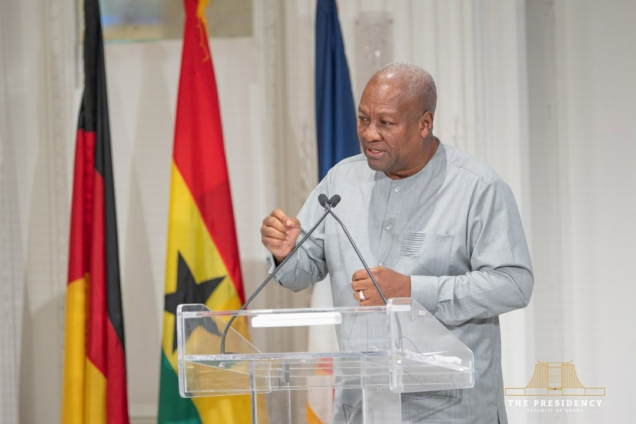
As world leaders gather in New York City for the 81st Session of the United Nations General Assembly under the overarching theme of restoring global trust and managing global transformation, Ghanaian President John Dramani Mahama has taken center stage with an ambitious, multi-faceted agenda.
Arriving in the United States with First Lady Lordina Dramani Mahama, Foreign Minister Samuel Okudzeto Ablakwa, and a senior government delegation, the Ghanaian leader has centred his diplomatic mission on systemic global finance reform, sovereign self-reliance, historical reparatory justice, and aggressive investment promotion for West Africa.
A central pillar of President Mahama’s engagement at this year’s assembly was the hosting of a high-level presidential side event dedicated to his signature policy initiative, the Accra Reset. Convening heads of state, multilateral leaders, and international partners under the theme of making global development work again, President Mahama launched the landmark Sovereign Future report.
The declaration urged nations across the Global South to end traditional health aid dependency and transition toward sovereign-led financing models, domestic pharmaceutical production, and self-sustaining health security systems.
The initiative received significant praise from peers across the continent, with Kenyan President William Ruto explicitly commending the Ghanaian president for championing financial independence and rallying global attention toward self-financing African institutions.
Parallel to his economic development crusade, President Mahama has led international discussions on historical accountability and cultural restitution. Hosting a high-level presidential summit focused on moving from commitments to action on reparatory justice, he outlined three core pillars for the return of looted cultural property, sacred artifacts, and national archives.
The Ghanaian president firmly rejected persistent arguments that African nations lack the technical infrastructure or capacity to preserve returned heritage, framing cultural assets not as luxury items to be considered after economic growth, but as vital engines of education, national identity, international tourism, and the creative economy.
His address highlighted recent historic UN declarations recognising the transatlantic slave trade as a grave crime against humanity and called for immediate, unhindered restitution of stolen African history.
On the sidelines of the UN Assembly, President Mahama has maintained an intense schedule of bilateral diplomacy and high-level economic engagement designed to market Ghana as a prime destination for global capital.
His meeting with UN Secretary-General António Guterres reinforced Ghana’s diplomatic standing, while bilateral sessions with global figures, including King Abdullah II of Jordan, Swiss President Guy Parmelin, and Queen Máxima of the Netherlands, focused on concrete economic partnerships.
In his discussions with the Swiss leadership, President Mahama outlined domestic economic revival strategies and requested technical cooperation to leverage artificial intelligence for tax administration and domestic revenue mobilisation.
To further seal commercial partnerships and court private investment, the president’s itinerary includes addressing top corporate executives at a US-Ghana Presidential Roundtable organized by the US-Africa Chamber of Commerce, delivering a major policy foreign policy address at the Council on Foreign Relations, participating in the Ocean Panel Leaders’ Meeting, and ringing the NASDAQ Closing Bell in Times Square.
Following his address to the main UN General Debate, where he advocates for structural reforms to the UN Security Council to grant Africa permanent representation and calls for an overhaul of international debt architectures, President Mahama will conclude his high-level mission by directly engaging the Ghanaian diaspora in a town hall meeting in New York.
The forum will serve as an open exchange to update citizens abroad on his administration's domestic economic transformation plans and establish new channels for diaspora-led investment back home.
Latest Stories
-
Ghana’s economy grows by 7.4% in July 2026
8 minutes -
NDC member challenges Dennis Yeboah Twumasi’s eligibility for Bono Regional Secretary elections
18 minutes -
Popular Nigerian gospel singer Toluwanisings dies
29 minutes -
Spio-Garbrah proposes debt swaps to fund reparative justice in Africa and Caribbean
36 minutes -
Alban Bagbin calls for governance reforms and coordinated action to address Africa’s debt crisis
39 minutes -
AAK Academy Ghana trains 22 chocolate and confectionery companies in production techniques
40 minutes -
Adwumawura Programme trains second cohort of young entrepreneurs in Bono East
42 minutes -
Destroying Jimi River for gold could cost us our lives – Asantehene
48 minutes -
Sammy Gyamfi didn’t say BoG has ceded its forex role to us – GoldBod
2 hours -
High Court sets November 4 for ruling on Wontumi’s bail application
2 hours -
Tetteh Kwetey files nomination for NDC Greater Accra Regional Chairmanship
2 hours -
Korle Bu appeals for more doctors, nurses as A&E Centre struggles under pressure
2 hours -
AFCON 2027Q: ‘I’m optimistic Black Stars can turn things around’ – Agyemang-Badu
2 hours -
Digital innovation could widen Africa’s inequalities if people are left out – Sam Jonah
2 hours -
Galamsey is an economic, health and moral problem – Sam Jonah
2 hours