

Audio By Carbonatix
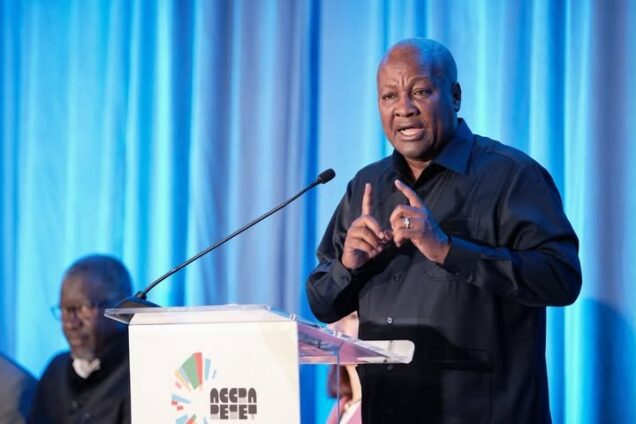
President John Dramani Mahama has called for a fundamental shift in the way global health cooperation is structured, insisting that countries in the Global South cannot truly own their health systems without control over their financing, resources and production capacity.
He made the call in New York on Monday, September 21, after launching the High-Level Panel Report of the Accra Reset, titled “A Sovereign Future for Health,” on the sidelines of the 81st United Nations General Assembly.
The report sets out proposals for reforming the global health architecture around stronger national and regional capabilities, greater domestic ownership and more accountable partnerships with international development institutions.
President Mahama said the initiative was aimed at moving developing countries away from a model in which critical health programmes remain heavily dependent on external funding and decisions made outside their jurisdictions.
“One year ago, through the Accra Reset, we rejected the idea that the health, dignity, and future of our people should remain perpetually tied to foreign donor magnanimity,” he said in a Facebook post announcing the report.
He argued that the concept of “country ownership” had often failed to give countries meaningful control over the resources and decisions shaping their health systems.
“To put it plainly, we were handed a broken cauldron and asked to own a soup cooked entirely in someone else’s kitchen,” he said.
“Today, through the Accra Reset, we declare unequivocally that there can be NO ownership without control.”
Mahama links sovereignty to accountability
While advocating greater control for developing countries, President Mahama said sovereignty must be matched by stronger domestic accountability.
He said Ghana’s own reform agenda would focus on tightening fiscal management, fighting corruption and strengthening local productive capacity.
“However, sovereignty is not a blank check. If we demand control, we must earn it through uncompromising domestic accountability,” he said.
According to him, the Resetting Ghana agenda includes efforts to strengthen fiscal management and build local industrial capacity, particularly in the pharmaceutical sector.
He said the objective was to enable Ghanaian pharmaceutical companies to manufacture essential medicines locally rather than depend excessively on foreign assistance.
The High-Level Panel report similarly proposes stronger regional health manufacturing, coordinated procurement and commodity security, sustainable financing transitions and independent mechanisms to track governments and development partners against agreed commitments.
Health sovereignty focused on maternal mortality
President Mahama said health had been chosen as the first major area of focus, with particular attention to maternal mortality across sub-Saharan Africa.
He pointed to initiatives including Mother Africa and Business United for Mothers, Babies and Youth (BUMBY) as part of efforts to translate the commitments into practical interventions for women, children and young people.
“We are selecting health as our first battleground with a direct focus on ending the unacceptable maternal mortality rates across Sub-Saharan Africa,” he said.
The Accra Reset’s Full Circle programme in New York placed the health report at the centre of its discussions on a new global development bargain, alongside initiatives on maternal and child health, skills, fair deal-making and shared prosperity.
New global health bargain
President Mahama said the report provides a framework for a new global bargain based on three principles: ownership backed by real control over resources and production capabilities; cooperation built around human dignity and equal partnerships; and domestic accountability to ensure public resources serve citizens.
“The report sets out a clear path for a New Global Bargain built on Ownership backed by real control over our resources and production capabilities, Cooperation defined by human dignity, [and] mature, equal partnerships with global allies, and Absolute domestic accountability to ensure public resources serve our citizens down to the last pesewa,” he said.
The High-Level Panel's proposals include a country-led “one-stop” health compact, sustainable financing transitions, stronger regional institutions, regional health manufacturing, improved procurement systems and independent follow-up on commitments. It proposes that independent follow-up begin within six months, while country-led compacts should be developed within 12 months.
The report does not call for an abrupt end to international assistance. Instead, it proposes a managed transition in which external support protects essential services while countries progressively build stronger national and regional health capabilities.
President Mahama expressed gratitude to former Nigerian President Olusegun Obasanjo, former Liberian President Ellen Johnson Sirleaf and former Costa Rican President Laura Chinchilla, as well as the High-Level Panel’s co-chairs and other partners, for their contributions to the initiative.
Latest Stories
-
“NSA did not tell us of any embassy arrangement” – Kofi Adams
12 minutes -
Glasner suffers loss on Selhurst return as Palace beat Forest
2 hours -
WAFU B U17: ‘We won but I expected more from my boys’ – Kassim Ocansey
2 hours -
Man City cruise to statement win over 10-man Liverpool
2 hours -
Be careful with cross-border lending, foreign currency exposures – BoG to financial institutions
4 hours -
GPL 2026/27: Medeama go three clear as Hearts of Oak recover and Bechem stage stunning comeback
5 hours -
Ntiamoah Foundation launches “BEYOND 20” anniversary campaign
5 hours -
Credit Risk Management Directive: BoG to begin implementation for banks, others from July 1, 2027
5 hours -
Ghana Brands Awards 2026: Leading brands, business trailblazers to shine on November 20
5 hours -
T-bills auction: Demand improves as government exceeds target by about 76%; interest rates soften
5 hours -
Ziope undertakes initiative to build a technologically inclined community, commissions self-help ICT lab
6 hours -
ECG announces power outage in parts of Tema, Central Region due to network fault, maintenance
6 hours -
When the Gospel Becomes a Weapon: The church, blackmail and the abuse of faith
7 hours -
JoyNews’ Jacqueline Ansomah Yeboah selected for UK Media Excellence for Emerging Technologies Fellowship
7 hours -
Mental Health Alliance urges government to operationalise Mental Health Fund
7 hours