

Audio By Carbonatix
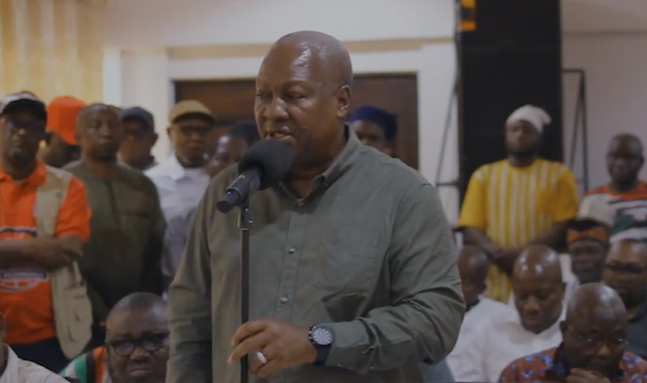
Flagbearer of the National Democratic Congress (NDC), John Mahama has shared in the frustration of soya farmers over claims of poor pricing of their produce, following a ban on the export of the product.
According to the former President, who is also a farmer, the product which sells at 460 cedis a bag is unable to cover the cost of production.
Mr Mahama made the story public in support of challenges of the Soya Bean Farmers Association which are proposing the lifting of a ban on soya bean exportation.
“If we are allowed to export and the price went up, it will make us put more land under soya bean cultivation. It will make us expand the acreage of soya bean so we can produce more and when we produce more, the price will come down naturally”, he explained.
Mr. Mahama explains how unprofitable the venture has become, “If you look at the diesel I used in the tractor, the salaries I paid my farmhands, the inputs and others then it means that we are not really breaking even. I have started a pilot onion production and I am getting about sixty bags of onions per acre and each bag can sell for 1400 cedis. So I am better off farming onions than soya beans”.
He was speaking at a town hall meeting at Tamale as part of the “Building Ghana Tour” of the National Democratic Congress.
The ban on export of soya took effect in 2021, aimed at ensuring local millers can have a year-round supply of soya bean to feed the poultry industry.
Hitherto, the local millers faced strong competition from foreign buyers, driving prices to about GHS600 of a 100 kilogram worth of soya bean.
According to the leadership of the farmers, it costs between 450 cedis and 460 cedis for a hundred kilogram of soya bean which is unable to make up for the cost of production.
They say the market for the product has continued to diminish.
Director of Administration at Ghana Association of Soya Bean Farmers and Aggregators, Abdul Hakim Issah reaveals, “casually there are people to buy but sometimes you will hear that they don’t have money. The grain is the bank of the farmer, you should be able to pick it at any moment and sell to get your money”.
Meanwhile, the Ghana Association of Soya Bean Farmers and Aggregators is proposing the government invests in the sector to drive production.
He added, “Ghana has capacity to produce 1.5 million tonnes a year but currently we are doing less than 250 thousand tonnes. We think government should increase investment into the sector so that people without jobs will find something to do on the arable lands we have”.
Meanwhile, the NDC flagbearer has assured the farmers of willingness to hold a discussion on the issues in a bid to find a lasting solution.
Latest Stories
-
Let The Constitution direct Chieftaincy to deliver “All Development Is Local”
15 minutes -
Ghana explores centre of excellence for hearing, communication and cochlear implant care
2 hours -
Schizophrenia-related disorders lead mental health cases recorded in Ghana
2 hours -
Dutch authorities enlist Ghana in hunt for fugitive drug lord Bolle Jos
2 hours -
Ghana housing finance conference adopts communiqué to improve affordable housing access
7 hours -
Special Initiatives Minister urges Wa Technical Institute to enrol more girls as EU-backed solar training lab opens
7 hours -
In the matter of my first year at the Bar
7 hours -
ActionAid Ghana calls for an end to child marriage, greater investment in girls’ rights
8 hours -
Newsfile to tackle World Cup visa scandal, beach demolitions, education strikes, BRICS bid
8 hours -
UK-Ghana Trade & Investment Summit: Trade Resource Centre to help businesses maximise UK-Ghana trade opportunities
8 hours -
Embassy of Denmark celebrates World Maritime Day
8 hours -
Linking LEAP to productive inclusion could cut extreme poverty by 2030 – UNICEF
9 hours -
Trade Ministry backs use of creative arts to rehabilitate prison inmates
9 hours -
Negotiations with government to continue despite strike suspension – GNAT
10 hours -
‘Ghana cannot afford to waste public resources; every cedi has a job’ – Ato Forson
10 hours