

Audio By Carbonatix
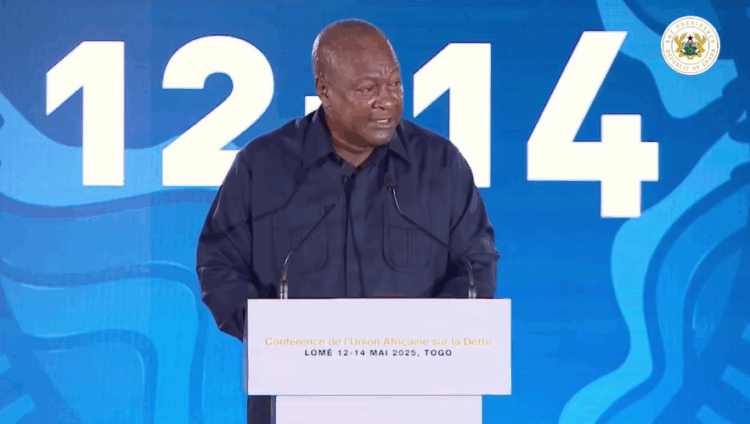
President John Mahama has urged African leaders to take part in the responsibility for the continent’s mounting debt burden.
He emphasised the need for responsible borrowing, greater transparency, and improved oversight.
Speaking at the African Union Debt Sustainability Conference in Lomé, Togo, President Mahama noted that poor governance and borrowing for consumption purposes have significantly contributed to the debt challenges facing many African nations, including Ghana.
“In Ghana over the last several years, there was an acceleration of debt accumulation, much of it going into budget support and consumption expenditure, and in a very poor governance environment,” he said.
President Mahama, who serves as the African Union’s Champion of Financial Institutions, stressed that African governments must ensure that loans are directed toward high-impact, value-driven sectors such as agriculture, education, health, and infrastructure.
He also highlighted the importance of stronger parliamentary oversight in the debt acquisition and management process, insisting that transparency and accountability must underpin every borrowing decision.
Mahama called for a broader shift in the global conversation around African debt, advocating for a narrative that reflects the continent’s potential rather than its problems.
“How do we redefine Africa’s debt narrative?” he asked. “Let us leave here with a renewed vision a vision where debt is no longer synonymous with crisis but with capacity; where our economies are built not on extraction and aid but on innovation, value addition, and equity, and where we act not as debtors pleading for relief but as partners demanding reform.”
“Ghana stands ready, shoulder to shoulder with our fellow African nations, to champion this agenda. Let us walk this road together with courage, clarity, and commitment. Africa, united in vision and action, can overcome its debt challenges and deliver prosperity for generations of Africans yet to come,” he added.
Also speaking at the conference, Zambian President Hakainde Hichilema echoed the call for sustainable debt solutions and stronger financial independence.
“Zambia was the first country to restructure its debt under the G20 Common Framework, an experience that, despite complexities, delivered meaningful relief,” President Hichilema stated.
He emphasised the need for investment in local financial institutions to drive development and reduce reliance on foreign lenders.
“If Africa is to become self-sufficient in financing our future, we must invest in our financial institutions so that they can facilitate development financing, regional crisis response, and debt restructuring,” he said.
“Zambia stands ready to collaborate with fellow African nations and key stakeholders across the world to transform debt management into a tool for scalable and indeed sustainable prosperity,” he added.
Latest Stories
-
A source of excellence across generations – Vice President Opoku-Agyemang lauds Mfantsipim
19 minutes -
(Photos) Mfantsipim School launches historic 150th anniversary
42 minutes -
Knights and Ladies of Marshall group backs Catholic Bishops’ stance on anti-LGBTQ+
2 hours -
Bright Simons writes: All the Filla in the Ibrahim Mahama/E&P – Gold Fields Saga
2 hours -
Monetise Idiocy In Ghana
2 hours -
The Ghanaian prophet and the mysterious death of his scottish wife Charmain Speirs
3 hours -
Nearly 400 sentenced in Nigeria for links to militant Islamists
3 hours -
Ghana’s recovery supported by gold strength despite global oil price pressures – Standard Bank Research
3 hours -
Methodist Church hails Mfantsipim@150; calls for “fresh consecration” to excellence
4 hours -
‘Excellence is our inheritance’ – Nana Sam Brew-Butler hails Mfantsipim’s 150-year reign in leadership
4 hours -
Kwaku Azar writes: A-G vs OSP
4 hours -
Mfantsipim–Adisadel rivalry built excellence, not division – Sam Jonah
4 hours -
Vice President launches Mfantsipim’s 150 years of shaping Ghana’s greatest mind
5 hours -
I assure Otumfuo, Mahama will join him to commission KNUST Teaching Hospital by end of this year – Haruna Iddrisu
5 hours -
Barcelona dominate derby to extend La Liga lead
6 hours