

Audio By Carbonatix
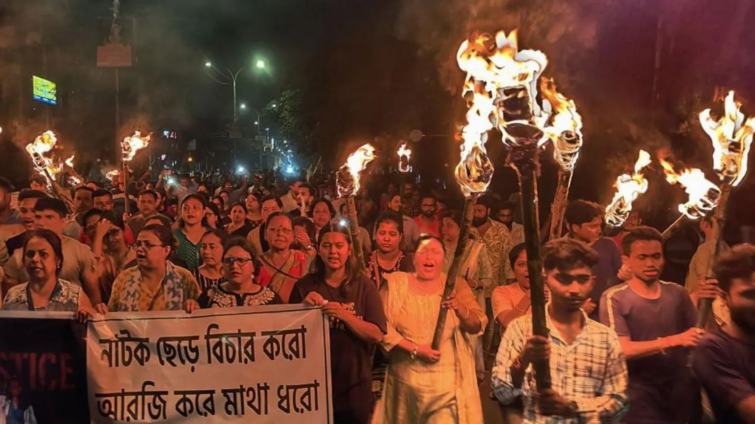
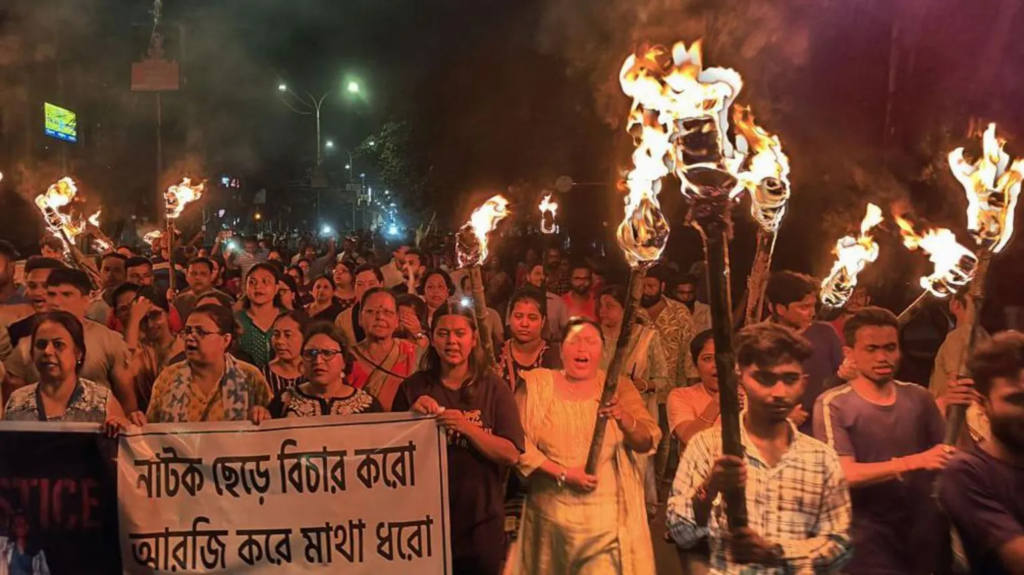
Tens of thousands of women in West Bengal marched through the streets on Wednesday night in protest against the rape and murder of a trainee doctor at a state-run hospital in Kolkata last week.
The Reclaim the Night march was the culmination of nearly a week of frenzied protests ignited by the brutal rape and murder of a 31-year-old female trainee doctor at the RG Kar Medical College last Friday.
Responding to calls on social media, women from all walks of life marched across Kolkata city and throughout West Bengal state on a rainy Wednesday night.
Smaller protests were also held in many other Indian cities like Delhi, Hyderabad, Mumbai and Pune.
In Kolkata, the peaceful protests were marred by clashes between the police and a small group of unidentified men who barged into the RG Kar Hospital, the site of the doctor’s murder, and ransacked the emergency department.
Police fired tear gas to disperse the unruly crowd. Some police vehicles were also damaged.
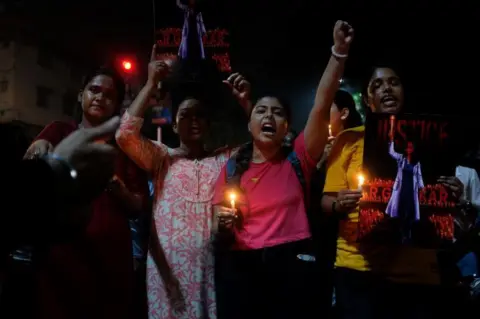
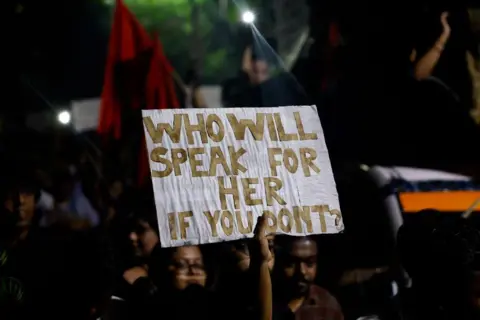
Elsewhere in the city, women marched resolutely, holding placards of protest, their faces illuminated by the glow of mobile phones, candlelight, and flaming torches. Some carried national flags. They were joined by men, both young and elderly.
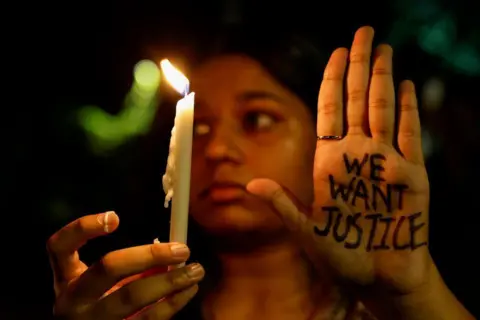
During the marches and at many gatherings near a university, theatre hall and bus terminus, they stood united, holding hands as the humid air echoed with loud and powerful chants of “we want justice”. Protesters blew conch shells - the sound is considered auspicious.
At the stroke of midnight, as India completed 77 years of Independence, the soundscape of protest changed.
The air filled with a spontaneous chorus of the national anthem. Then it began raining, but the protesters walked in the rain, or holding umbrellas over their head.
“We have never seen anything like before in the city, such a huge gathering of women marching at night,” a reporter belonging to a news network said.
It was a night of barely concealed rage and frustration.
A woman, who joined the march well after midnight with her 13-year-old daughter said: “Let her see whether a mass protest can set things right. Let her become aware of her rights”.
“Women have no respect!” said another. “Our worth is less than cows and goats."
"When do we get our independence? How long do we have to wait to work without fear? Another 50 years?” asked a student.
Sanchari Mukherjee said she marched with thousands of others from a bus terminus in Jadavpur, undeterred by the rain.
She met "people of all ages, from all classes, the well-to-do, the middle class and the poor".
"I saw an elderly couple, the husband helping the woman to walk,” she said.
"One family brought their little girl along, perhaps so the memory of this event would be etched in her mind - how her parents stood up against injustice, and how she, too, can protest one day."
Ms Mukherjee said the entire city seemed awake as the marchers passed by illuminated homes, with people peering out of windows and crowding verandahs to watch.
“They may not have participated but they were with us in spirit," she said.
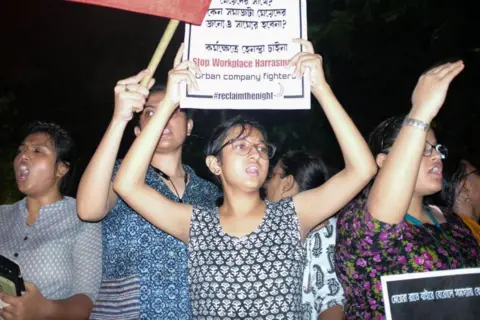
"'We want justice' had become the anthem of the march, and it didn’t feel like just a slogan," Ms Mukherjee said.
"It felt like every young woman was deeply hurt and determined, frustrated that they still face these issues in 2024."
Ms Mukherjee added that she had to walk a few miles to join the march because the streets were gridlocked late at night.
"I was instantly swept up in a sea of people heading to the protest site. There was no excitement, just a stoic determination to create an event which would become a symbol for the times to come."
The protests have been fuelled by anger over local authorities’ handling of the young trainee doctor's rape and murder.
She had fallen asleep in a seminar room after a 36-hour shift last Thursday, as there was no designated rest area for her to sleep in.
The next morning, her colleagues discovered her half-naked body on the podium, bearing extensive injuries.
Police later arrested a hospital volunteer worker in connection with what they said was a case of rape and murder.
But there have been accusations of cover-up and negligence. The case has since been transferred from local police to the federal Central Bureau of Investigation.
Despite scant resources, Kolkata’s Reclaim the Night march appeared to have been meticulously organised. In an advisory, organisers welcomed women and people from marginalised sexual and gender identities to the march.
“Men are welcome as allies and observers,” the advisory added.
They also emphasised that politicians were not welcome and requested that no party flags be brought to the protest.
It was not the first time that a Reclaim the Night march has been staged in India.
Inspired by similar marches elsewhere in the world by women to assert their rights to walk in public areas without fear, a march was held in 1978 in Bombay (now Mumbai) in protest against the rape of a woman on the street.
Blank Noise, a community-based art project and activist collective, has organised several midnight walks in Delhi to encourage women to assert their right to walk freely at night.
But in terms of scale, the Kolkata march, echoed by smaller ones across other cities, stands as the largest yet.
"We seized the night. We've never seen anything like this in the city. This is unprecedented. I hope it wakes up the authorities," said Chaitali Sen, a protester.
Latest Stories
-
Gabriel Tanko Kwamigah-Atokple vindicated as court slams EOCO over unlawful account freeze
4 minutes -
UN slavery resolution a pathway to healing and justice – Mahama
9 minutes -
Mahama warns against modern-day erasure of black history in schools, media
16 minutes -
At Nobi Agriculture, scale and systems redefine farming in Ghana
17 minutes -
TCL named official electronics sponsor of UG Corporate Football League
25 minutes -
Hon Stanley Basil Bade Carboo aka Nene Opertoto II
30 minutes -
Stop charging young people recruitment fees – Senyo Hosi tells government
33 minutes -
WAES condemns conviction of Malian journalist, warns of threat to press freedom
37 minutes -
What a Strait of Hormuz Blockade could mean for Ghana’s economy in 2026 – A PwC analysis
40 minutes -
Education Minister receives WAEC Council Chairman ahead of 74th Anniversary in Ghana
41 minutes -
NPA engages stakeholders on Driver and Mate Pay Framework
46 minutes -
Become advocates for change within your workplaces, communities – Deloitte Tax Partner to women professionals
53 minutes -
Cedi slides as demand for forex increases; one dollar equals GH¢11.70
60 minutes -
Xoese Ghana: NGO helps 5 couples overcome infertility and welcome own babies
1 hour -
Asiedu Nketia begins 3-day ‘Thank You Tour’ of Ashanti Region
1 hour