

Audio By Carbonatix
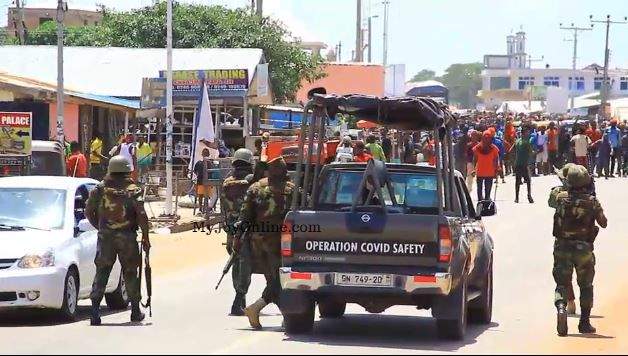
Security analyst, Emmanuel Bombande, says had it not been for the military intervention in the Ejura riot, the shootings which claimed the lives of two rioters would not have occurred.
According to him, the police were doing a good job managing the situation “until the military started jumping out of their pickups.”
“It was when the military started intervening that we then saw the shootings that then led to the killing of these two people. That should tell us a lot,” he said.
He says this recent incident is enough reason to justify why the military should be prevented from engaging with civilians in crowd control and other policing duties.
“We should not be involving the military in policing duties. The military should not be seen trying to engage in matters of crowd control and the other incidences that have occurred to bring us into the type of conversation that we are having this morning,” he said on the AM Show on JoyNews.
“But in the overall, I totally agree that we should have less of the army involved with civilians in managing what we are generally describing as to whether it is crime control, whether it is curbing crime and you name it… it is basically to say that the military belongs to the barracks and their duties are to ensure that the territorial integrity of Ghana is well preserved and well-defended,” he added.
Mr Bombande, however, stated that the military can be brought in for policing duties under extraordinary conditions, most often when the Ghana Police Service do not have enough personnel to carry out the operation.
He stated that even under such conditions, the military should not be allowed to operate on their own accord as was witnessed in Ejura, but should be made subservient to the direction of the Police in command of the operation.
He said, “I, however, admit that on specialized duties, for example in the organization of elections, because the number of men and women in the Ghana Police Service will often be insufficient you want joint operations that bring in the other security agencies to participate, but always with the understanding that it is the police that has the command and that the other agencies, particularly the military submit themselves to the command and rules of procedure of the police. But these would be very rare in my view.
“Another example will be when the level of crime becomes elevated to the point that the police alone are struggling to bring down the incidences of crime, you might want to have a specialized operation that brings in the army to play a role, but again strictly under the direction of the police.”
Latest Stories
-
AFCON 2027Q: ‘Our Black Stars team is gone’ – Former Sports Minister
8 minutes -
Prof. Prempeh calls for public review of draft constitutional reform bills
21 minutes -
AFCON 2027Q: ‘I have never seen a poor performance from Black Stars like against Gambia’ – Nii Lante Vanderpuye
25 minutes -
Nigeria set to launch National Digital Address System 9 years after Ghana showed the way
48 minutes -
Policy rate decision takes time to reflect in lower lending rates – BoG
58 minutes -
Western Regional Minister applauds Karpowership’s role in Ghana’s power sector
1 hour -
Livestream: Road safety crises: Where are we getting it wrong?
1 hour -
Enterprise Life celebrates 25 years of protecting families and building trust
2 hours -
ICC London rules in favor of Ghana against Tullow over $400m tax charge
2 hours -
We are disappointed in ICC’s ruling over our corporate income tax assessment in Ghana – Tullow Oil
2 hours -
Cost of building inflation for August 2026 increases to 4.6% – GSS
2 hours -
Today’s front pages: Wednesday, September 30, 2026
2 hours -
Bawumia highlights agricultural, compulsory insurance reforms in IBAG engagement
2 hours -
Ghana will secure Tullow tax revenues while protecting Jubilee, TEN investments – Ato Forson
3 hours -
Ghana wins $393m Tullow tax arbitration as tribunal upholds GRA assessment
3 hours