

Audio By Carbonatix
William Antiaye Addy, Deputy Director of Finance, Ghana Statistical Service (GSS), has urged Metropolitan, Municipal and District Assemblies (MMDAs) to utilise the district-level Multidimensional Poverty Index (MPI) reports to accelerate development at the local level.
He said the universal adherence to the principle of evidence-based decision-making has generated increased demand for timely, credible, and relevant statistical data.
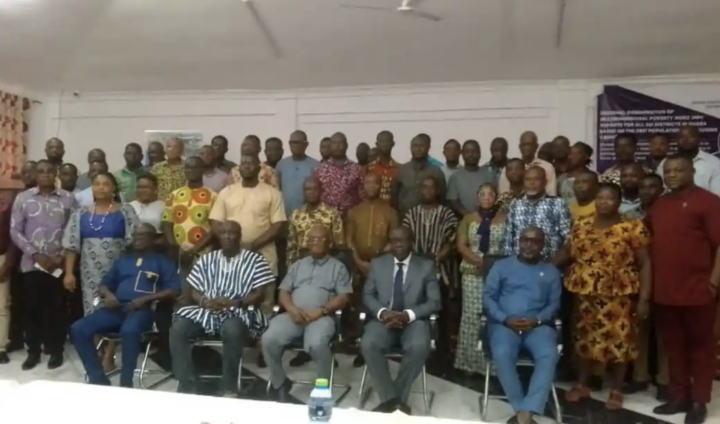
Mr Addy was addressing a workshop in Ho, in the Volta Region on behalf of the Government Statistician on Regional Dissemination of the MPI Reports and training on StatsBank for the 18 Municipal and District Assemblies in the Volta Region.
The Deputy Director said to meet this demand, the GSS had continually produced and disseminated crucial statistical information to the public, fostering a culture of evidence-based decision-making.
He said the MPI was a testament to their commitment to making comprehensive data readily available to users, and the computation of the MPI also provided users with relevant information to address challenges that confront the country.
“The targeted users of the report include the Municipal Planning and Coordination Unit, Development Partners, Civil Society Organisations (CSOs), the private sector, research institutions, academia, religious organisations, traditional rulers, and the general public,” he said.
Mr Addy said the report provided relevant and timely data to support the implementation and monitoring of the Medium-Term National Development Policy Framework (MTNDPF) 2022-2025.
“The disaggregated statistics will also support the monitoring of progress towards several Sustainable Development Goals (SDGs), including SDG 1, SDG 3, SDG 4, SDG 10, and SDG 11.
These SDGs aimed to end poverty in all its forms everywhere, ensuring healthy lives and promoting well-being for all at all ages, ensuring inclusive and equitable quality education and promoting lifelong learning opportunities for all, reducing inequality within and among countries, and making cities and human settlements inclusive, safe, resilient, and sustainable,” he said.
Mr Addy emphasised the importance of the report in the provision of targeted interventions for the allocation of resources, monitoring and evaluating local government development programmes, thereby enhancing their effectiveness.
He said the report was also relevant in tracking trends in multidimensional poverty over time, providing insights into the progress being made, and assessing progress across a range of interlinked SDGs and targets at the sub-national level, in line with the national development frameworks.
Mr Addy thanked the Ministry of Local Government, Decentralization and Rural Development, MMDAs for their cooperation and support, which he said greatly contributed to the successful completion of the reports.
“We gratefully acknowledge the expertise and resources provided by the World Bank through the Harmonising and Improving Statistics in West Africa Project (HISWAP), and the German Agency for International Cooperation (GIZ) for its funding support,” he added.
Dr Archibald Yao Letsa, Volta Regional Minister, said poverty was not merely a lack of income as it encompassed various deprivations that people faced in their daily lives.
He said the MPI was a powerful tool that captured the multifaceted nature of poverty by examining factors such as education, health, and living standards and provided a deeper understanding of the poverty dynamics in the various municipalities and districts.
The Minister stated that the region, with its rich cultural heritage and agricultural potential, had made significant strides in development, however, the MPI reports identified some critical challenges that must be addressed to ensure inclusive and sustainable growth.
Dr Letsa charged the District Chief Executives and Coordinating Directors to develop comprehensive measures to translate the findings of the report into actionable policies and implement strategies that would alleviate the multidimensional aspects of poverty in their jurisdictions.
“I urge you to take these findings seriously and work collaboratively with your teams to develop targeted interventions that address the specific needs highlighted in the reports,” he said.
Latest Stories
-
High data costs threaten Africa’s participation in AI revolution – Bawumia
11 seconds -
Africa risks missing another tech revolution without urgent AI adoption – Bawumia
2 minutes -
No bed syndrome is result of systemic failures, not lack of beds – Aurum Institute Ghana Director
4 minutes -
Black Stars technical team needs to sit up – Augustine Ahinful
28 minutes -
No bed syndrome: People have classified this as a location issue rather than a holistic one – Dr Bonney
31 minutes -
Ghana, Zimbabwe hold inaugural joint commission talks to deepen bilateral cooperation
50 minutes -
Forestry Commission, Terraformation deepen partnership to boost climate resilience and job creation
1 hour -
Not all Big Push projects were awarded through sole sourcing – Alhassan Suhuyini
1 hour -
Our request for Big Push contracts records was denied until we appealed – Sulemana Braimah
1 hour -
Big Push sole-sourced contracts: NDC has ‘reset’ Ghana for the worse – Baffour Awuah
2 hours -
Roads Minister’s response to our report was ‘hollow’ – Sulemana Braimah
2 hours -
NDC committed to ending sole-sourcing abuse – Alhassan Suhuyini
2 hours -
Big Push is government’s biggest intervention to fix Ghana’s roads – Alhassan Suhuyini
2 hours -
A firm awarded sole-sourced Big Push contract has 4 workers; another has just one – Sulemana Braimah
3 hours -
One firm awarded a Big Push sole-sourced contract was created in January 2025 – Sulemana Braimah
3 hours