

Audio By Carbonatix
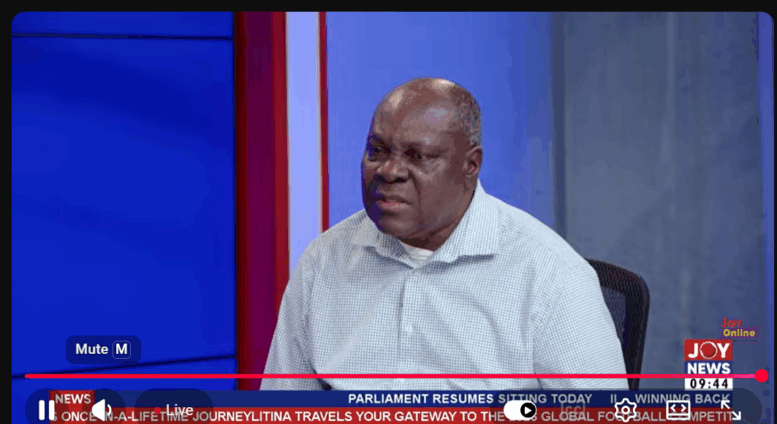
Leading member of the New Patriotic Party (NPP), Dr Arthur Kobina Kennedy, says the increasing monetisation of internal party politics has worsened inclusivity, eroded meritocracy, and contributed to growing divisions within political parties, warning that the trend has made Ghana’s politics “darker and less ideal.”
Speaking on, Dr Kennedy said while monetisation has long existed in party politics, its influence has intensified in recent years with damaging consequences.
“Monetisation has gotten worse,” he stated. “It is a problem caused by political parties, and I agree with you that it has become much worse.”
He argued that despite the expansion of the delegate system, inclusivity within parties has ironically declined.
“I think inclusivity has gotten worse,” he said. “Now, it is almost a case of ‘if you are not with me, you are against me.’ There is no middle ground.”
Dr Kennedy explained that in the past, party leadership recognised internal factions and worked deliberately to manage and reconcile them.
“Before, we understood that every party has factions, and the duty of the leader was to unite and pacify them. That understanding is gone,” he noted.
He also lamented what he described as a “dumbing down” of party structures, saying long-standing informal systems of meritocracy have collapsed.
“There used to be a quiet meritocracy in the party about who could do what,” Dr Kennedy said. “There was an understood sense that certain people were unqualified to do certain things. All that has broken down.”
According to him, the presence of some party executives today has negatively affected the party’s public image.
“There are some national executives who, in my humble opinion, are an insult to our image,” he added.
Reflecting on earlier years of party organisation, Dr Kennedy recalled a period of sacrifice, collegiality, and transparent fundraising.
“There was not much dark money,” he said. “It was sacrificial, honest money that was keeping the party running.”
He contrasted this with the current situation, where wealthy individuals finance campaigns with expectations of reward.
“We now have political financiers who invest in elections with the expectation that when we come to power, they will get contracts,” he said. “That has made our politics darker and less ideal.”
Dr Kennedy also questioned recent internal reforms, particularly those concerning party leadership structures, arguing that power in political parties is tied to access to state resources.
“Influence in political parties is tied to resources,” he explained. “A president controls more resources, so for practical purposes, he becomes the de facto leader of the party, regardless of what is written on paper.”
He added that party officials who serve in government often lose their independence.
“Many have become so sycophantic that nobody hears of them,” he said, attributing this to the president’s control over thousands of appointments.
Latest Stories
-
A source of excellence across generations – Vice President Opoku-Agyemang lauds Mfantsipim
6 minutes -
(Photos) Mfantsipim School launches historic 150th anniversary
29 minutes -
Knights and Ladies of Marshall group backs Catholic Bishops’ stance on anti-LGBTQ+
1 hour -
Bright Simons writes: All the Filla in the Ibrahim Mahama/E&P – Gold Fields Saga
2 hours -
Monetise Idiocy In Ghana
2 hours -
The Ghanaian prophet and the mysterious death of his scottish wife Charmain Speirs
3 hours -
Nearly 400 sentenced in Nigeria for links to militant Islamists
3 hours -
Ghana’s recovery supported by gold strength despite global oil price pressures – Standard Bank Research
3 hours -
Methodist Church hails Mfantsipim@150; calls for “fresh consecration” to excellence
3 hours -
‘Excellence is our inheritance’ – Nana Sam Brew-Butler hails Mfantsipim’s 150-year reign in leadership
4 hours -
Kwaku Azar writes: A-G vs OSP
4 hours -
Mfantsipim–Adisadel rivalry built excellence, not division – Sam Jonah
4 hours -
Vice President launches Mfantsipim’s 150 years of shaping Ghana’s greatest mind
4 hours -
I assure Otumfuo, Mahama will join him to commission KNUST Teaching Hospital by end of this year – Haruna Iddrisu
5 hours -
Barcelona dominate derby to extend La Liga lead
5 hours