

Audio By Carbonatix
Montenegro's new government wants to rewrite a controversial law on religion that had sparked anger from the Serbian Orthodox Church. Protesters say the new leaders are betraying Montenegrin identity.
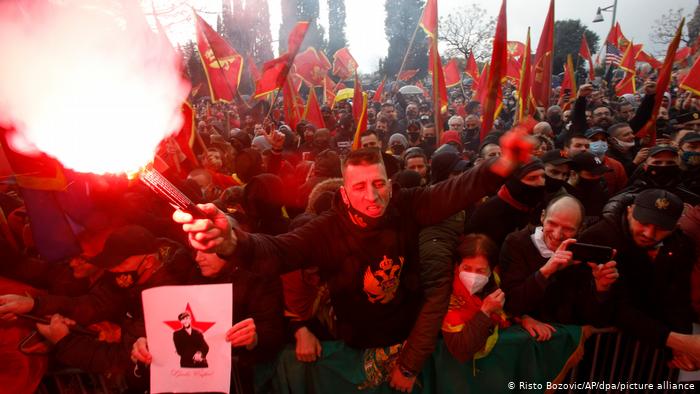
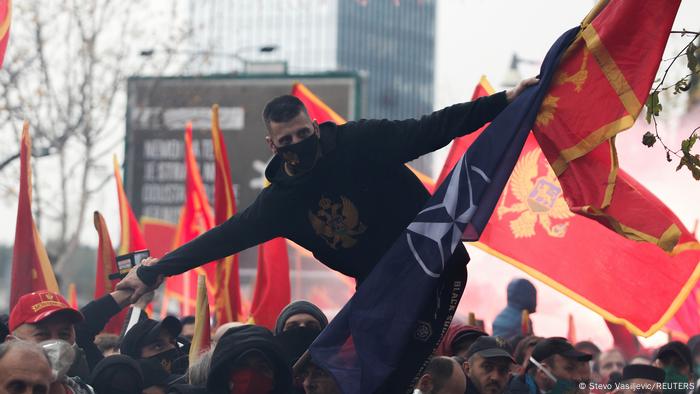
Thousands of protesters rallied in front of the Montenegro parliament on Monday as lawmakers launched a procedure to change a divisive religion law passed by the previous government. The law had angered the Serbian Orthodox Church, and the new government's initiative is widely seen as an attempt to end the row.
The marchers, however, believe the new cabinet aims to undermine Montenegrin national identity and to give control over religious sites to the Serbian state.
Protesters waved Montenegrin flags and chanted "Treason" and "This is not Serbia" during the Monday rally. Some of them carried signs decrying the ruling majority as "Serbian mercenaries."
They also applauded opposition lawmakers who came out of the building.
The participants crowded the area in front of the fenced-off parliament, with many of them not wearing masks despite coronavirus concerns.
What is the conflict about?
The previous government, strongly influenced by longtime strongman Milo Djukanovic, pushed the law through parliament in December, 2019, despite strong opposition from the Serbian Orthodox Church and pro-Serbian political parties. Critics slammed the legislation as an attempt to seize church property. The authorities have denied such plans.
Eventually, the conflict sparked a full-blown protest movement, which saw church leaders lead religious processions in opposition to the law. High-ranking priests also supported the anti-Djukanovic bloc ahead of the August election.
The bloc then managed to win a slim majority and — following long and arduous talks — confirm a new government led by Zdravko Krivokapic earlier this month.
Krivokapic has pledged to maintain Montenegro's independence from Serbia, but his critics claim he intends to steer Montenegro closer to its bigger neighbor and traditional ally.
The revisions to the legislation, discussed by lawmakers on Monday, aim to revoke all disputed sections on the transfer of church property. It was not immediately clear when the new parliament would vote on the changes.
What ties Montenegro and Serbia?
Montenegro's statehood and identity are emotionally-charged issues in the smaller nation, as the country only regained full independence from Serbia after a 2006 referendum. The countries remain connected by historic and cultural links. Nearly 30% of Montenegrin citizens consider themselves ethnic Serbs.
However, many see the Serbian Orthodox Church in Montenegro as a close ally of nationalist politicians in Belgrade. Many also fear the row with the church will lead to Serbia expanding its political influence in Montenegro.
Latest Stories
-
Ghana to begin camping with 12 athletes after Accra Open Championships – Bawa Fuseni
21 minutes -
Anthony Joshua declines showdown with Tyson Fury but admits they ‘probably’ clash next
34 minutes -
Tyson Fury dominates Makhmudov, calls out Joshua next
53 minutes -
I have supported highway authority financially to fix roads in my constituency – A Plus
2 hours -
US, Iran fail to reach peace agreement after marathon talks in Pakistan
2 hours -
ECG kicks off Phase Two of transformer upgrades at Lashibi; brief outages expected
3 hours -
Port crises loom as 11,000 drivers threaten four-day strike
4 hours -
A source of excellence across generations – Vice President Opoku-Agyemang lauds Mfantsipim
5 hours -
(Photos) Mfantsipim School launches historic 150th anniversary
5 hours -
Knights and Ladies of Marshall group backs Catholic Bishops’ stance on anti-LGBTQ+
6 hours -
Bright Simons writes: All the Filla in the Ibrahim Mahama/E&P – Gold Fields Saga
6 hours -
Monetise Idiocy In Ghana
6 hours -
The Ghanaian prophet and the mysterious death of his scottish wife Charmain Speirs
7 hours -
Nearly 400 sentenced in Nigeria for links to militant Islamists
8 hours -
Ghana’s recovery supported by gold strength despite global oil price pressures – Standard Bank Research
8 hours