

Audio By Carbonatix
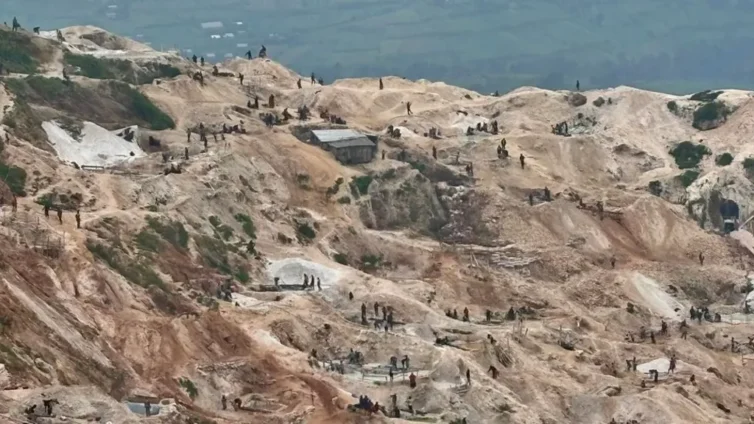
More than 200 people have been killed in a mine collapse in eastern Democratic Republic of Congo, rebel authorities have said.
The mine, in the town of Rubaya, gave way on Wednesday due to heavy rains, Lumumba Kambere Muyisa, spokesman for the North Kivu region's rebel governor, told reporters. At the time, the death toll remained unclear.
Women and children were among those mining coltan - a mineral used to manufacture electronics such as smartphones and computers - at the time.
A former supervisor of the mine told the BBC the site was not properly maintained, making accidents more likely and hampering rescue efforts when they occur.
He added that the fragile nature of the soil made the situation worse.
Women, children and artisanal miners - those not officially employed by a mining firm - are among those killed in the collapse. Around 20 survivors are said to be receiving treatment in hospital.
A source whose cousin died in the landslide expressed shock, saying it was "a big loss" for the family and community.
"I didn't believe he could pass away in such circumstances," the source, who did not wish to be named, told the BBC, describing his cousin as a "courageous" and "ambitious" man whose main goal was to provide for his wife and two children.
"I didn't believe [he was dead] because investigations were still ongoing. His body wasn't found after the accident, so I did have hope that he could be found alive. Unfortunately, some hours later, his body was discovered."
Governor Erasto Bahati Musanga, who was appointed by M23 rebels after seizing swathes of territory in North Kivu, visited survivors of the incident on Friday.
Rubaya is one of a number of towns across North Kivu under the control of the M23, who international observers say are backed by neighbouring Rwanda.
The mines in Rubaya hold about 15% of the world's coltan supply and half of the DR Congo's total deposits.
The metallic ore contains tantalum, which is used to produce high-performance capacitors in a range of electronic devices, making it in high demand worldwide.
When a BBC team visited the site in July 2025, they observed miners digging manually to source the precious mineral. Conditions at the site are very bad, with dangerous pits dotted around its vast expanse.
Since 2024, the M23 rebels have been in control of the mines. The UN has accused the group of imposing taxes on the mining sector for their own benefit.
The BBC has contacted the Congolese government in Kinshasa for comment.
Latest Stories
-
Latvian businessman Aldis Ozols enstooled as development Chief of Supresu-Man
12 minutes -
‘We should go in for the best’ – Ernest Thompson on next Black Stars coach
17 minutes -
US, Iran receive 45-day ceasefire proposal as Trump deadline to reopen Strait of Hormuz looms
30 minutes -
Iran defiant as Trump vows ‘entire country’ could be taken out if no deal reached by tonight
35 minutes -
Afigya Kwabre North crowned champions of maiden MTN Ashantifest Regional U17 football competition
36 minutes -
The case for an explicit and limited Legal threshold for internal military deployment in Ghana
37 minutes -
UK Wireless Festival sponsorship withdrawals highlight high cost of Kanye West controversy for global brands
39 minutes -
CAF President to pay working visit to Senegal over AFCON title saga
47 minutes -
GPL 2025/26: Samartex end winless run with victory over Kotoko
49 minutes -
Afreximbank to avail US$10bn under its Gulf Crisis Response Programme to shield African, CARICOM economies from Middle East conflict
54 minutes -
NPP behind every monumental agenda in Ghana – Miracles Aboagye
1 hour -
Ho Airport not a misplaced priority — GACL Board Chair
1 hour -
Nationwide sensitisation of haulage truck drivers ahead of Axle Load Enforcement
1 hour -
Vice President backs community tourism at Vodza Regatta 2026
1 hour -
Tree Crops Development Authority says media reports on rubber exports are misleading, demands apology
1 hour