


Audio By Carbonatix
Blue Gold Limited is facing fresh legal trouble after investors sought emergency intervention from the Grand Court of the Cayman Islands to block what they describe as a deliberate attempt to strip them of their lawful shareholder rights.
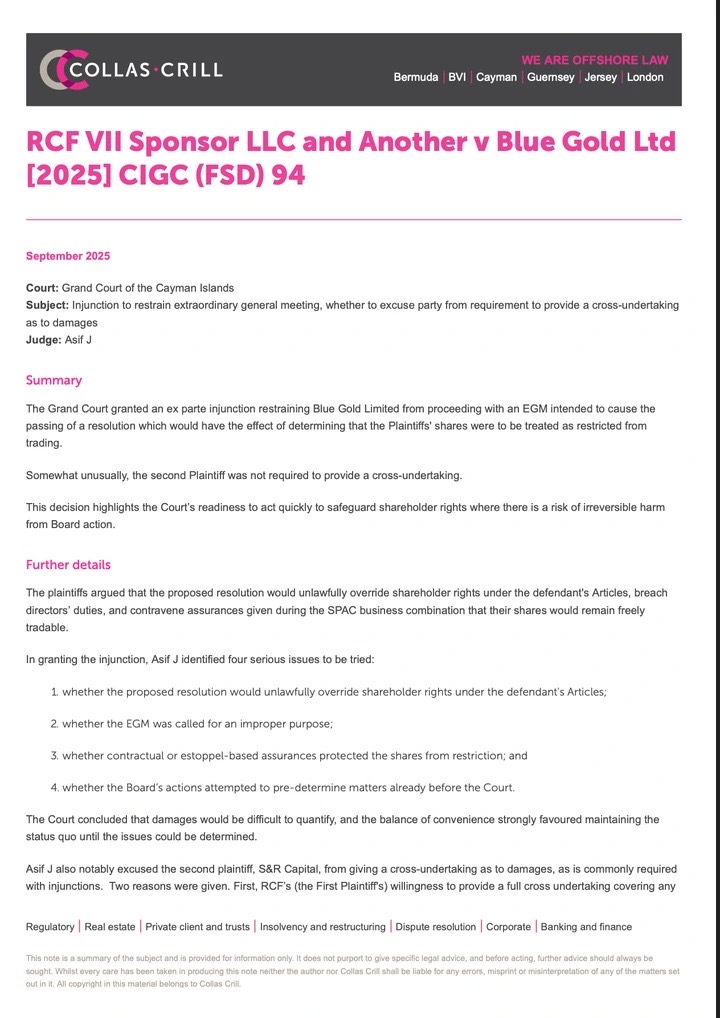
In a decisive ruling, the Court granted an injunction preventing the company from proceeding with an Extraordinary General Meeting (EGM) that was expected to pass a resolution restricting the trading rights of certain investor shares.
The Court held that there were serious legal issues to be determined, including whether Blue Gold’s actions breached shareholder protections and directors’ fiduciary duties.
The ruling follows growing concerns over corporate governance, investor disclosures, and restructuring activities linked to the Bogoso-Prestea gold mine in Ghana.
Alleged Attempt to Restrict Shareholder Rights
Institutional investors, including RCF VII Sponsor LLC and S&R Capital, initiated urgent legal proceedings after Blue Gold’s board proposed a resolution to classify their shares as restricted from trading.
According to court filings, investors argued that the move would:
- Override shareholder rights protected under the company’s governing documents
- Breach directors’ fiduciary duties
- Contravene contractual assurances that their shares would remain freely tradable
- Pre-empt legal issues already before the Court
The Court agreed that the claims raised serious legal questions and ruled that allowing the resolution to proceed could cause irreversible harm, justifying the injunction to preserve the status quo.
SEC Filings Raise Deeper Concerns
Further scrutiny of Blue Gold’s public disclosures has revealed additional red flags. SEC filings indicate that capital was raised for an entity known as Blue Gold Bogoso Prestea Limited, presented to investors as being connected to the Bogoso-Prestea mine.
However, Ghanaian mining records show that this entity never held the mining lease and did not legally own the mine. Instead, the lease was held by a separate legal entity, creating a fundamental disconnect between the investment vehicle presented to investors and the entity that legally controlled the asset.
For investors, legal ownership of the mining lease represents the core value of the investment. Raising capital for an entity without legal ownership of the mine raises serious questions about disclosure accuracy, investor representations, and the legal basis on which funds were solicited.
History of Collapse and Losses
These concerns follow the well-documented collapse of the Bogoso-Prestea mine under previous ownership structures, which left behind unpaid workers, unpaid suppliers, and significant debt. The Ghanaian government later revoked the mining lease due to operational and financial failures.
Despite this history, Blue Gold restructured and sought to raise fresh capital through new corporate vehicles and public listings.
The Cayman Islands injunction now signals that even institutional investors have been forced to turn to the courts to protect their ownership rights.
Court Signals Serious Governance Risks
In its ruling, the Court held that restricting investor shares could cause damage that would be difficult to quantify and that immediate intervention was necessary to prevent irreversible harm. In an unusual move, the Court excused one of the plaintiffs from providing a cross-undertaking in damages, reflecting the urgency and strength of the claims.
Broader Implications for Investor Confidence
The dispute highlights a troubling combination of issues:
- Capital raises tied to entities without legal ownership of core assets
- Corporate restructuring amid unresolved liabilities
- A history of financial collapse and creditor losses
- Attempts to restrict shareholder rights through corporate resolutions
Together, these developments raise profound questions about corporate governance, disclosure practices, and investor protection.
The Cayman Islands proceedings will now determine whether Blue Gold’s actions violated shareholder agreements, corporate law, and fiduciary obligations — a ruling that could have far-reaching implications for investor confidence in mining ventures structured through offshore vehicles and public listings.
Latest Stories
-
FABAG commends Ato Forson’s over removal of 20% excise duty on locally manufactured fruit juices
4 minutes -
HIV stigma discourages testing, prevention and treatment in Ghana – Ghana AIDS Commission
6 minutes -
Blocking cocaine probe lends weight to claims of political protection for traffickers – Assin South MP
10 minutes -
NPP Vice Chair race: I may be the youngest, but most experienced – Nana B
12 minutes -
Last UK and US troops leave Iraq as anti-Islamic State mission ends
12 minutes -
Don’t stay home idle, embrace entrepreneurship while awaiting posting – Unemployed nurses urged
24 minutes -
Aayalolo buses not speeding on contra-flow lanes – GAPTE assures commuters
26 minutes -
Effia MP calls for Kurt Okraku’s removal, overhaul of Ghana football structure
27 minutes -
CAS hearing on AFCON final appeal by Senegalese Football Federation set for October 8
28 minutes -
STC fares to go up by up to 8% this week – Deputy MD
29 minutes -
Photos: Accra-Kumasi bypasses get new lease of life as contractors return to site
29 minutes -
Man allegedly swallows five SIM cards to conceal evidence after arrest
30 minutes -
After three finals, Ayikuma Methodist Basic School finally lifts National Juniors Challenge trophy
30 minutes -
Black Stars management ignored players’ health conditions ahead of Gambia game – Ernest Thompson alleges
31 minutes -
Ghana is 5th largest crypto market in sub-Saharan Africa; annual transactions around $21bn
32 minutes