

Audio By Carbonatix
After the Kpangba displacement camp became the first in this part of war-torn Congo to record deaths from Ebola two weeks ago, health workers rushed to trace those who had come into contact with the deceased to break chains of transmission.
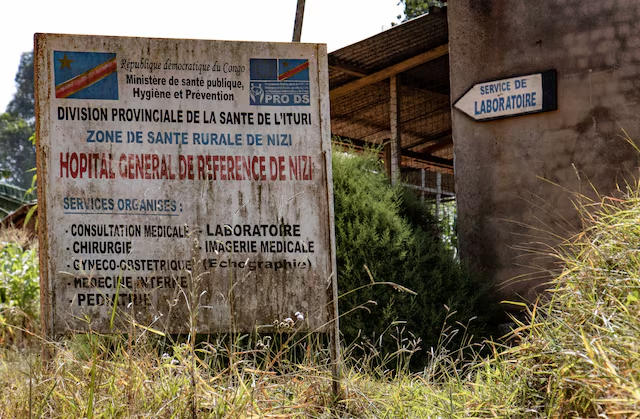
But the workers - from the provincial health ministry, the World Health Organization and other aid agencies - were forced away by angry locals who denied that the two women had died from Ebola, said Jean-Claude Lonzama, the chief doctor for the local health zone of Nizi, a heavily populated mining area.
"Up to this day, we are not able to follow up on the contacts of these cases," Lonzama told Reuters on Saturday.
The standoff has left health authorities flying blind as they try to stave off a surge of Ebola cases in this camp of around 30,000 people, most of whom have fled inter-ethnic violence in surrounding areas.
"We have 22 displaced persons sites in the Nizi health zone ... with around 81,124 residents," Lonzama said. "This is also our great worry because no preventive measures have been put in place in these sites aside from a few educational messages."
Since the outbreak was declared a month ago, several treatment sites have been attacked by locals angry about not being able to bury their loved ones because of precautions taken to keep the virus from spreading or convinced Ebola is a hoax.
POOR SANITATION
Aid workers fear Ebola could spread quickly in this and other displacement camps, where hundreds of people sometimes share a single toilet and open defecation is common, accelerating the spread of what is already one of the world's largest-ever outbreaks.
There are more than 5 million displaced people across the three provinces affected by the outbreak - Ituri, South Kivu and North Kivu - all of which have been devastated by decades of conflict.
In Kpangba, as in towns and rural areas across eastern Democratic Republic of Congo where cases have been recorded, health workers trying to contain the outbreak are running up against deep-seated mistrust of the government and outsiders.
The attacks on Ebola treatment sites recall the widespread violence targeting health facilities by civilians and armed groups during a 2018-2020 outbreak in eastern Congo that killed more than 25 health workers.
The deaths in Kpangba occurred on May 31 and June 1, but were first made public in a report by the U.N. refugee agency published on Thursday.
According to a Congolese health ministry report seen by Reuters, the first victim, a 60-year-old woman in the camp, tested positive for Ebola on May 30 but had, by then, broken out of quarantine and could not be located.
The difficulties winning trust from the population, combined with shortages of critical equipment and armed conflict across much of the affected areas, has left health experts deeply worried about the prospects for containing the outbreak.
Latest Stories
-
Nana B passport claims a diversionary tactic — Abu Jinapor
10 minutes -
Pope Leo diagnosed with cancer as doctors remove lobe of lung, Vatican says
10 minutes -
Legal Aid Commission takes free legal services to Techiman main lorry terminal
15 minutes -
Nana B denies seeking passport favour, accuses Ablakwa of failing to account for GH¢16.4m
19 minutes -
Young girls demand climate action, stronger protection against child marriage
31 minutes -
Ex-gang boss sentenced to 40 years for orchestrating Tupac Shakur’s murder
32 minutes -
From near-deferral to three awards: UMaT graduate’s academic journey
34 minutes -
Atta Akyea denies seeking presidential pardon for Wontumi in galamsey case
1 hour -
Photos: Mahama commissions 85-bed Police Hospital ward, donates two ambulances
1 hour -
GTEC directs Ghana’s public universities to reopen by October 16 and begin lectures on October 19
1 hour -
Star Oil donates GH¢1million towards construction of new CID facility
1 hour -
Court hands Adjetey Sowah, two others lifetime bans after Amputee Football legal dispute
2 hours -
NDC appoints Julius Kwame Anthony as a Deputy Communications Director
2 hours -
Ghana repatriates 120 Nigerians rescued from suspected cybercrime centres
2 hours -
NPP rejects Emelia Agbenyo’s appointment as Deputy EC Chair, demands withdrawal
2 hours