

Audio By Carbonatix
The newly established West Africa Centre for Clean Air (WACCA) is looking to build stronger regional partnerships and mobilise long-term support for air-quality management as funding for clean-air action continues to decline globally.
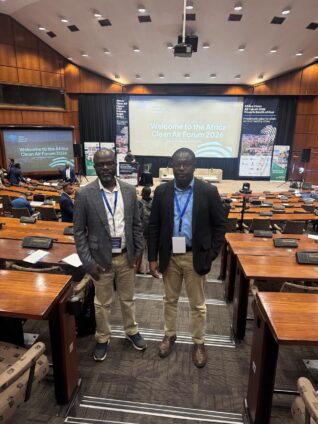
The Centre, hosted by the Kwame Nkrumah University of Science and Technology (KNUST), was represented at the 2026 Africa Clean Air Forum in Pretoria, South Africa, by its Coordinator and Co-Principal Investigator, Dr Yen Adams Sokama-Neuyam, and Prof. Francis Kemausuor, the project’s Lead.
The forum, held under the theme “Investment Case for Clean Air and Healthy Cities,” brought together policymakers, researchers, industry, civil society and other stakeholders to examine how Africa can accelerate action against air pollution while attracting the investment needed to sustain it.
For WACCA, the meeting offered an opportunity to connect Ghana's emerging regional clean-air institution with organisations, researchers and potential funders working across the continent.
“Most importantly, it enables us to build the networks that we need to be able to drive this regional centre of excellence that we've just established,” Dr. Sokama-Neuyam said.
WACCA is being established as part of a CCAC-supported project aimed at strengthening Ghana's air-quality management policies and building national and regional capacity for effective air-quality management. The initiative involves KNUST, the University of Energy and Natural Resources and Beijing University of Chemical Technology.
The project is intended to build on Ghana's existing air-quality expertise and institutions while creating stronger regional coordination.
Dr Sokama-Neuyam, a Senior Lecturer in Petroleum Engineering at KNUST and Scientific Director of the university's Net-Zero Carbon Emission Lab, says Ghana already has a strong foundation of researchers and institutions working on air quality.
“So we have the expertise.”
He points to researchers at KNUST and other Ghanaian universities, as well as the Environmental Protection Authority and the Ministry of Environment, Science, Technology and Innovation, as evidence that Ghana has an established base from which to build.
But he believes WACCA could significantly expand that capacity.
“In KNUST, air quality is going to get better, because we've just established the West Africa Centre for Clean Air, and that changes everything.”
The Centre's ambition is regional, with Dr Sokama-Neuyam saying it will “spearhead air quality research policy and integration, regional integration and regional regulation and implementation.”
That ambition fits the broader CCAC project, which seeks to strengthen Ghana's air-quality management while supporting a West African Centre of Excellence built around existing institutions.
The Centre is expected to help strengthen the link between air-quality science and policymaking, while supporting capacity building and regional cooperation.
That role is particularly important as African countries confront growing urbanisation, transport emissions, household pollution, waste burning and other sources of polluted air.
Prof. Francis Kemausuor, who was with Dr Sokama-Neuyam i Pretoria, brings a complementary energy and sustainability background to the WACCA team. He is a KNUST professor specialising in bioenergy technology, energy planning and energy policy, and has worked on research and consultancy projects in Ghana and across West Africa.
Their participation in Pretoria therefore came at a critical stage for the Centre, not only to share Ghana's experience, but to establish relationships that could support the Centre's regional mandate.
The networking comes against a difficult financial backdrop.
The Clean Air Fund's State of Global Air Quality Funding 2025 found that international development funding for outdoor air-quality action fell 20%, from US$4.7 billion in 2022 to US$3.7 billion in 2023. Between 2019 and 2023, air-quality projects accounted for just 1% of international development funding.
The situation in sub-Saharan Africa was even more stark, with outdoor air-quality funding falling by 91% in 2023, from US$129 million to US$12 million.
For Dr Sokama-Neuyam, securing funding for research and implementation is likely to become increasingly difficult.
“Funding in every sector has never been easy. And I think it's only going to get harder over a period of time, because the funding landscape has become a bit difficult, because many of the institutions that used to invest in research have started cutting back on their investment.”
He says Ghana's research environment has, however, seen some improvement in access to air-quality funding.
“In Ghana, and especially within the research space, access to funding has improved in recent times, especially within air quality.”
Beyond establishing the Centre, the KNUST team is already thinking about what happens after the current funding cycle ends.
Dr. Sokama-Neuyam says the team has been engaging institutions and funding agencies to build a sustainable future for WACCA.
“We've also been working with several institutions, funding agencies to be able to give sustainability to the centre at the end of the funding cycle.”
That focus on sustainability is particularly relevant given the funding trends highlighted at the Pretoria forum.
The Africa Clean Air Forum itself was designed to examine not only scientific and policy responses to air pollution, but also funding pathways and opportunities for private-sector investment.
For WACCA, the forum therefore offered both a learning opportunity and a chance to begin building the relationships needed to survive beyond its initial project funding.
Dr Sokama-Neuyam described the Centre's participation as its first at the forum.
“This is the first time we have participated in this forum. The Africa Air Quality Forum is a very big one. We've learned a lot for the past three days.”
WACCA's emergence gives Ghana an opportunity to play a more prominent role in shaping the region's response to air pollution.
The Centre is being built on an existing network of researchers, government institutions and technical expertise, but its success will ultimately depend on whether that knowledge can be translated into stronger policies, better monitoring, regional cooperation and sustained investment.
And as the money available for dedicated clean-air action becomes harder to secure, the Centre will have to compete not only for research funding, but for the attention of governments, development partners and private investors.
For Dr Sokama-Neuyam, however, the Pretoria forum has provided a starting point.
“Most importantly, it enables us to build the networks that we need to be able to drive this regional centre of excellence that we've just established.”
This story was a collaboration with New Narratives. Funding was provided by the Clean Air Fund which had no say in the story’s content.
Latest Stories
-
Imagination Africa, Mentors Chess Academy to host second African Genius Chess Championship at Ghud Park
2 hours -
Techiman South MP ends decades of water struggle in Asutia
3 hours -
Three things we’ve learnt about the UK economy from the IMF
3 hours -
Nana B passport claims a diversionary tactic — Abu Jinapor
3 hours -
Pope Leo diagnosed with cancer as doctors remove lobe of lung, Vatican says
3 hours -
Legal Aid Commission takes free legal services to Techiman main lorry terminal
3 hours -
Nana B denies seeking passport favour, accuses Ablakwa of failing to account for GH¢16.4m
3 hours -
Young girls demand climate action, stronger protection against child marriage
4 hours -
Ex-gang boss sentenced to 40 years for orchestrating Tupac Shakur’s murder
4 hours -
From near-deferral to three awards: UMaT graduate’s academic journey
4 hours -
Atta Akyea denies seeking presidential pardon for Wontumi in galamsey case
4 hours -
Sasaabi scam centre busted: 19 arrested, 117 trafficking victims identified in global crackdown
4 hours -
Photos: Mahama commissions 85-bed Police Hospital ward, donates two ambulances
4 hours -
GTEC directs Ghana’s public universities to reopen by October 16 and begin lectures on October 19
4 hours -
Star Oil donates GH¢1million towards construction of new CID facility
5 hours