

Audio By Carbonatix
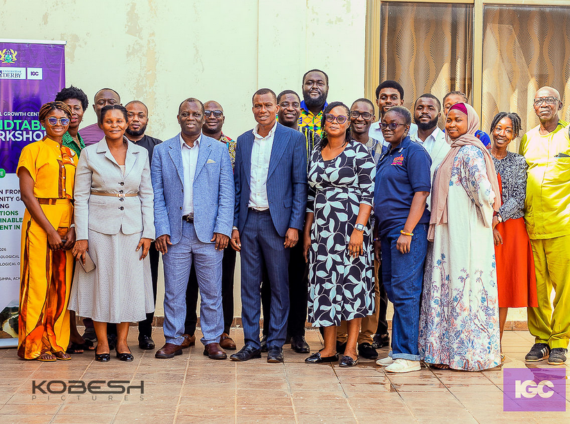
Researchers assessing the impact of Ghana's Community Mining Scheme (CMS) have presented their findings to an audience of regulators, researchers, and mining sector stakeholders in Accra.
The research, titled "Transition from Galamsey to Community Gold Mining: Unravelling the Conditions for Sustainable Rural Development in Ghana," was funded by the International Growth Centre (IGC) and carried out by a team from the University of Derby and the University of Mines and Technology (UMaT).
According to one of the study's co-investigators, Dr Akuba Bezeba Yalley, the study sought to evaluate the CMS's benefits since its introduction in 2019, assess the challenges it has faced, and identify where policy and practice need to change.
Reflecting on the complexity of the artisanal and small-scale mining (ASM) sector and the need for pragmatic policy solutions, a representative of the IGC Country Director noted that "Galamsey is a very complex problem…and there's no singular silver bullet to confronting it.
“We need to find ways not to deny [the people involved] their livelihood by bringing them in and controlling them in such a way that they can maintain their livelihood while our natural resources are protected."
The Principal Investigator, Associate Professor Andrews Owusu, presented the headline findings from a baseline survey of 500 CMS miners and thirteen interviews with regulators, miners and representatives of the Ghana National Association of Small-Scale Miners. Most respondents credited the scheme with achieving between 50% and 70% formalisation of small-scale mining in their communities, alongside gains in youth employment and corporate social responsibility from large-scale miners operating nearby.
The researchers also walked attendees through a longer list of obstacles drawn from the same interviews, among them are political and chieftaincy interference, disputes over land tied up in concessions held by large-scale mining companies, weak coordination between regulatory bodies, and the near-absence of women in community mining due to entrenched superstition.
The presentation closed with a set of recommendations, including an independent authority to oversee community gold mining, co-management of land held by large-scale companies, geological surveys ahead of new schemes, and a shift toward hard rock mining within community-supported operations.
The conversation also turned toward the reality of "community" ownership, with some stakeholders asserting that many sites are effectively controlled by individual politicians or "ghost" investors who treat local people as mere labour rather than equitable partners. This led to a debate over the traditional "division by three" system, where proceeds were historically shared more transparently between expenses, workers, and concession owners.
The event takes place more than a year after government disbanded all Community Mining Schemes in March 2025, replacing them first with Mining Cooperatives and later folding them into the Cooperative Mining and Skills Development Programme that Cabinet approved in August 2025. Several of the study's recommendations, particularly on independent oversight and land co-management, remain directly relevant to that ongoing reform.
The session closed with the research team acknowledging the IGC's Ghana office for funding the project, and the Minerals Commission, Water Resources Commission and community-supported mining organisations that participated in the study.
Latest Stories
-
Lekzy DeComic to feature four generations of comedians on upcoming show
2 hours -
Nigeria wins arbitration as Sunrise’s $400 million hydropower claim dismissed
2 hours -
Xhaka under investigation over Covid-19 certificate
3 hours -
FAW chief questions Infantino’s Fifa reform claims
3 hours -
La Liga chief dismisses Real’s ref conspiracy claims
3 hours -
GMA rejects claims its vessel monitoring system is ineffective
3 hours -
I was close to joining Liverpool in 2016 – Mbappe
3 hours -
Ministry of Sports and Recreation holds national validation workshop on National Sports Policy Draft
3 hours -
‘Do you want me to be happy with this poor performance?’ – Bono East Minister fumes over Kintampo market project with less than 1% work done
3 hours -
London screening honours Nkrumah and 103 years of Ghana cinema
3 hours -
Founder’s Day: Is Nkrumah’s glory fading? – Nkrumah’s iconic fountain at Circle runs dry
3 hours -
GHS calls for stronger systems to ensure safe care for NCD patients
3 hours -
Kufuor calls for Africa’s resources and youthful population to be transformed into opportunities
3 hours -
Mahama administration not clamping down on free speech – Shamima Muslim
4 hours -
Ghana TVET Service, UNESCO, KPMG, Microsoft to train 100,000 facilitators in AI
4 hours