


Audio By Carbonatix
Drones that scatter swarms of sterile mosquitoes over wide areas are being developed to help stop the spread of diseases such as malaria.
Sterile male mosquitoes cannot produce offspring when they mate with females. By crowding out other males, they reduce the mosquito population.
But spreading them is difficult in areas without roads, so technology organisation WeRobotics has been developing drones to do the job.
It will trial the idea in 2018.
"Mosquitoes carry many diseases such as malaria, dengue fever and Zika virus. It makes them one of the biggest animal killers worldwide," Adam Klaptocz, WeRobotics co-founder, told the BBC.
"There are lots of methods to control mosquito populations - fumigation, insecticide - but they all have downsides. Insecticide is not good for environment and needs to be constantly deployed."
Releasing sterile insects had been an effective method of population control for a variety of species, he said.
Often the sterile insects are released from backpacks carried by the scientists, but it is difficult to spread them over a wide area - and they cannot simply be dumped in one location.
WeRobotics was approached by international aid organisations to help produce a solution.
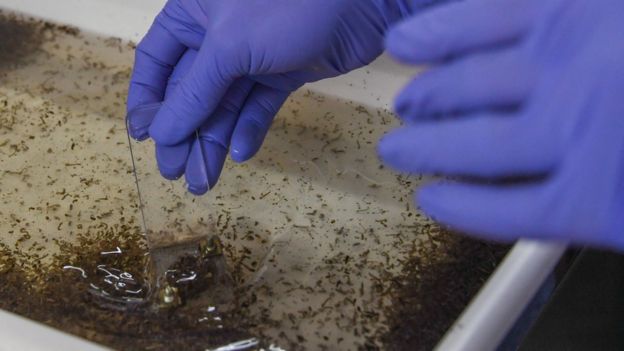
Mosquitoes are exposed to radiation in a lab, which makes them infertile
"A lot of the places where these diseases exist are also places where roads do not exist. The drones could spread the mosquitoes where there are no roads," said Mr Klaptocz.
But one of the challenges is packing hundreds of thousands of fragile mosquitoes into a payload without damaging their thin legs and wings.
"A mosquito that comes out of a drone damaged - or dead - is not going to mate with females," said Mr Klaptocz.
To protect the insects, they are first cooled to 4-8C, putting them into a sleep-like state that stops them moving around.
The next challenge is releasing the insects gradually over a wide area, without waking the whole lot up at once.
To do so, the team has designed a rotating platform with holes in, through which individual mosquitoes fall. They land in a holding chamber where they wake up, and can fly out into the wild.
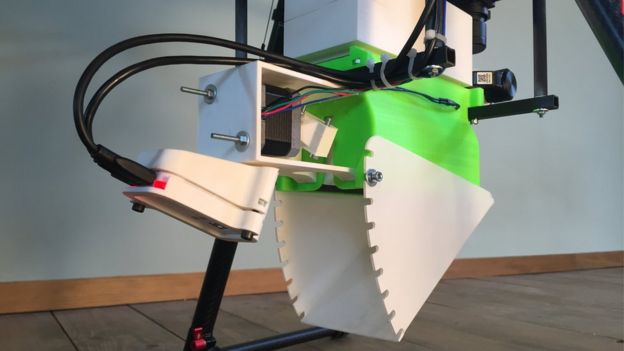
The green "dosing mechanism" releases a few mosquitoes at a time
"Community engagement is also a key part of the release campaign," Mr Klaptocz told the BBC.
"We may be spreading mosquitoes in areas where they are seen as a vector of death. We need to speak to the local population before a single mosquito is released."
The drones are still in development, but the non-profit company hopes to trial its technology in Latin America in 2018.
Mr Klaptocz hopes to focus on areas at risk from Zika virus first.
Latest Stories
-
Spain’s huge pork industry seeks salvation from swine fever threat
55 minutes -
Trump declares victory after rescue but threats to US operation in Iran still loom
1 hour -
US Secret Service investigates reports of gunfire near White House
1 hour -
Current account stability to mitigate pressure on cedi; currency to end year at GH¢11.40 to a dollar
2 hours -
Oil back above $110 after expletive-laden Trump threat to Iran
2 hours -
T-bills auction: Government records 32% undersubscription; interest rates rise again
2 hours -
Economy to remain relatively insulated from fallout of US–Iran conflict – Fitch Solutions
2 hours -
Pep’s asistant Lijnders hints at Man City departure for Silva
4 hours -
[Watch Live] Shatta Wale, Kofi Kinaata, and others ignite the grand finale of Gomoa Easter Carnival
4 hours -
Caster Semenya pledges to fight against Olympic gender-testing policy
4 hours -
Four children killed in nursery school stabbing attack in Uganda
4 hours -
Burkina Faso military leader Traore says ‘forget democracy’
4 hours -
DR Congo to receive ‘third-country’ deportees from the US under new deal
5 hours -
Four injured in robbery attack on Elshadai Enterprise at Akatsi
5 hours -
Two remanded for alleged attack, robbery at jewellery shop
5 hours