

Audio By Carbonatix
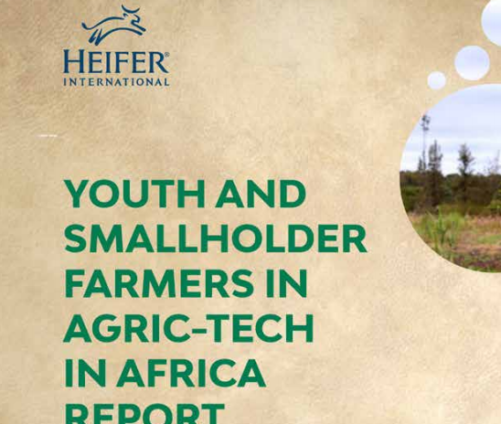
Heifer International has launched its 'Youth and Smallholder Farmers in Agri-Tech In Africa Report', which focuses on an assessment of the role of the youth and technology in Accra.
The event was held on Thursday, July 15, 2021. It was attended by representatives from Ghana's Ministry of Food and Agriculture, Peasant farmers, academia and other key stakeholders. Participants had a passionate conversation on how Agriculture, recognized for employing so many in Africa and feeding the continent, can be improved with the use of technology.
The other key theme for the launch of the 68-paged report, was the broad focus on the youth and how their energy and interest could be drawn to Agriculture.
Launching the report, Interim Country Director of Heifer International Ghana, Ewurabena Yanyi-Akofur noted that that the report represents the views of a total of 29,954 youths, 299 smallholder farmers and 110 agriculture-focused organizations shared through an online survey. The data collected, is representative of 11 African countries with each country contributing at least 5% to 13% of the total data sets.
She emphasized that agriculture contributes immensely to the Gross Domestic Product (GDP) of many African countries and employs more than half of the rural population across the continent. She further stated that agriculture has been used as a catalyst for economic growth and development.
She revealed that according to the findings of the survey, "one of the interesting things was that in Ghana, only 12% of the youth were using any form of technology in Agriculture. In fact, we are the least performing country in the 11 countries that we studied. And for me, the question is why is that the case? Is it because it's difficult to access it, what are the barriers? It's something we need to find and do an in depth analysis of why it is so and why it's different elsewhere? In East Africa, they are doing very well, what are the lessons from there, that we can leverage and do better here?"
Despite the positive effects of agriculture across the continent, the sector remains unattractive to young people. Many young Africans move to the urban areas and have no interest in taking up agriculture as a source of livelihood.
Part of the 68-paged report reads, "the rural population, comprising mostly smallholder farmers, practices subsistence farming, and for many, there is a lot of uncertainty that comes with farming. Issues like climate change, lack of technology, illiteracy, and access to opportunities pose a great threat to their source of income."
"Innovators have begun to rely on technology such as artificial intelligence, remote sensing, geographic information softwares, virtual reality, drone technology, application programming interface technology and precision technology to provide an accurate measure of rainfall, pest control, soil information, soil productivity, and farm size and productivity potential", the report indicates.
The outcome of the research, suggests that efforts geared towards providing financial capital, capacity building and access to land will spur the youth’s interest in agriculture. Smallholder farmers will embrace technology if their capacities are developed and the cost of the technology is affordable. Innovation in agriculture will act as a pull factor for every stakeholder in the agriculture sector as it will create opportunities for young people to participate more, increase productivity for smallholder farmers and create a positive economic climate that will benefit businesses greatly.
The report indicated that although youth unemployment is massive on the African continent, the youth do not see Agriculture as a viable means of employment and a means of livelihood, even if they are interested. This is because of lack of funds and other challenges, including difficulty in acquiring land and the largely subsistent nature of Agriculture on the continent.
This research which was carried in East, West and Southern Africa, aimed at providing evidence-based data for the launch of Heifer International's 'Envision Africa’s Agriculture 2030 programme' and to also understand the challenges that have led to decreasing farm productivity and dwindling incomes amongst African smallholder farmers.
Understanding the challenges of technology adoption by smallholder farmers in Africa and youth participation in agriculture, their fears and their impact on food security, technological innovation in agriculture, its adoption rate, barrier-to-entry, scalability, and potential impact in supporting agriculture development on the continent were key focus areas for the research.
It was observed among the youth surveyed that access to finance (37%), access to land (14%) and lack of training (12%) are the three key barriers to youth engagement in Agriculture in Africa.
It was also observed that there is a low agricultural technology adoption across the surveyed countries, with only 23% of youth engaged in agriculture, using any form of agricultural technology (an App, SMS, website, software).
Moreover, access to land or ownership of same, is a major cause of concern as 59% of youths surveyed, indicated they lack both.
Focus on Ghana
The Agriculture sector contributes about 17% to Ghana's GDP. Even though Ghana’s agricultural sector is well-placed to contribute to the attainment of the country's development goals, its growth performance has been erratic. This irregular performance is driven by irregular rainfall and price fluctuations, including international prices of export commodities such as, cocoa.
More than half of the Ghana's workforce (52%) are currently engaged in agriculture.
The challenge is that Ghana is faced with a bitter reality, a decline in agricultural productivity continues to threaten the economic development of the country. Smallholder farmers lack access to the financial support they require to improve their yields. Urbanization has also led to more non-farm jobs. This has reduced Ghana’s agricultural competitiveness by increasing the need for imported goods. Farmers in remote areas have no/limited access to information and how to process information gathered on topics like crop rotation, the use of fertilizer, etc. it emerged that farmers do not understand these subjects due to illiteracy.
Limited access to fertilizers, poor transportation and storage facilities are also contributing
to decreased productivity in the Agric sector. All of these challenges have contributed to decreased youth participation in agriculture.
Panel discussions
At the launch, Director of Agricultural Extension at the Ministry of Food and Agriculture, Paul Siameh revealed that Ghana's extension officers to farmers ratio is, a poor 1 is to 706. This, however, is an improvement on the 2017 statistics, which indicates that each extension officer covered more than 1,900 farmers. The globally accepted standard is one extension officer to 500 farmers.
Participants including young farmers shared their experiences, perspectives and challenges in the sector and how they have been coping.
Academia brought the fine flair of balancing the practicalities of this all important sector with well researched and reasoned theory and how both aspects can be assimilated to achieve a common end.
The launch also served as an avenue for agricultural technology entrepreneurs to display their technologies, network and seek support from interested stakeholders.
Latest Stories
-
Power restoration fault suspected in Kumasi Central Market fire
2 hours -
The 7-foot giant of Ngleshie Amanfro: Seven-foot Ghanaian Ephraim Saawa dreams of joining the national basketball team
3 hours -
Government promises support for Kumasi Central Market fire victims
3 hours -
Vibes The Movie: Big Ghun’s Ghanaian film earns five nominations at 2026 REFFA
4 hours -
MamaCare CEO warns unresolved conflicts among health workers could undermine maternal and neonatal care
4 hours -
Health professionals urged to translate medical knowledge into practice to save mothers
4 hours -
Conflicts among care providers linked to maternal, neonatal deaths – Expert
6 hours -
GIS marks 10th TIME conference, champions improved teaching practices
6 hours -
BRICS Or Balance? What Ghana’s bid really means
6 hours -
GPRTU wants full TRAFFITECH-GH implementation to start in 2027
7 hours -
Mahama announces plans to import electric wheelchairs for PWDs
7 hours -
KGL U17 Colts 2026: Western beat Prempeh Elite Academy to set up final final with Greater Accra Region
7 hours -
Late Solanke strike salvages 10-man Spurs draw at Man United
7 hours -
Gender Ministry to monitor welfare of Nana Akua Addo’s children amid domestic violence case
7 hours -
Benedict Okyere Yeboah: Ghana’s football problem goes beyond sacking a coach
7 hours