

Audio By Carbonatix
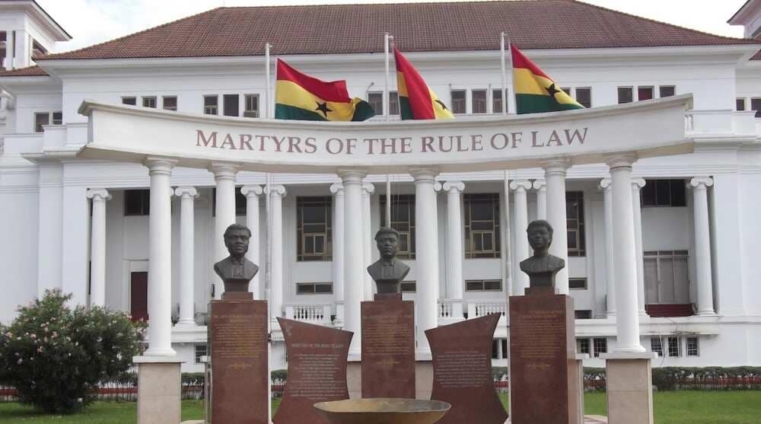
The Supreme Court has provided a detailed explanation for its decision to uphold the suit brought by Majority Leader, Alexander Afenyo-Markin.
According to the apex court, a Member of Parliament (MP) is deemed to have vacated their seat if they change their political affiliation and continue to serve in Parliament under a new party identity.
This ruling supports the suit filed by the Majority Leader, clarifying that the relevant constitutional provisions apply only within the current term of Parliament.
The court specified that Articles 97(1)(g) and (h) of the Constitution do not extend to future parliamentary terms, such as when an MP runs for election under a different political party in subsequent elections.
The Supreme Court emphasised that an MP’s seat must be vacated if they switch parties while holding office within the same parliamentary term.
In other words, changing political affiliation during a parliamentary term while remaining in Parliament will lead to the loss of their seat.
The judgment also addressed the situation for independent MPs, making it clear that if an independent MP joins a political party while serving their current term, they must vacate their seat.
The ruling elaborated that the constitutional provisions should be viewed in the context of the existing term of Parliament.
They do not intend to regulate future candidacies or the electoral ambitions of MPs who may wish to contest under different political parties in the future.
“It follows from the above, therefore, that the only plausible conclusion which must necessarily flow from a holistic and contextual reading of Article 97(1)(g) and (h) is that an MP’s seat shall be vacated upon departure from the cohort of his elected party in Parliament to join another party in Parliament while seeking to remain in that Parliament as a member of the new party,” the court stated.
Additionally, the ruling clarified that the constitutional articles in question are not concerned with future elections.
They strictly pertain to the current period in which an MP holds their seat and make no provisions for future electoral scenarios.
In conclusion, the Supreme Court’s decision firmly defines the circumstances under which an MP must vacate their seat, focusing exclusively on changes in political affiliation within the same parliamentary term.
Latest Stories
-
I have supported highway authority financially to fix roads in my constituency – A Plus
31 minutes -
US, Iran fail to reach peace agreement after marathon talks in Pakistan
55 minutes -
ECG kicks off Phase Two of transformer upgrades at Lashibi; brief outages expected
1 hour -
Port crises loom as 11,000 drivers threaten four-day strike
2 hours -
A source of excellence across generations – Vice President Opoku-Agyemang lauds Mfantsipim
3 hours -
(Photos) Mfantsipim School launches historic 150th anniversary
4 hours -
Knights and Ladies of Marshall group backs Catholic Bishops’ stance on anti-LGBTQ+
4 hours -
Bright Simons writes: All the Filla in the Ibrahim Mahama/E&P – Gold Fields Saga
5 hours -
Monetise Idiocy In Ghana
5 hours -
The Ghanaian prophet and the mysterious death of his scottish wife Charmain Speirs
6 hours -
Nearly 400 sentenced in Nigeria for links to militant Islamists
6 hours -
Ghana’s recovery supported by gold strength despite global oil price pressures – Standard Bank Research
6 hours -
Methodist Church hails Mfantsipim@150; calls for “fresh consecration” to excellence
7 hours -
‘Excellence is our inheritance’ – Nana Sam Brew-Butler hails Mfantsipim’s 150-year reign in leadership
7 hours -
Kwaku Azar writes: A-G vs OSP
7 hours