

Audio By Carbonatix
Ninety minutes before one nation touched football immortality, 80,663 voices had already decided this would not be an ordinary final. Blue and white flags collided with a sea of red and yellow, while every warm-up touch drew a roar worthy of a winning goal.
Yet for all the noise, symbolism and spectacle that surrounded the 2026 FIFA World Cup final, football ultimately delivered the moment that mattered most.
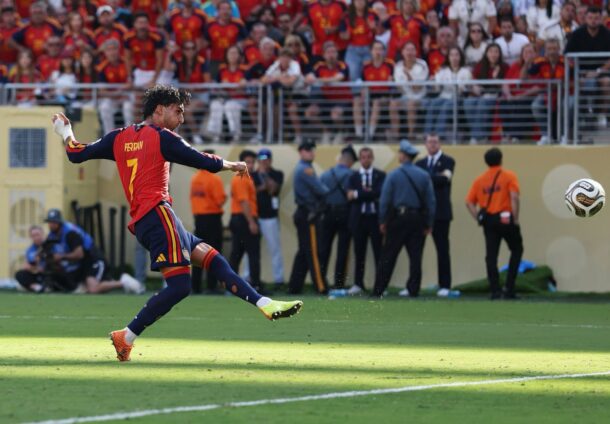
Sixteen years after Andrés Iniesta's strike crowned Spain world champions in Johannesburg, Ferran Torres etched his own name into Spanish football folklore, smashing home the winning goal 37 seconds into the second period of extra time to seal a 1-0 victory over Argentina and return the World Cup to Madrid via New Jersey.
It was a triumph built on patience, control and relentless belief, ending Lionel Messi's dream of retaining the trophy and perhaps signalling the passing of football's greatest torch to Spain's teenage sensation, Lamine Yamal.
Long before kick-off, this final had already become wrapped in mythology.
Spain coach Luis de la Fuente had spoken of destiny, recalling the now-famous photograph of Lionel Messi bathing an infant Lamine Yamal nearly two decades ago. The photographer who captured the image had admitted he never believed in fate until that day. On this night, the two figures met with football's greatest prize between them.
There was another emotional subplot. Nine years earlier, De la Fuente had taught Lionel Scaloni during UEFA's coaching programme at the Spanish Football Federation headquarters in Madrid. Teacher and student had become rivals, each standing one victory away from football immortality.
The build-up was pure American theatre.
Robbie Williams and Nicole Scherzinger entertained before kick-off. Tom Cruise strode onto the pitch declaring football "turns strangers into friends". Three military aircraft thundered overhead before Donald Trump arrived alongside FIFA president Gianni Infantino, Spain's King Felipe VI, Canadian Prime Minister Mark Carney and Mexico's President Claudia Sheinbaum.
The delayed start mattered little to the 80,663 spectators, most of whom had transformed MetLife Stadium into what felt like an extension of Buenos Aires. Argentina's supporters sang at deafening volume long before the first whistle, bouncing in unison until the stadium itself seemed to tremble.
Once the football finally began, however, Spain seized complete control.
Argentina monopolised possession during the opening exchanges, but Spain quickly established their rhythm, pressing aggressively and circulating the ball with remarkable composure. Lamine Yamal almost opened the scoring inside five minutes after combining neatly with Dani Olmo, only for Emiliano Martínez to produce the first of what would become a masterclass in goalkeeping.
Moments later, Unai Simón raced almost halfway across the pitch to deny Julián Álvarez after a clever through ball, the only fleeting indication that Argentina might threaten.
From then on, Spain dictated proceedings.
Rodri and Fabián Ruiz controlled midfield while Yamal, Olmo and Alex Baena repeatedly stretched Argentina's defensive lines. Emiliano Martínez was forced into action time after time, brilliantly adjusting his feet to deny Yamal after a wicked deflection before comfortably gathering efforts from Mikel Oyarzabal and Marc Cucurella.
Messi, meanwhile, was almost anonymous.
His influence was restricted to isolated flashes—a delicate touch beyond Rodri that earned a free-kick and a handful of intelligent passes—but Spain's organisation denied him the spaces that had defined his tournament.
Argentina, so devastating in previous comeback victories over Cape Verde, Egypt and England, reached half-time without a single attempt on goal or even a touch inside Spain's penalty area.
The score remained goalless, but only because Martínez refused to yield.
The lengthy halftime entertainment featuring Madonna, Shakira, Burna Boy, BTS, Justin Bieber, Ronaldinho and Ronaldo only delayed what had become an increasingly one-sided football contest.
Spain resumed exactly as they had ended the opening period.
Within seconds Martínez was again saving from Baena after Spain won possession high up the pitch.
Argentina suffered further disruption through injuries and tactical reshuffles, while Spain continued probing. Dani Olmo, Ferran Torres, Pedri and Yamal all tested Martínez, whose reflexes and positioning single-handedly kept the defending champions alive.
The statistics told a remarkable story.
By the closing stages of normal time, Spain had registered ten shots, seven on target.
Argentina had not managed one.
Frustration eventually spilt over. Enzo Fernández collected a second yellow card deep into stoppage time after a reckless challenge on Pau Cubarsí, reducing Argentina to ten men and handing Spain an additional advantage heading into extra time.
Still, Martínez would not surrender.
He produced another magnificent save from Yamal's curling free-kick in the dying seconds, celebrated by Argentina's supporters as passionately as a goal.
Extra time felt inevitable.
So too, perhaps, did penalties.
Spain had dominated every meaningful statistic but remained unable to find the breakthrough against a goalkeeper producing one of the finest performances in World Cup final history.
Then, just 37 seconds after the restart, everything changed.
Pedro Porro floated a deep cross beyond the far post.
Nico Williams climbed highest to head the ball back across goal.
Arriving perfectly on cue, Ferran Torres crashed an unstoppable finish into the roof of the net.
For the first time all evening, the small pockets of red inside the stadium finally drowned out Argentina's sea of blue and white.
The teacher had finally moved ahead of his student.
Argentina desperately searched for another miracle.
Messi curled dangerous deliveries into the penalty area, Giuliano Simeone twice came agonisingly close, while Torres thought he had scored again before being denied by the offside flag.
Only in the 117th minute did Argentina register their first shot of the match, Messi's fierce effort crashing into Mikel Merino after 117 minutes of frustration.
Their best opportunity arrived almost at the death when Simeone blazed over from ten yards after another Messi set-piece had caused panic.
It was not to be.
When referee Slavko Vinčić blew the final whistle, Spanish players collapsed to the turf while Argentina's dreams dissolved into silence.
Some Argentine supporters remained frozen in their seats, staring blankly at the pitch. Others drifted slowly towards the exits. The disappointment was tangible. Cigarettes replaced songs.
Spain's celebrations, by contrast, had no end.
Sixteen years after conquering the world in South Africa, La Roja stood atop football once again.
If Johannesburg belonged to Iniesta, New Jersey belonged to Ferran Torres.
And as Lionel Messi walked away from perhaps his final World Cup appearance, another image emerged to define the night.
The greatest footballer of his generation embracing the teenager many believe will inherit the game.
Years after bathing a smiling baby for a charity calendar photograph, Lionel Messi had finally handed football's biggest stage to Lamine Yamal.
The circle, just as Luis de la Fuente had imagined, was complete.
Latest Stories
-
Conflicts among care providers linked to maternal, neonatal deaths – Expert
1 hour -
GIS marks 10th TIME conference, champions improved teaching practices
1 hour -
BRICS Or Balance? What Ghana’s bid really means
2 hours -
GPRTU wants full TRAFFITECH-GH implementation to start in 2027
2 hours -
Mahama announces plans to import electric wheelchairs for PWDs
2 hours -
KGL U17 Colts 2026: Western beat Prempeh Elite Academy to set up final final with Greater Accra Region
2 hours -
Late Solanke strike salvages 10-man Spurs draw at Man United
3 hours -
Gender Ministry to monitor welfare of Nana Akua Addo’s children amid domestic violence case
3 hours -
Benedict Okyere Yeboah: Ghana’s football problem goes beyond sacking a coach
3 hours -
GPL 2026/27: Darkwah Wiafe’s winner sees All Blacks beat Kotoko
3 hours -
ITF World Tour : Patel Wins Boys’ Singles Final at J100 Accra
3 hours -
Ghana must pursue BRICS partnership if it brings economic benefits – Kpebu
3 hours -
Success and Wright Claims J100 Accra Girls’ Doubles Championship
3 hours -
ITF J100: America’s Wright wins J100 Accra Girls’ Singles Title
3 hours -
Expedition hopes to find aviator Amelia Earhart’s plane on remote island
3 hours