

Audio By Carbonatix
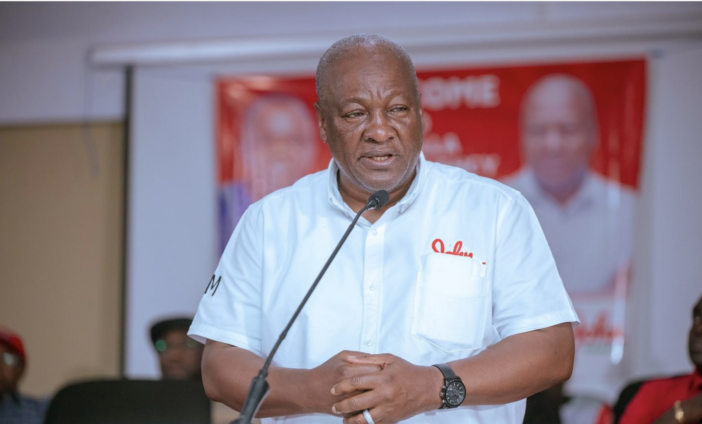
Former President John Dramani Mahama has once again highlighted his commitment to transforming Ghana’s economy with an innovative and ambitious 24-Hour Economy Policy.
“This game-changing initiative, outlined under the next National Democratic Congress (NDC) government, seeks to revitalize key sectors and create a robust economic framework capable of driving sustainable growth”.
He said at the heart of the policy was a deliberate strategy to stimulate economic activity by enabling businesses and public institutions to operate around the clock in three eight-hour shifts.
“This 24-hour operational model is designed to increase employment, productivity, production, and revenue, while enhancing access to public services”.
In a recent address, Mahama emphasized the transformative potential of this policy. “The 24-Hour Economy is more than just a policy; it’s a catalyst for industrialization, export promotion, and job creation. It’s about building an economy that works for everyone, every hour of the day,” he said.
The 24-Hour Economy focuses on key sectors such as agro-processing, manufacturing, pharmaceuticals, construction, financial services, and more.
Strategic investments in infrastructure, energy, and security will provide the foundation for businesses to thrive. Public institutions with high customer traffic, such as ports, customs, and the DVLA, will also operate around the clock to enhance efficiency.
He said to ensure seamless implementation, an Accelerated Export Development Authority (AEDA), chaired by the President, would oversee export promotion efforts under this strategy.
“Additionally, a new Employment Act will be enacted in consultation with organized labor and stakeholders to complement existing labor laws and regulate the 24-hour economy effectively.
Mahama’s 24-Hour Economy Policy is underpinned by a comprehensive support package for businesses. Participating enterprises will benefit from tax incentives, financing support through the Ghana Exim Bank, and cheaper electricity rates based on a Time-of-Use tariff system.
The government will also promote the “Made in Ghana Agenda” by prioritizing local goods, thereby stimulating domestic demand and fostering a sense of national pride.
The policy also addresses workers’ welfare by promoting good work ethics and ensuring efficient eight-hour shifts across public and private sectors.
Mahama’s vision prioritizes sustainable, decent-paying jobs that empower individuals and strengthen families.
“The Policy reflects his forward-thinking approach to governance and economic development. By focusing on import substitution, export promotion, and industrialization, he seeks to position Ghana as a competitive player in the global economy.”
Latest Stories
-
Ablakwa receives Presidential Special Envoy on Reparations to advance global agenda
4 minutes -
Christina Koch becomes first woman to travel around the moon on Artemis II
14 minutes -
Epstein survivors’ calls to meet King Charles and Queen harder to ignore as US visit approaches
20 minutes -
UN Secretary-General names Ghana’s Anita Kiki Gbeho as South Sudan envoy
22 minutes -
Mali withdraws recognition of Sahrawi Republic, backs Morocco’s autonomy plan
26 minutes -
Gov’t distributes over 8,500 laptops to One Million Coders project
27 minutes -
Julius Debrah, ‘man to beat’ as NDC’s James Agbey dismisses Musah Dankwah’s polls
33 minutes -
GPRTU in Savannah Region to protest alleged eviction in Damongo
1 hour -
Re: Reinsurance does not replace process — A response to the SIGA–SIC defence
1 hour -
Gender Ministry supports Harriet Amuzu in ongoing abuse case
2 hours -
AG joins plaintiff to scrap OSP ?: We should be mindful of the mischief in this – Bobby Banson
2 hours -
Samson Lardy Anyenini questions willingness of Attorneys-General to prosecute political colleagues
2 hours -
It is only fair the OSP is heard in Supreme Court case – Bobby Banson
2 hours -
Asiedu Nketia resumes Ashanti tour, second leg kicks off on Sunday
2 hours -
NLA denies salary cut claims, threatens legal action over reports
2 hours