

Audio By Carbonatix
Fighting has been reported in Myanmar despite the military junta and a rebel group alliance announcing temporary ceasefires to support earthquake relief.
As of Friday, the military had carried out at least 14 attacks since the ceasefire, according to reports received by the UN Human Rights office.
The military accused two rebel groups in the alliance that declared a ceasefire of carrying out attacks. One group said fighting broke out in response to "offensives" by the military.
Maj Gen Zaw Min Tun, military council spokesman, issued a general statement saying "we will respond if military bases are attacked without reason". An army spokesman did not respond to BBC Burmese's request for comment.
UN High Commissioner for Human Rights Volker Türk urged "a halt to all military operations" and a focus "on assisting those impacted by the quake, as well as ensuring unhindered access to humanitarian organisations" following the 7.7 magnitude quake on 28 March.
A civil war has been ongoing between the junta - which seized power in a 2021 coup - and ethnic militias and resistance forces across the country.
The military council declared a 20-day ceasefire on 2 April, after the alliance made up of three rebel groups had announced one.
The official death toll from the earthquake in Myanmar rose to 3,564 on Monday, according to state media. Another 5,012 people were injured and 210 people remain missing.
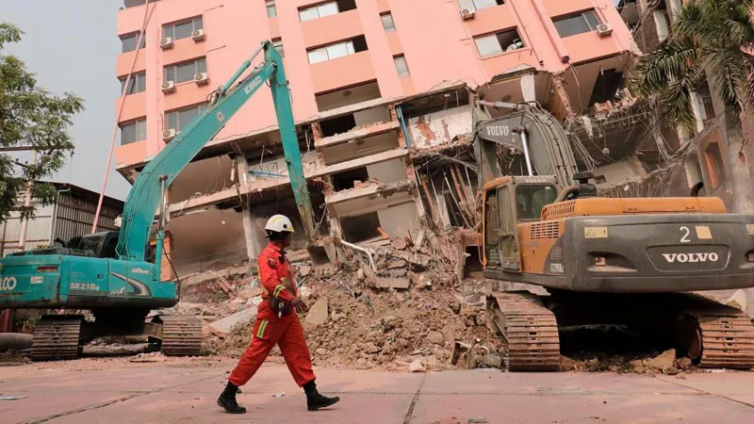
More than a week after the earthquake, rescue workers were recovering bodies from the rubble of collapsed buildings in Mandalay over the weekend, state media reported.
Rain also fell over the weekend, which aid groups said could hamper relief efforts.
The UN Human Rights office said on Friday that while humanitarian efforts had progressed in areas where access had been granted, "longstanding limitations imposed by the military on humanitarian operations and access" meant that multiple badly affected areas "have remained inaccessible to humanitarian emergency assistance – except for what can be organised locally by residents".
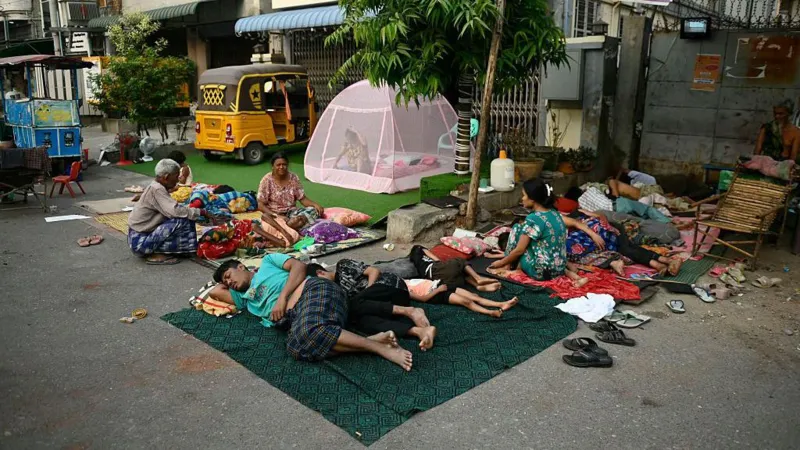
UN humanitarian chief Tom Fletcher said in a video filmed in Mandalay on Saturday that people "need food. They need water. They need the power back on. They're telling me that they need shelter".
Aftershocks continue, with a 4.9 magnitude earthquake recorded over the weekend, and people are "living with that trauma", he said.
Before the earthquake, almost 20 million people were already in need in this community, he added.
"So it's a compounding crisis. It's earthquake, on top of conflict, on top of huge existing need," he said.
Latest Stories
-
‘Groundbreaking but an uphill struggle’ – Amanda Clinton breaks down UN slavery resolution
36 minutes -
Otumfuo demands year-end completion for stalled KNUST hospital
1 hour -
Sir Sam Jonah slams political interference in insurance industry
2 hours -
Yemen’s Houthis enter Iran war with attacks on Israel, while US Marines arrive in region
3 hours -
Potential Houthi threat to Red Sea shipping could further damage global economy
4 hours -
Sir Sam Jonah unveils five-point plan to boost Ghana’s insurance industry
5 hours -
Abstention not a rejection of Ghana’s slavery resolution — EU
6 hours -
‘DDEP was a big blow; full recovery not achieved yet’ – Sir Sam Jonah
6 hours -
The hypocrisy of the global north and the truth about the Transatlantic Slave Trade
7 hours -
2,280 students graduate with B-Tech, M-Tech from Takoradi Technical University
7 hours -
“We are losing ourselves” – Special Prosecutor laments cultural erosion in Ghana’s education system
7 hours -
‘We were trained to serve, not lead’ – Special Prosecutor condemns colonial education legacy
8 hours -
Education must preserve identity and drive innovation – Special Prosecutor
8 hours -
Corruption raises bank risk, weakens diversification benefits, research finds
9 hours -
The Apostolic Church-Ghana bans ‘you may kiss your bride’ during marriage ceremonies
11 hours