

Audio By Carbonatix
The National Service Scheme (NSS) is adopting the use of technology to improve efficiency and help boost yields on its various farms across the country.
The NSS is mandated to deploy Ghanaian graduates from the various tertiary institutions in and outside the country for a mandatory 12-month service to Ghana under Act 426 (1980).
The deployment is done to various sectors of the economy such as agriculture, education, health, local government, military services, and many more.
The Scheme in its contribution to the development of the country also engages in agriculture and owns farms in Dawhenya, Brenam, Damongo, Tantala, and Ejura which they cultivate maize.
"The NSS are also into animal production at Papao, Nungua, and Ohiamadwen".
In April 2017, President Nana Addo Dankwa Akufo-Addo launched his government flagship "Planting for Food and Jobs" programme and expressed his renewed commitment to technology in agriculture by increasing access to improved seeds, subsidized fertilizers and machinery, financing and mobile agriculture extension services, and the Ghana Commodity Exchange among others.
He said: “ICT provides easier access to markets and information resources, and I have no doubt that if this is mainstreamed into our agricultural practices, productivity within the sector will be increased to ensure that not only will farmers’ input increase, but also the nation’s food security will be guaranteed.”
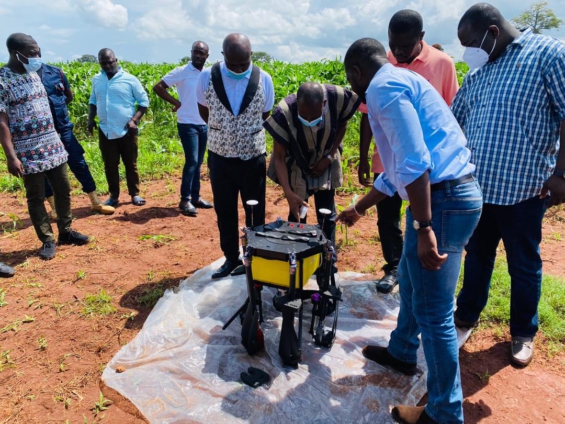
The Executive Director of the NSS, Mr Mustapha Ussif, on Thursday led a delegation to the Scheme Ejura farms to have firsthand information on the use of drones to monitor the output at the farms and expressed the Scheme’s willingness to position its farms to enable them to fully implement the modern ways of farming.
Mr Ussif believed technology was created to make things easier, faster, and achieve high output and that it had become necessary for the scheme to also adopt that method.
He said the NSS farms had over the years been doing well to ensure that the planting and rearing for food and jobs was a success, adding, “We’ve also been supporting the free SHS with some bags of maize through the National Food Buffer Stock Company
"We can’t continue using traditional farming practices if we truly want to continue playing a pivotal role in the growth of the country’s Agric sector,” he added.
The Executive Director also called on National Service Personnel (NSPs) to take advantage of the policies and programmes of government such as the Planting for Food and Jobs, Rearing for Food and Jobs and other initiatives geared towards encouraging the youth into Agric.
”The era where farming was said to be that of the old and poor is no more. Farming is now advanced and very lucrative. NSPs should position themselves and venture into Agric in other to be job creators and not job seekers.”
He admonished the workers in the farm to attach seriousness to their work and handle the drones carefully as it was a valuable asset to the scheme and the country.
The Deputy Minister of Agric minister, Dr. Sagri Bambangi, said the current leadership of the Scheme had done a wonderful job to resuscitate its farms which took a nosedive under the previous administration.
He said: “Not only have this leadership revived the Agric projects, but also initiated the use of drone technology on their farms and this is commendable.”
Dr Bambangi said the Ministry through the support of President Akufo-Addo placed priority on Agric as its played an essential role in strengthening the economy, adding, "Programmes such as the one-village-one-Dam, one-District-one-warehouse, Planting for Export and one-District-one- factory to help process raw materials from the farms, and many more.
These policies he believed are programmes that clearly indicated that the government was visionary and serious.
The NSS Deputy Executive Director in-charge of Operations Mr Kwaku Ohene Djan and Mr Oxford Osei Bonsu the NSS Director of Projects explained to the delegation the roles and uses of the drones on the farms and also assured them that the drones technology will be used judiciously.
The drone technology is expected to be used for the application of fertilizers, Pest control mechanism, monitor crop health and growth rate, sowing, general surveillance, and many others.
Latest Stories
-
SOE comments controversy: ‘We must never abandon our humanity because of judicial office’ – CJ
4 minutes -
Samuel Kojo Brace declares intention to contest NPP parliamentary primary in Ahanta West
5 minutes -
Dr Apaak calls for evidence-based education response to emergencies
9 minutes -
Pilot may have sought to crash Israel-bound flight after stabbing other pilot, Netanyahu says
13 minutes -
Report flags potential money laundering, terrorist financing risks among Ghana’s NGOs
14 minutes -
Breast Cancer Awareness Month launched: 2,695 women die from breast cancer annually — Dr Ann-Dadzie
21 minutes -
Mahama’s proposed airline looks to South America, Caribbean as Ghana confronts mounting drug trafficking cases
37 minutes -
5% progress on Suame Interchange Phase One inadequate – Roads Minister tasks contractor to speed up work
39 minutes -
Photos: Vice President joins GAAS Awards to celebrate outstanding women leaders
40 minutes -
OSP vs Ken Ofori-Atta, SML and others: Court gives OSP four more weeks to serve Ofori-Atta with summons
42 minutes -
High Commission sends caution to Ghanaians in South Africa ahead of planned protests
45 minutes -
Okai Mintah outlines vision for NDC Youth Wing as he engages MMDCEs
50 minutes -
Mahama Ayariga leads renewed push for stronger local governance through partnerships
54 minutes -
NDC youth organiser aspirant Okai Mintah consults MMDCEs ahead of elections
55 minutes -
PHOTOS: Ayikuma Methodist Basic School wins National Juniors Challenge
57 minutes