

Audio By Carbonatix
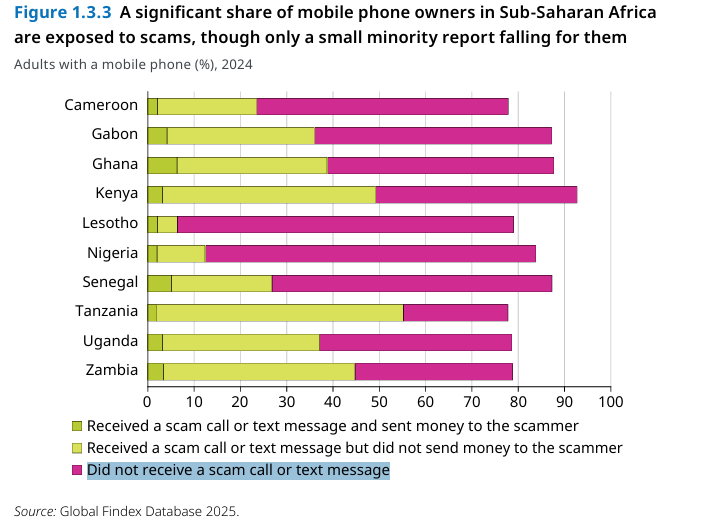
Nearly, 8.0% of Ghanaians who use mobile phones received a scam call or text message and sent money to the scammer.
According to the 2025 Global Findex Report by the World Bank, about 32% of Ghanaians who use mobile phones, also received a scam call or text message but did not send money to the scammer.
Also, about 48% did not receive a scam call or text message.
The report said adults who are exposed to a digital scam are asked if they sent money to their scammer.
“In a few economies, however, mobile phone owners have both high levels of exposure to scams or extortion and a high tendency to send funds, including Gabon, Ghana, and Senegal”, it explained.
It added that women are not overall more likely than men to receive scams or extortion attempts or to send money in response.
The report continued that consumer awareness about scams and the methods of scammers has shown promise for increasing people’s ability to avoid them.
For example, a study in Uganda that employed interactive games, delivered through interactive voice response, to teach people about fraud decreased the shares of both women and men falling for scams.
Opportunities Exist to Increase Responsible Digital Use
Though the Global Findex 2025 Digital Connectivity Tracker shows that a relatively small share of people experiences such harassment, any level is unacceptable. International efforts to address issues surrounding such violence include the UN’s Global Digital Compact, which aims to establish principles for an open, free, and secure digital future that respects human rights.
Globally, the report mentioned that only 53 out of 190 economies reviewed in one study impose criminal penalties for offenses associated with cyber harassment.
It is therefore calling for legal frameworks to revolve to recognise online harassment and treat it with the same seriousness as physical harassment.
“At the same time, tailored training programs in digital literacy for vulnerable populations— particularly women, adolescent girls, and marginalized communities—can help build preventive capacity by teaching users to recognize warning signs and employ privacy-enhancing settings on their mobile phones”, it added.
Finally, it wants accessible, confidential reporting channels with transparent processes for handling cases can enable victims to seek help without stigma.
Latest Stories
-
Tamale Water Project to help address northern Ghana’s water shortages – Ghana Water Limited
20 minutes -
Oil prices fall and stocks rise after Trump says Iran war ‘very complete’
27 minutes -
Ghana-Peru Relations: Foreign Ministry outdoors new book focusing on a Journey of Friendship and Cooperation
30 minutes -
Kufuor advocates strict separation of powers to strengthen Ghana’s democracy
30 minutes -
Well-structured governance institutions improve efficiency and strengthen democracy – Kufuor
34 minutes -
Two Turkish firms to construct water treatment plant for Eastern Accra
37 minutes -
Rising sophistication in science and technology is deepening corruption – Kufuor
51 minutes -
Allegations of product hoarding by OMCs are baseless – CBOD
55 minutes -
Council of State not enough to check executive – Kufuor
56 minutes -
CLOGSAG strike without production: Ghana’s dangerous culture of entitlement
59 minutes -
Achimota School raises infrastructure concerns as surging demand outpaces facilities
60 minutes -
Ghana’s economic challenges fuel corruption, private sector must grow – Kufuor
1 hour -
Five Iranian footballers granted Australian visas after anthem protest
1 hour -
Kufuor calls for higher pay for public servants to curb corruption
1 hour -
Kufuor calls for stronger separation of powers, greater parliamentary control over national budget
1 hour