

Audio By Carbonatix
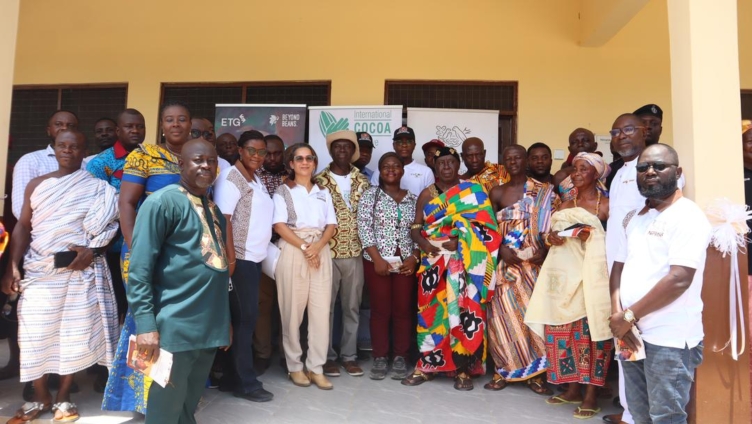
Nestlé, in partnership with the International Cocoa Initiative (ICI) and ETG/Beyond Beans, has commissioned school infrastructure in four communities in the Ashanti Region of Ghana.
With funding from Nestlé through the Nestlé Cocoa Plan and implemented by the International Cocoa Initiative, these facilities have been constructed to enhance students' access to quality school infrastructure, as well as provide water, sanitation, and hygiene (WASH) facilities.
To promote social inclusion and child protection, a thorough community profile exercise was carried out, highlighting Ntinanko, Pewodie, Agogooso, and Adjeikrom as communities lacking sufficient school infrastructure.

Salome Azevedo, Business Executive Officer for Dairy, Beverages and Confectionery, Nestlé Central and West Africa, speaking at the commissioning, said, “We are committed to enhancing the well-being of communities directly linked to our operations. We deeply appreciate the tireless efforts of the farmers who supply us with the finest cocoa for our production.
“With this in mind, we urge the pupils to make the most of the upgraded school environment, complete with improved water, sanitation, and hygiene facilities, and fully dedicate themselves to their studies. This investment is specifically for your benefit, empowering you to realize your dreams and embrace a promising future."

Ghana Country Director of ICI, Mike Arthur, noted, "This initiative is a great example of how we can reduce child labour and poverty in cocoa-growing communities. Research shows that communities with good-quality education have a lower prevalence of child labour.
“Children are more likely to be attracted to school to learn rather than staying at home. Providing WASH facilities is also incredibly important and can help ensure children, especially girls, stay in school."
Research has emphasised the critical role of quality education in promoting child protection.
In particular, the presence of primary schools in cocoa-growing communities has been shown to significantly increase school enrolment while decreasing child labour rates.
Furthermore, proximity to schools and the availability of basic facilities such as toilets are also key factors in improving school enrolment.

This underlines the importance of investing in educational infrastructure and access to improve the learning environment for quality schooling as a remediation strategy for combating child labour in cocoa-growing communities.
Stephen Kofi Akomaning, Headmaster of Ntinanko R/C “A” Basic School, expressed appreciation to ICI, Nestle, ETG/Beyond Beans and Cocoa Merchants Ltd for their numerous development projects in the community and promised to oversee the maintenance and upkeep of the facilities.
Latest Stories
-
Boakyewaa Glover Writes: The Fight Within
5 minutes -
Sweet abroad, bitter at home: Ghana’s bittersweet cocoa contradiction — Kay Codjoe writes
15 minutes -
Kojo Oppong Nkrumah: Parliament must do the people’s business
24 minutes -
Woman arrested after setting fire at Alpha Hour founder Pastor Elvis Agyemang’s church auditorium
41 minutes -
Parliament holds public hearing on Security and Intelligence Agencies Bill
59 minutes -
Amansie Central Assembly denies creating ‘galamsey tax’, says practice dates back to 2008
59 minutes -
Today’s Front pages: Tuesday, February 10, 2026
2 hours -
NDC MPs have no right to demand annulment -Anthony Nukpenu on Ayawaso East primary
2 hours -
Ghana’s anti-corruption efforts fail to yield results as CPI score stagnates at 43
2 hours -
Portugal had over 40 staff in Qatar 2022 – GFA justifies expanded Black Stars Technical team
2 hours -
NHIA donates GH¢800k to Ghana Medical Trust Fund to support NCD patients
2 hours -
NDC begins nationwide membership registration today with new party register
3 hours -
NDC’s Ayawaso East vote-buying probe committee set to submit findings today
3 hours -
Ghana Medical Trust Fund assesses regional hospitals ahead of NCD care rollout
3 hours -
Offinso MP blames Mahama gov’t for cocoa sector challenges
3 hours