

Audio By Carbonatix
Somewhere in Europe tonight, a couple unwraps a glossy bar of chocolate proudly labelled premium Ghana cocoa. The aroma is rich. The branding elegant. The price may equal what a farmer here earns after days of labour beneath an unforgiving sun. That contrast should disturb us far more than it currently does.
Ghana exports roughly five hundred thousand to eight hundred thousand tonnes of cocoa annually. In strong years production has crossed the one million tonne mark. Even in difficult seasons Ghana remains the world’s second largest cocoa exporter and one of the most important suppliers to global chocolate manufacturers. Our beans are trusted. Our quality is respected. Our reputation is secure.
Yet the farmer behind that reputation often lives with uncertainty.
Recent tensions between COCOBOD and farmers did not emerge suddenly. Payment delays, financing constraints, global price swings, and structural weaknesses collided. Farmers delivered beans expecting timely income. Months passed for some without payment. For them cocoa income is not theoretical revenue. It is school fees, medicine, fertilizer, food, dignity. When that rhythm breaks, anxiety becomes frustration.
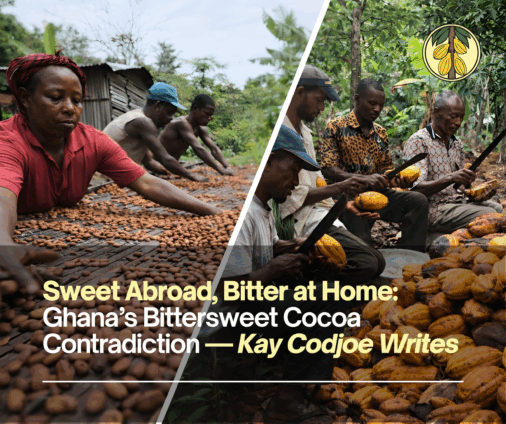
Visit cocoa communities in Eastern Region, Western North, Ashanti, Bono, Ahafo. Dawn arrives before comfort. Farmers walk into fields carrying years of experience in their hands. They prune, spray, harvest, ferment, dry. Their beans travel across oceans. Wealth grows elsewhere. The farmer often remains financially exposed.
That is the uncomfortable truth Ghana must confront.
We produce exceptional cocoa yet capture only a modest share of the finished chocolate value chain. Processing, branding, marketing, and retail profits largely accumulate abroad. Ghana exports excellence but imports expensive chocolate. We export raw potential but often import finished prosperity.
This imbalance is not inevitable. It is structural.
COCOBOD leadership including Chief Executive Randy Abbey has acknowledged financing pressures and apologized for payment delays. That transparency matters. Institutions must speak honestly when difficulties arise. But explanations alone cannot restore trust if farmers remain uncertain about when income arrives.
The debate has drifted into political trenches. Some portray farmers as agitators. Others portray COCOBOD as indifferent. Both narratives miss the larger issue. Farmers are not political tools. COCOBOD is not an enemy. The real challenge is how Ghana restructures its cocoa economy so national pride translates into farmer prosperity.
Processing even thirty percent of our annual cocoa domestically could transform rural economies. Processing half could stabilize foreign exchange significantly. Processing seventy percent could position Ghana as a global chocolate powerhouse rather than primarily a raw supplier. That is not fantasy. It is industrial policy.
The employment implications alone are enormous. A world class cocoa processing and chocolate manufacturing ecosystem could directly create thousands of skilled factory, logistics, research, marketing, and administrative jobs. Indirectly it could support tens of thousands more through transport, packaging, retail distribution, maintenance services, and supporting industries.
Entire rural towns could see renewed economic activity, from food vendors to construction workers, from teachers to health professionals serving more economically stable communities.
This is also what a genuine national RESET looks like in practice. Not slogans. Not speeches. Tangible industrial transformation that creates jobs day and night. A cocoa sector that feeds factories, powers logistics, drives exports, and sustains a real twenty four hour economy where production, processing, marketing, and distribution operate continuously. That is how nations build resilience. That is how prosperity becomes visible.
Economic logic strongly supports this shift. Cocoa already contributes billions in export earnings. Local value addition would multiply that impact through manufacturing growth, technology transfer, packaging industries, export logistics expansion, and brand development. It would strengthen the cedi, deepen industrial expertise, and reduce vulnerability to global commodity price shocks.
There is also a generational urgency. Younger farmers increasingly question whether cocoa offers a stable future. Illegal mining, despite its environmental damage, sometimes appears financially more predictable. That perception alone should alarm national planners. A strategic export sector cannot survive if the next generation walks away from it.
None of this requires demonizing COCOBOD or government. Ghana faces fiscal pressures, currency volatility, climate challenges, and global market uncertainties. Institutional constraints are real. But empathy must flow both directions. Farmers are not statistics. They are custodians of a national economic pillar.
Transparency about pricing, financing, and payment timelines is essential. Predictable payment systems are essential. Investment in domestic processing is essential. Strong farmer cooperatives are essential. National pride must translate into measurable farmer wellbeing.
Ultimately cocoa is not merely an export figure. It is the quiet labour of hundreds of thousands of Ghanaians whose hands rarely appear in policy debates. Listening carefully to those voices while acknowledging institutional realities is not weakness. It is national maturity.
Until the farmer who grows the bean experiences prosperity that reflects the global prestige of that bean, Ghana’s cocoa story remains incomplete. The sweetness the world enjoys should never be rooted in silent hardship at home.
Latest Stories
-
MTN set to deploy 5G services after winning spectrum licenses worth US$202m
1 hour -
NPP national elections: 3,000–4,000 police to handle security, traffic in Kumasi – Karbo
3 hours -
Atta Akyea fumes as Manhyia MP is to spend another night in EOCO custody
4 hours -
SSNIT says La Beach clearance was to protect hotel investments, beaches to remain public
5 hours -
APSU congratulates St Augustine’s College after back-to-back National Investment Quiz wins
5 hours -
Renewed flood intervention at Mallam Junction raises hopes among residents, businesses
5 hours -
St Augustine’s College retain National Investment Quiz title after nail-biting grand finale
6 hours -
Education infrastructure investment will drive Banda’s development – Ahmed Ibrahim
6 hours -
Teacher unions strike: Gov’t presents fresh proposals as talks end inconclusively
6 hours -
51,000 teachers’ promotion arrears to be validated for October payment – Education Minister
7 hours -
Kwabena Boamah appointed Board Chair for Impact Investing Ghana
7 hours -
Striking teacher unions to meet Fair Wages and Salaries Commission on October 6
7 hours -
EOCO working with AG to arraign Nana Baffour Awuah before weekend court
7 hours -
Duraplast reassures customers after fire, announces October 5 reopening
7 hours -
Call off strike, gov’t will not renege on promotion arrears pledge – Haruna Iddrisu to teacher unions
7 hours