

Audio By Carbonatix
A first-of-its-kind satellite that will be able to see through clouds and leafy canopies to assess how the world's rainforests are protecting the planet from climate change, has successfully launched.
The Biomass satellite, from the European Space Agency, will "weigh" the Earth's forests, revealing how much planet-warming carbon is being stored within trees and therefore kept out of the atmosphere.
Until now the amount of carbon stored by the 1.5 trillion trees in the planet's rainforests has been impossible to calculate.
Led by European aerospace group Airbus, the project hopes to help scientists more accurately model climate change and track rates of deforestation.
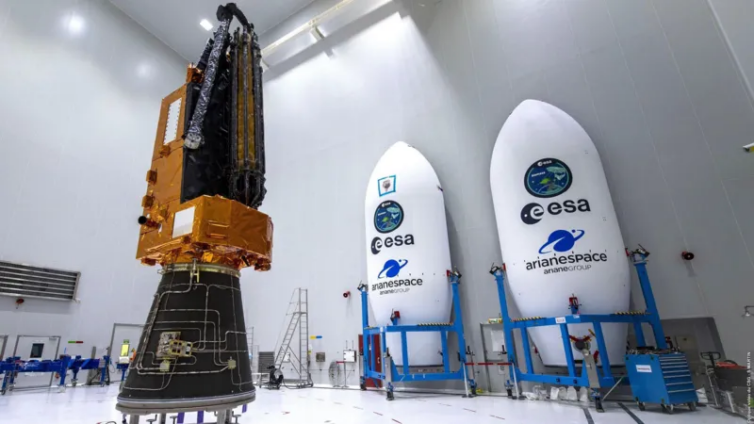
The satellite launched from ESA's Kourou station in French Guiana and you can watch live coverage here on the BBC iplayer.
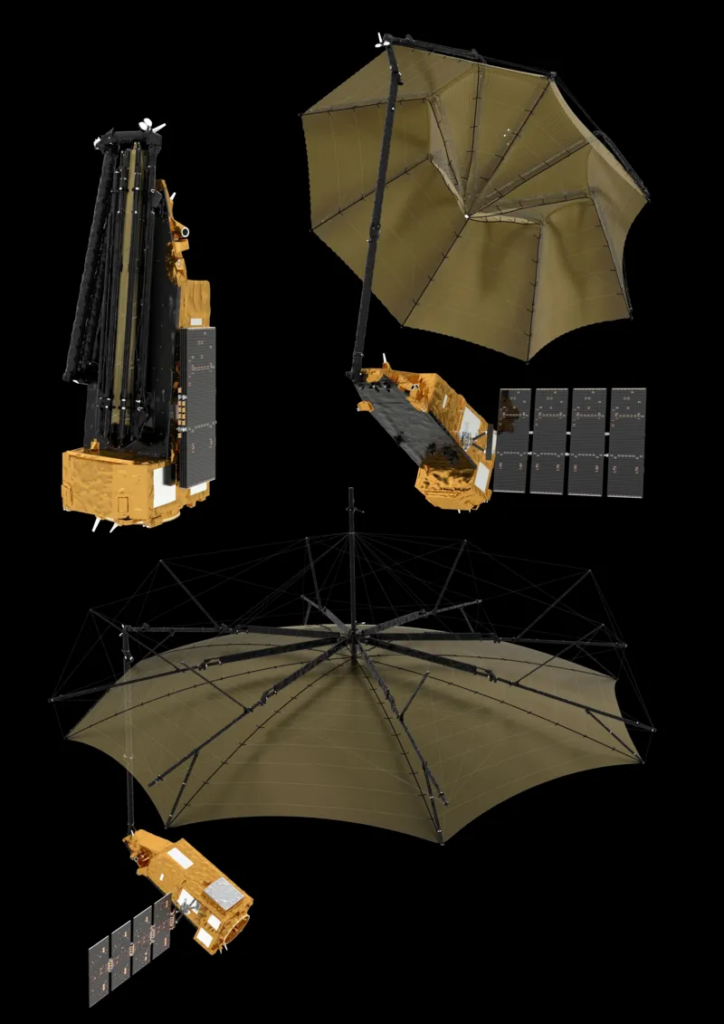
It has been affectionately named "space brolly" for its giant 12m diameter antenna which expands outwards.
The antenna will use radar with a very long wavelength - allowing it to see deeper inside forests and reveal branches and trunks obscured by the canopy.
"Most radars that we have in space today take wonderful images of icebergs, but when they look at forests they see the tops of the forest, the little twigs, the little leaves, they don't penetrate down into the forests," explained Dr Ralph Cordey, head of geosciences at Airbus.
"But what we found was that by using a much longer radar wavelength, we could see down into the depths of trees and forests," he said.
The 1.2-tonne satellite will use an approach not dissimilar to that used in a CT scan, and analyse slices through the trees on repeat passes to build up a picture of how much woody material is present.
It is this material that can be used as a proxy for the amount of planet-warming carbon dioxide stored.
Currently scientists have been measuring individual trees and trying to extrapolate, but this presents a "huge challenge" said Prof Mat Disney, professor of remote sensing, at University College London.
"Our current understanding is really patchy, because it's really, really difficult to measure," he said. "Essentially, what we're talking about is trying to weigh the amount of carbon that's stored in one and a half trillion trees across the tropics.
"Satellites are really the only way you can do that consistently."
On the ground measurements will continue to take place after the satellite is launched to verify the data it is sending back.
Despite years of testing, the launch was challenging.
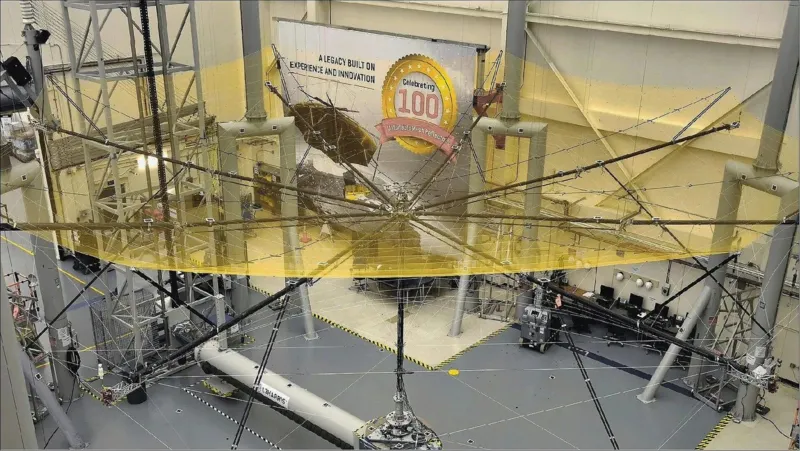
"Certain things on the satellite are big, that includes its big 12-metre, deployable antenna. It's a bit like deploying an umbrella in space, only a very big one, so we will be looking for that to happen smoothly," said Dr Cordey.
Airbus brought in engineers from the American company L3Harris Technologies to their site in Stevenage to oversee the construction of the antenna-reflector.
L3Harris are specialists in these large, unfurlable systems - expertise which is not currently possessed in Europe.
The team is hoping to produce the first maps within six months, and will then continue to gather data for the next five years.
These annual maps will not only show how much carbon is stored but how much is being lost through deforestation.
"The kind of observations that we've had for 50 years from [other] satellites like Landsat are affected very heavily by clouds. And in tropical regions, we have clouds a lot of the time, so you may not see a chunk of tropical forest," said Prof Disney.
Another advantage of the longer wavelength of the Biomass satellite is that it can penetrate clouds giving a consistent, comparable view of a forest from one year to the next.
It is this outcome which has motivated the scientists who have worked on the project for more than 20 years.
"It's exciting, because it's going to tell us about how something that we perhaps take for granted," said Dr Cordey. "Our forests, our trees, how they are contributing to the processes which govern our planet, and in particular, the processes behind climate change which are so important to us today and for the future."
Latest Stories
-
Police probe deaths of teacher and farmer in Assin Area
6 minutes -
Gov’t reaffirms commitment to safeguard Ghana’s energy supply amid Middle East crisis
6 minutes -
What is wrong with us? When containers become our urban plan
16 minutes -
Afenyo-Markin referred to Privileges Committee over security recruitment allegations
40 minutes -
President Mahama backs private sector push to expand Ghana Wheat Initiative to cut imports
47 minutes -
Ghana to declare 21 communities Marine Protected Areas, starting with Cape 3 Points
50 minutes -
Women of Valour: I had to save myself from abusive marriage – Diana Hopeson
1 hour -
Women of Valour 2026 Conference sells out ahead of London event
1 hour -
ECG assures the public of meter accuracy amid billing concerns
1 hour -
BBNJ Has Finally Arrived: What next for the world’s oceans?
1 hour -
Low turnout in Ayawaso East by-election won’t change outcome – Mussa Dankwah
1 hour -
Women in Government and Media Forum sets agenda for stronger collaboration and public trust
1 hour -
I wouldn’t be surprised if Baba Ali wins Ayawaso East—Nana B
2 hours -
NPP Youth Organiser expresses concern over low turnout in Ayawaso East by-election
2 hours -
Ayawaso East by-election: We’re confident our deployment at polling centres will cater for any eventuality – Police
2 hours