

Audio By Carbonatix
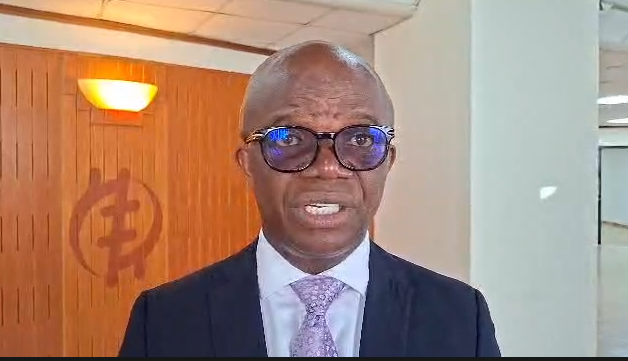
The Member of Parliament for Nhyiaeso, Dr Stephen Amoah, has raised concerns about the level of research backing a proposal to make the cultivation of tree crops mandatory for public officials.
His comments follow a policy proposal by the Ghana Tree Crops Development Authority (GTCDA), which is seeking to require public servants, civil servants, members of Parliament, ministers of state, and other government appointees to cultivate tree crops such as coconut, cashew, oil palm, and shea. The proposal was announced at the maiden Ghana Tree Crops Investment Summit and Exhibition.
Speaking to JoyNews' James Avedzi on February 17, Dr Amoah welcomed the proposal in principle but raised concerns about the level of groundwork underpinning it. He began by commending the initiative, stating:
“In the first place, my opinion, I think it's a good proposal. It's not the first time any government has done what they are doing, whether NDC or NPP, being the leading fraternities, political fraternities. So it's good, and I need to commend them for that.”
However, he quickly pointed to what he described as a recurring problem in Ghana’s policymaking process.
“However, I always have a challenge. It looks as if almost all the policies, the bills, the laws, all the programs earmarked by certain governments in Ghana, are not preceded by any properly conducted research with collected data or designed frameworks to really know specifically what we want to attain so that it becomes a benchmark to appraise what we do as a country or as a government.”
He warned that the absence of proper research often affects sustainability, “because these things are not done; most of these policies programmes are not sustainable.”
Call for Detailed Planning
When asked how the policy should be approached, Dr Amoah stressed the need for scientific and data-driven planning before implementation.
“I think what they have to do is, it's not every constituency that can grow cash crops in the first place.”
He suggested that comprehensive research should already have identified suitable areas.
“So they should have conducted the needed research, and by now they should have been able to earmark areas that are relevant, districts, constituencies, and regions that are relevant.”
According to him, clear production targets and land assessments must be established.
“And then they should have a target. Okay, we want to have, for example, for instance, we want to have additional 2 million tons of cocoa. What size of land are we going to need for this particular project or program? Who owns that land? What is the soil content?”
He continued by outlining further considerations.
“What size, what fraction of that? Do we need 100,000 hectares or acres? Who owns it? How are we going to do it? What is the entire value chain? How will it look? In terms of the scale component of the labour force that we need. Do we have them? If we don't, what do we have to do? How much will it cost us? Likely.”
Dr Amoah added that job creation, international markets, and trade frameworks must also be factored into the policy design.
“In terms of even job creation, for each of the segments, you need to do all these things. If you want to go beyond the boundaries of your country, what would be the other expected destinations? And what are the even world trade policies that we need?”
He cautioned that without such comprehensive planning, Ghana’s economy would remain fragile.
“We need to put these comprehensive programs together. And if we're able to do this as a country, and these are the things that we don't take care of, that even future in our economic endeavour, or what we want to do with our economy. We're always having a very fragile, very dependent economy, an economic framework that has never been resilient."
Personal Research Initiative
Responding to whether similar research is required even for crops such as mango and coconut, Dr Amoah insisted that detailed studies are even more necessary.
“Even more than that, I have started personally. I've set up the African Research and Development Institute, headed by Professor Adibangi.”
He revealed that preliminary categorisation work has already been done.
“As I'm talking to you now, we have been able to actually categorise almost all the districts or regions and the type of crop that can be grown there. We have them.”
He said the next phase would focus on land size, labour requirements and export potential.
“We will move beyond that to find the size of land we need to meet the aggregate demand for that crop in our country. And what will be the labour size we need and the skill component of the labour size if we want to go beyond domestic consumption.”
Dr Amoah maintained that such groundwork should precede any legislation.
“I even think the research should have been conducted before so that for them to even come out, they have the relevant pieces of information and features that are all integrated into the whole law, bill, or policy framework.”
Drawing a comparison with international standards, he added:
“Once you do that, that's what the white people do. Before this structure was put in place, they had to do the soil test. What kind of soil do they have, the depth they need, whether they are stones, whether it is a muddy area, the iron rods they need, whatever. They design it.”
He concluded with a critique of Ghana’s political culture.
“Ghana is the only country where there are NDC and NPP. Most of the time our policies, our bills, our programmes, our manifestos, and other things are not preserved when we do research. And that is why most of our policies are not sustainable.”
Latest Stories
-
Church of Pentecost supports over 2,000 BECE candidates in Obuasi with career guidance seminar
33 minutes -
Brandon Asante and Coventry all but promoted to Premier League despite Sheffield Wednesday draw
54 minutes -
GPL 2025/26: Late Kwartemaa strike downs Hearts in Tema
1 hour -
Ghana Faces Sierra Leone Moment as Prosecutorial Powers come under strain
1 hour -
Don’t consume fish or seafood from Tema Shipyard until further notice – FDA warns
1 hour -
Why volunteering might be Africa’s most underrated career accelerator
1 hour -
ActionAid Ghana raises concern over gender gaps in Feed Ghana Programme
1 hour -
Windstorm wreaks havoc in Gushegu, displacing nearly 2,000 residents and damaging schools
1 hour -
Friends of Bridget Bonnie Marks her 35th birthday with donation to Kasseh Model Health Centre
2 hours -
From Ekumfi Kokodo to the Pulpit Stage: Essi Donkor’s gospel journey takes shape
2 hours -
Landfilling waste management creates no value, it’s an economic waste
3 hours -
Photos: Speaker Bagbin Commissions MPs constituency office under parliamentary decentralisation programme
3 hours -
Black Stars technical advisor Winfried Schäfer sacked as GFA shakes up backroom staff
3 hours -
Wenchi water project almost complete, critical to gov’t agenda – GWL MD
3 hours -
Anti-LGBTQ+ bill not part of government’s legislative agenda – Inusah Fuseini
3 hours