

Audio By Carbonatix
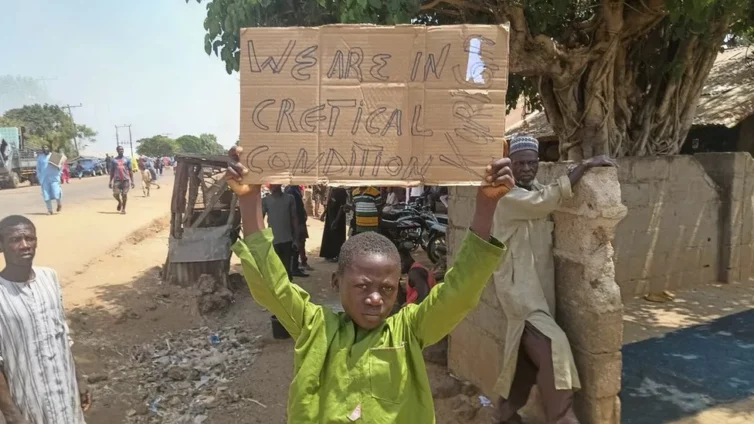
Nigeria's spate of abductions worsened on Saturday as more than a dozen students and four women were kidnapped from a school in Gada, Sokoto.
Local MP Bashir Usman Gorau told the BBC that 15 students were among those kidnapped early in the morning.
Meanwhile, the army is still searching for hundreds of schoolchildren taken in the western town of Kuriga on Thursday.
In an update, the state governor Uba Sani told the BBC that at least 28 of these children had escaped.
Thursday's kidnapping - which saw 280 students taken - was the biggest mass abduction from a school since 2021.
Gangs of armed men on motorbikes took primary and secondary school children between the ages of eight and 15, school authorities and parents said.
Nigerian troops are working with police and local search teams to comb forests within the state of Kaduna, where Kuriga is located, as well as neighbouring states.
Almost every family in the town is thought to have a child among those kidnapped.
One pupil, believed to be 14 years old, who had been shot by the gunmen and was being treated in hospital, has since died.
The kidnappings followed women and children taken from a remote town in Borno state the day before.
Mr Sani said the lack of boots on the ground was the main reason for the rise in kidnappings in the area.
Families of the abducted children have formed vigilante groups and are seeking help from neighbouring communities on the whereabouts of the children.
Nigeria's Vice President Kashim Shettima is visiting Kaduna and is due to meet the governor.
President Bola Tinubu said on social media he was confident the victims will be rescued.
He tweeted: "Nothing else is acceptable to me and the waiting family members of these abducted citizens. Justice will be decisively administered."
- Why mass abductions have returned to haunt Nigeria
- What in the World Podcast- Nigeria's kidnap crisis
- Why Nigeria's economy is in such a mess
The Kaduna mass abduction has evoked memories of the nearly 300 girls in Nigeria's north-eastern town of Chibok in 2014.
In parts of northern Nigeria, parents fear for their children's safety and are wary of allowing them to go to school. As a result, thousands of children are not attending school.
The last major abduction of children in Kaduna was in July 2021 when gunmen took more than 150 students.
They were re-united months later after their families paid ransoms.
But in 2022, Nigeria passed a law banning ransom payments to kidnappers and imposed a 15-year jail term for making them.
It also made abduction punishable by death in cases where victims die.
Latest Stories
-
Monetise Idiocy In Ghana
2 minutes -
The Ghanaian prophet and the mysterious death of his scottish wife Charmain Speirs
47 minutes -
Nearly 400 sentenced in Nigeria for links to militant Islamists
1 hour -
Ghana’s recovery supported by gold strength despite global oil price pressures – Standard Bank Research
1 hour -
‘Excellence is our inheritance’ – Nana Sam Brew-Butler hails Mfantsipim’s 150-year reign in leadership
2 hours -
Kwaku Azar writes: A-G vs OSP
2 hours -
Mfantsipim–Adisadel rivalry built excellence, not division – Sam Jonah
2 hours -
Vice President launches Mfantsipim’s 150 years of shaping Ghana’s greatest mind
3 hours -
I assure Otumfuo, Mahama will join him to commission KNUST Teaching Hospital by end of this year – Haruna Iddrisu
3 hours -
Barcelona dominate derby to extend La Liga lead
3 hours -
Gov’t to roll out free special education for persons with disabilities from July 1 – Education Minister
4 hours -
Importers and Exporters Association declares full support for Publican AI port system
4 hours -
“We used it to test our officiating officials’ readiness” – Bawah Fuseini after CAA Athletics event
4 hours -
Volleyball emerges as Ghana’s fastest rising sport
4 hours -
National Sports Fund needs strong leadership from the top – Administrator David Wuaku
4 hours