

Audio By Carbonatix
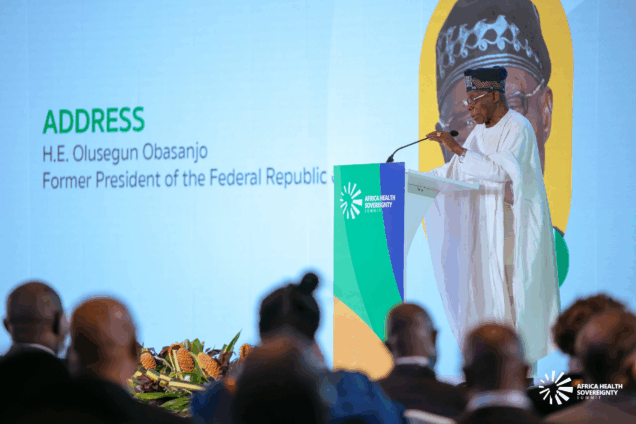
Former Nigerian President Olusegun Obasanjo has proposed the creation of a dedicated Africa Health Fund to provide sustainable, Africa-led financing for health infrastructure and emergency response systems across the continent.
Speaking at the Africa Health Sovereignty Summit in Accra, he said the fund would reduce dependency on delayed foreign assistance and empower African nations to address their own health challenges with speed, resilience, and autonomy.
He said the fund could be modelled on the African Union Peace Fund, which had already proven effective in responding to continental crises.
Recounting his own experience as a special envoy to the Horn of Africa, Mr. Obasanjo noted how a lack of immediate donor support delayed interventions in Ethiopia and the Democratic Republic of Congo.
The former Nigerian President explained, “When I was handling the situation in Ethiopia, they were waiting for European money or American money before I could start. But when we started using the AU Peace Fund, things changed. If we can do this for peace, we can certainly do it for health.”
Mr. Obasanjo proposed a $100 levy on flights into and out of Africa, excluding intra-African travel to generate seed capital.
The levy, he said, would serve as an initial contribution to the health fund, which he suggested could be managed by the African Development Bank (AfDB).
He also urged African governments to explore additional innovative sources to grow the fund into a robust financial mechanism for both emergency health response and long-term health infrastructure development.
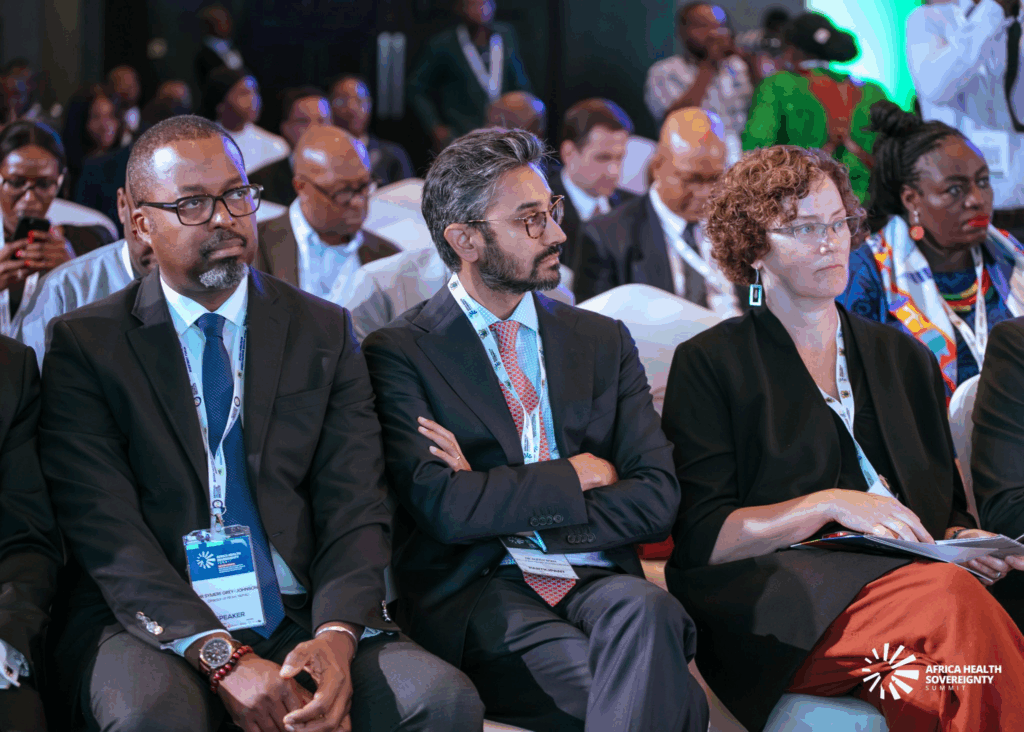
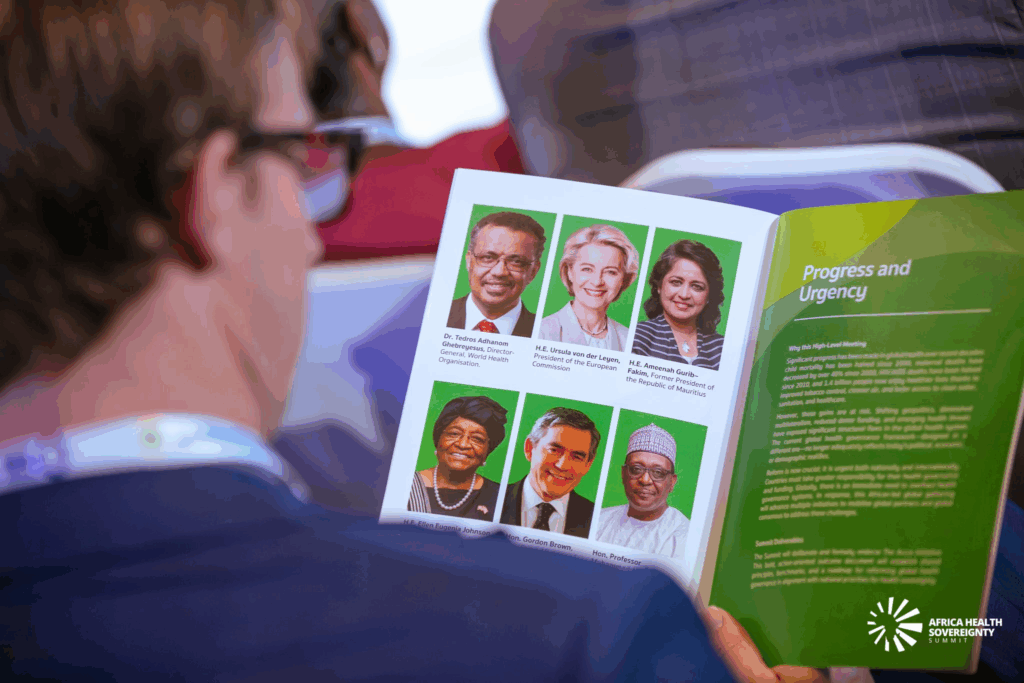
The summit is expected to culminate in the adoption of the Accra Compact, a bold declaration for health sovereignty that outlines a new roadmap for health governance.
It also includes the launch of initiatives like SUSTAIN, which seeks to mobilise domestic and diaspora funding for health reforms.
While calling for Africa’s financial self-reliance, Mr. Obasanjo stressed the importance of global solidarity and cooperation, and that “Our slogan should not be Africa Beyond Aid. It should be Africa Health Without Aid, but with global partnership and support.”
He stated, “Pandemics know no borders. We have to work separately and together for health security for all.”
Mr Obasanjo further proposed that 25 per cent of national health insurance funds across African countries be earmarked for infrastructure investments.
The former President urged African nations to stop viewing health as a consumption burden and instead see it as a strategic investment in national development, emphasizing that, “Health is not a drain on our resources,” he said. “It is the foundation of our national security and development.”
The elder statesman also advocated for strengthening traditional medicine as part of a broader community-level health strategy.
Mr. Obasanjo reminded participants of Africa’s resilience in past health crises such as HIV/AIDS, Ebola, and COVID-19, urging the continent to build on those experiences.
Former President John Dramani Mahama, who opened the Africa Health Sovereignty Summit, called for urgent reform of global health governance, declaring that Africa must no longer be a passive recipient of solutions but the author and architect of its own health destiny.
He described the current global health framework as outdated and unfit for a multipolar world facing intersecting crises, from pandemics to climate shocks and widening inequality.

“We are here by conviction, shared purpose, and a collective refusal to accept the limits imposed on us by an outdated global health order,” he said.
He announced two major commitments to drive the agenda forward: the establishment of a Presidential High-Level Task Force on Global Health Governance, and the launch of the SUSTAIN Initiative, a continent-led platform to align national budgets with health priorities and scale up domestic investment.
President Mahama emphasised that health must be treated as a capital investment, not a social cost, urging African nations to mobilise public, private, and diasporic capital to build resilient, data-driven health systems.
Latest Stories
-
Knights and Ladies of Marshall group backs Catholic Bishops’ stance on anti-LGBTQ+
26 minutes -
Bright Simons writes: All the Filla in the Ibrahim Mahama/E&P – Gold Fields Saga
50 minutes -
Monetise Idiocy In Ghana
57 minutes -
The Ghanaian prophet and the mysterious death of his scottish wife Charmain Speirs
2 hours -
Nearly 400 sentenced in Nigeria for links to militant Islamists
2 hours -
Ghana’s recovery supported by gold strength despite global oil price pressures – Standard Bank Research
2 hours -
Methodist Church hails Mfantsipim@150; calls for “fresh consecration” to excellence
3 hours -
‘Excellence is our inheritance’ – Nana Sam Brew-Butler hails Mfantsipim’s 150-year reign in leadership
3 hours -
Kwaku Azar writes: A-G vs OSP
3 hours -
Mfantsipim–Adisadel rivalry built excellence, not division – Sam Jonah
3 hours -
Vice President launches Mfantsipim’s 150 years of shaping Ghana’s greatest mind
3 hours -
I assure Otumfuo, Mahama will join him to commission KNUST Teaching Hospital by end of this year – Haruna Iddrisu
4 hours -
Barcelona dominate derby to extend La Liga lead
4 hours -
Gov’t to roll out free special education for persons with disabilities from July 1 – Education Minister
4 hours -
Importers and Exporters Association declares full support for Publican AI port system
5 hours