

Audio By Carbonatix
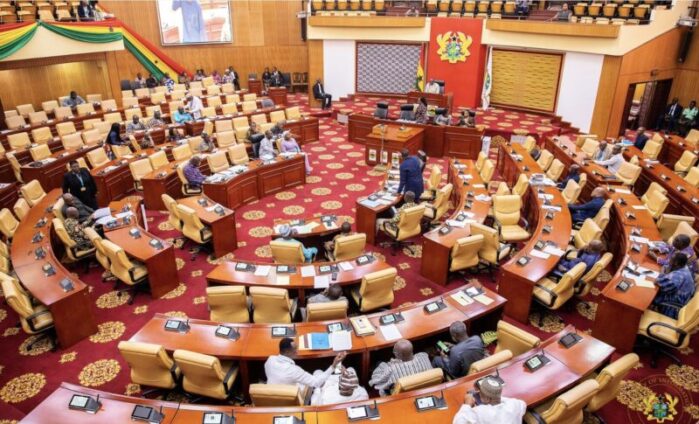
Parliament has gone into a closed-door session to deliberate on emoluments for Article 71 officeholders, specifically the executive and the judiciary.
The decision is part of a long-standing constitutional arrangement governing salaries, allowances, and benefits for specific public office holders under Ghana’s 1992 Constitution.
Under Article 71, public officers in these categories are paid their salaries in arrears, based on prior approvals from a similar committee. For the four years they serve in office, their salaries are pegged at the previously approved rates and finalized at the end of their tenure, with any balance paid accordingly.
Additionally, these officeholders receive ex gratia payments at the conclusion of their service, determined by a specific formula. The responsibility for approving these benefits is shared between Parliament and the executive.
Parliament approves the emoluments for members of the executive and the judiciary. The executive, in turn, approves the benefits for Members of Parliament (MPs), the Speaker, and Deputy Speakers.
This reciprocal arrangement has often been criticized as a “scratch my back, I scratch your back” system, with both arms of government favouring each other.
Article 71 outlines the framework for determining salaries, allowances, and benefits for key officeholders, including the President, the Vice President, the Speaker of Parliament, Deputy Speakers, and MPs.
Others are the Chief Justice and Justices of the Superior Courts, the Auditor-General and other independent constitutional officers as well as Ministers, Deputy Ministers, and members of the Council of State.
Determination of these emoluments is based on recommendations from a committee appointed by the President in consultation with the Council of State.
The Constitution also provides for retirement benefits for Article 71 officeholders.
Article 98 provides that MPs shall receive salaries and allowances as determined under Article 71.
Article 114 also provides that MPs who have served for at least four years are entitled to gratuity payments upon leaving office or upon their death.
The arrangement has sparked debates over the years over its fairness and transparency.
Critics argue that the mutually beneficial approvals lack accountability, especially when contrasted with the limited benefits provided to ordinary public sector workers and the nation’s economic challenges.
Calls for constitutional reforms to review the emolument system and align it with the country’s fiscal realities have grown louder in recent years. However, the political will to amend this entrenched provision remains uncertain.
Incoming President John Mahama has promised to scrap the Article 71 ex gratia arrangement.
Read Also: NDC will scrap payment of ex gratia – Mahama
Latest Stories
-
Dad unlawfully killed daughter in Texas shooting, coroner rules
2 hours -
Anas wins 7 – 0 as SC unanimously rejects attempts to reverse judgment in his favour
2 hours -
The cocoa conundrum: Why Ghana’s farmers are poor despite making the world’s best chocolate
3 hours -
Powerful cyclone kills at least 31 as it tears through Madagascar port
4 hours -
GoldBod summons 6 gold service providers over compliance exercise
4 hours -
Power disruption expected in parts of Accra West as ECG conducts maintenance
4 hours -
Police investigate alleged arson attack at Alpha Hour Church
5 hours -
Heavy Sunday downpour wrecks Denyaseman SHS, schools, communities in Bekwai Municipality
5 hours -
Ridge Hospital is in critical condition – GMTF Boss appeals to corporate Ghana
5 hours -
Introduce long term measures to tackle challenges in cocoa sector – IERPP to government
5 hours -
Agricultural Economist proposes blended financing model to support cocoa sector
5 hours -
NPP MP warns against reducing producer price as government rolls out cocoa reforms
6 hours -
Tano North MP urges halt to grain exports over food glut
6 hours -
Farmers hopeful as government moves to expedite cocoa payments
6 hours -
Tensions at Agbogbloshie market women oppose AMA drain cleaning exercise, items confiscated
7 hours