

Audio By Carbonatix
The Ministry of Trade, Agribusiness and Industry has reported a 41.21 per cent growth in non-traditional export (NTE) earnings for the first half of 2025, reaching $2.54 billion, as part of steps towards a $10 billion export target by 2030.
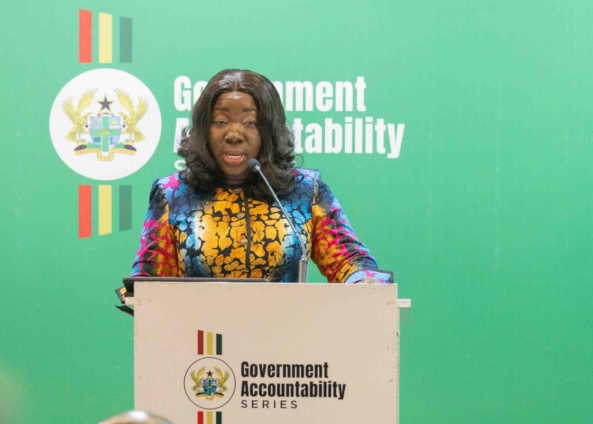
The sector minister, Elizabeth Ofosu-Adjare, announced this yesterday when she took her turn at the Government Accountability Series at the Presidency.
She said the performance aligned with President John Dramani Mahama’s vision to transform Ghana into an export-led economy with sustainable job creation.
Mrs Ofosu-Adjare said the ministry had been realigned by an Executive Instrument to reflect a sharper focus on agribusiness and industrialisation, with the core objective of reducing the cost of doing business, revamping local manufacturing, and formalising the informal economy.
“Our vision is driven by the President’s desire to implement revolutionary policies that create decent, well-paying jobs, especially for the youth,” Mrs Ofosu-Adjare stated.
Achievements
The minister disclosed that under the Accelerated Export Development Programme, an Advisory Committee chaired by President Mahama had been inaugurated to steer the export drive.
She enumerated achievements under the ministry to include Ghana’s award for “Best Theme Development” at the World Expo in Osaka, Japan, which had already attracted about 50 Japanese investors.
Additionally, for the first time, Ghana exported mangoes to Morocco via 55 trucks carrying 26 tonnes each.
The ministry also played a critical role in securing a three-year extension of the African Growth and Opportunity Act (AGOA) through diplomatic and technical engagements, safeguarding vital access to the US market despite recent tariff impositions.
The Ghana Export Promotion Authority (GEPA) also supported 91 small and medium enterprises (SMEs) and seven horticultural associations at international fairs, securing export orders worth $350 million.
Another 150 SMEs in handicrafts and manufacturing generated over $250 million in orders.
Reviving industry
Under the Rapid Industrialisation for Jobs Initiative, Mrs Ofosu-Adjare revealed that the ministry had completed drafts of key industrial policies, including textiles and garments, pharmaceuticals, special economic zones, and automotive components, including electric vehicles.
Seven mini agro-processing plants are being established across regions, including Savannah, Greater Accra, Western North, Bono East and Ahafo, focusing on value chains such as groundnut, poultry, plantain, cashew and ginger.
Mrs Ofosu-Adjare also announced that the ministry was recruiting transactional advisors to assess and revitalise several defunct state-owned enterprises, including Akosombo Industrial Company Limited, Juapong Textiles, Zuarungu Meat Factory, Pwalugu Tomato Factory and Komenda Sugar Development Company.
She said the Ghana Enterprises Agency trained 155,216 practitioners and potential entrepreneurs nationwide in 2025, supplied start-up kits to 6,194 youths, and facilitated access to over GH¢19 million in financing.
Special focus, the minister said, had been given to women in cross-border trade, with sensitisation programmes for over 2,800 women, youth and persons with disability across major border points, in collaboration with TradeMark Africa and the World Bank.
Mrs Ofosu-Adjare said the Business Regulatory Reform Programme had produced Ghana’s first B-Ready Self-Assessment Report and developed an online reforms management portal, while a Business Regulatory Reforms Bill was being finalised with the Office of the Attorney-General.
In line with the Made-in-Ghana Promotion Programme, the Ghana Standards Authority certified 957 locally manufactured products and inspected over 66,000 high-risk goods to ensure safety.
The minister also revealed that from this year, uniforms and apparel for state institutions would be sourced locally to reduce imports, support domestic producers and stabilise the currency.
Outlook
Looking ahead, Mrs Ofosu-Adjare said the ministry had planned to establish three garment factories in the Central, Bono East and Eastern regions, fully operationalise seven agro-processing plants, and build two cashew processing plants in Jaman North District in the Bono Region and Aboabo in the Ashanti Region with Ghana EXIM Bank funding.
Other plans include setting up 24/7 business registration centres, drafting Consumer Protection and Competition Bills, and promoting large-scale contract farming to feed local industries.
“We are committed to positioning agribusiness as the centrepiece of our economic transformation, empowering domestic trade, and enhancing the business environment to make Ghana the most business-friendly country in Africa,” Mrs Ofosu-Adjare said.
Latest Stories
-
Anti-LGBTQ Bill: Forget the rumour mongers, I’m a man of action, and will pass the bill – Speaker
1 minute -
Women and children among those killed in Sudanese army shelling of wedding celebration
5 minutes -
President Mahama is not sincere with Ghanaians on LGBTQ bill matter – Hassan Tampuli
22 minutes -
Gov’t to establish Prison Industrial Hub to equip inmates with income-generating skills – Prison Service boss
41 minutes -
Alhassan Tampuli donates cement, roofing sheets to support storm victims in Gushegu
42 minutes -
Alhassan Tampuli appeals for urgent support for storm victims in Gushegu
45 minutes -
The hypocrisy must stop; pass Anti-LGBTQ+ Bill now – Alhassan Tampuli to Mahama
48 minutes -
Imprisonment should be rehabilitative, not punitive – Ghana Prisons boss at UNGA
1 hour -
Ga Adangbe traditional priests petition Mahama over McDan aviation licence revocation
1 hour -
Anti-LGBTQ Bill: NDC’s arrogance is worrying – Hassan Tampuli
2 hours -
Let’s give OSP time to mature, not to scrap it – Hassan Tampuli
2 hours -
Nigeria convicts 386 Islamist militants in mass trials
2 hours -
Djibouti president wins election with 97.8% of vote, state media says
2 hours -
We don’t have mandate to deduct tax from rent allowance of security services personnel – Interior Ministry clarifies
2 hours -
Ablakwa receives Presidential Special Envoy on Reparations to advance global agenda
2 hours