

Audio By Carbonatix
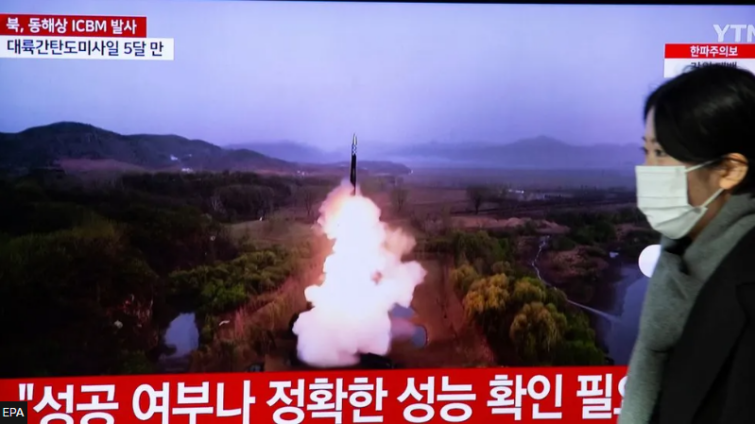
North Korea has fired its most advanced long-range missile, South Korean authorities confirm, defying UN curbs.
The launch of the solid-fuel intercontinental ballistic missile drew immediate condemnation from the West. It landed west of Hokkaido in Japan.
It comes after South Korean and US defence officials met last week to update plans on how to respond to a nuclear attack from the North.
Pyongyang had said in response it would take "more offensive countermeasures".
The isolated state launched the long-range missile on Monday morning about 08:24 local time (23:24 Sunday GMT) from the Pyongyang area.
South Korean and Japanese officials said the missile travelled for 73 minutes, covering about 1,000km (621 miles).
ICBMs have the range to reach the North American continent. Monday's launch is North Korea's fifth successful launch of an ICBM this year.
Tensions between the North and the South flared last month when Pyongyang successfully launched a spy satellite into orbit, in violation of United Nations sanctions.
Seoul responded by partially suspending a military agreement with the North that was meant to limit military activity along the border and reduce the likelihood of clashes.
Pyongyang then withdrew from the agreement entirely. North Korea has since rearmed its soldiers in previously unarmed areas of the Demilitarised Zone.
Last week, South Korea's national security advisor Kim Tae-hyo said he was expecting the North to launch an ICBM at some point in December.
On Monday, South Korean national security officials confirmed the ICBM launched was a solid-fuel missile. Such missiles can be fired with less warning, as they do not need to be fuelled prior to launch.
The North had tested its Hwasong-18 missile in July following a first successful flight in April.
North Korea is also working to develop a new solid-fuel medium-range ballistic missile. Last month it claimed to have successfully tested the engine, but the missile had not yet been successfully launched.
As North Korea continues to refine and add to its arsenal of nuclear weapons, South Korea and the United States are stepping up their defence of the region.
In a meeting in Washington on Friday, officials updated their contingency plans for how to respond to a North Korean nuclear attack. The two countries also agreed to war-game the use of nuclear weapons in their military exercises next summer.
Latest Stories
-
Ablakwa receives Presidential Special Envoy on Reparations to advance global agenda
5 minutes -
Christina Koch becomes first woman to travel around the moon on Artemis II
16 minutes -
Epstein survivors’ calls to meet King Charles and Queen harder to ignore as US visit approaches
22 minutes -
UN Secretary-General names Ghana’s Anita Kiki Gbeho as South Sudan envoy
23 minutes -
Mali withdraws recognition of Sahrawi Republic, backs Morocco’s autonomy plan
28 minutes -
Gov’t distributes over 8,500 laptops to One Million Coders project
29 minutes -
Julius Debrah, ‘man to beat’ as NDC’s James Agbey dismisses Musah Dankwah’s polls
35 minutes -
GPRTU in Savannah Region to protest alleged eviction in Damongo
1 hour -
Re: Reinsurance does not replace process — A response to the SIGA–SIC defence
1 hour -
Gender Ministry supports Harriet Amuzu in ongoing abuse case
2 hours -
AG joins plaintiff to scrap OSP ?: We should be mindful of the mischief in this – Bobby Banson
2 hours -
Samson Lardy Anyenini questions willingness of Attorneys-General to prosecute political colleagues
2 hours -
It is only fair the OSP is heard in Supreme Court case – Bobby Banson
2 hours -
Asiedu Nketia resumes Ashanti tour, second leg kicks off on Sunday
2 hours -
NLA denies salary cut claims, threatens legal action over reports
2 hours