

Audio By Carbonatix
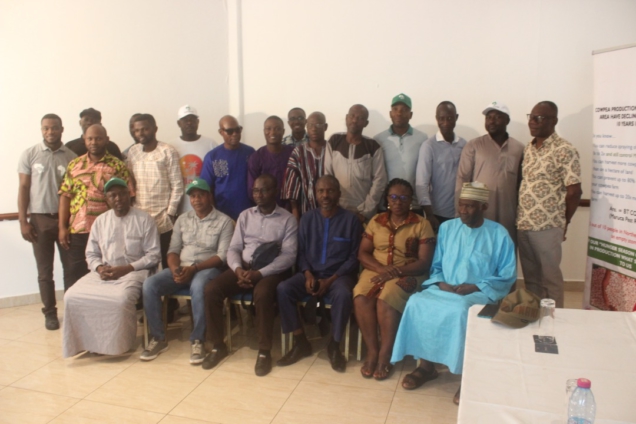
Open Forum on Agriculture Biotechnology (OFAB) Ghana, has partnered with the Council for Scientific and Industrial Research (CSIR), to organise a day’s sensitisation programme on Biotechnology and Genetically Modified Foods (GMOs) for some Muslim clergypersons in the Kumasi.
It was aimed, among others, at equipping the Muslim clergy members with the requisite knowledge and understanding of biotechnology in farming and agriculture to help effectively educate the general public to adopt the technology to ensure sustainable national food security and improved farmers' livelihoods.
Biotechnology involves the exploitation of biological processes for industrial and other purposes, particularly the genetic manipulation of micro-organisms to produce antibiotics, and hormones, among others.
Owing to the misconception about the adoption of GMO technology, OFAB believes that the training would enable the clergy members to significantly educate policy-making on agriculture issues through the provision of expert knowledge and facts.
According to OFAB, one tool, which is currently used to enhance biodiversity, is biotechnology. The technology covers various techniques and applications that allow variation and enhancement in living organisms to provide desirable products for humanity.
The one-day sensitisation programme, held with the Muslim clergy members in the Ashanti Region, was also to enable the clergy members to contribute significantly to neutralising the false impression, beliefs, and mystery surrounding the adoption of GMO products.
It brought together high-profile Muslim personalities and researchers from Council for Scientific and Industrial Research (CSIR) and Savanna Agricultural Research Institute (SARI).
Alhaji Professor Walter Alhassan, a senior statesman and former Director-General of CSIR, mentioned to the clergymen that the GM technology can be considered “Halal” in the Muslim faith.
The former Director-General, who is also a staunch Muslim, explained that GMO crops must be considered 'Halal', meaning pure for consumption by Muslims.
“Let’s all help promote the GM technology; it will help solve food security issues in Ghana and even beyond,” he said.
Latest Stories
-
Ghana must rethink education around relevance, resilience and responsibility — Ibn Chambas
2 minutes -
Prince Harry faces defamation lawsuit from charity he co-founded
4 minutes -
South Korea deploys thermal cameras to track escaped zoo wolf
5 minutes -
Calls for royal meeting with Epstein survivors grow ahead of US visit
9 minutes -
Ibn Chambas advocates blend of technology and human values in education
10 minutes -
UMA improves healthcare access in Asutifi North with GH₵700k ‘Kim Taylor Legacy’ Walkway
15 minutes -
Scholarships Authority and Fanaka University offer sponsorship for procurement and supply chain studies
18 minutes -
Bisa Kdei drops new single ‘Go N Look’ featuring Medikal
24 minutes -
Benin facing rising terrorism in north as French military presence faces growing criticism
26 minutes -
UEW Public Lecture Series 2026: Education debate ‘about the soul of Ghana’s future’ — Dr Ibn Chambas
26 minutes -
EU fingerprint and photo travel rules come into force from today
53 minutes -
Anti-LGBTQ+ Bill: Ghanaians demand expedited passage, not dialogue – Ntim Fordjour to Mahama
1 hour -
EU airline industry warns of fuel shortages if Strait of Hormuz stays closed
1 hour -
White House staff told not to place bets on prediction markets
1 hour -
Auctioneers petition Prez Mahama over ‘interference’ in public auctions
1 hour