

Audio By Carbonatix
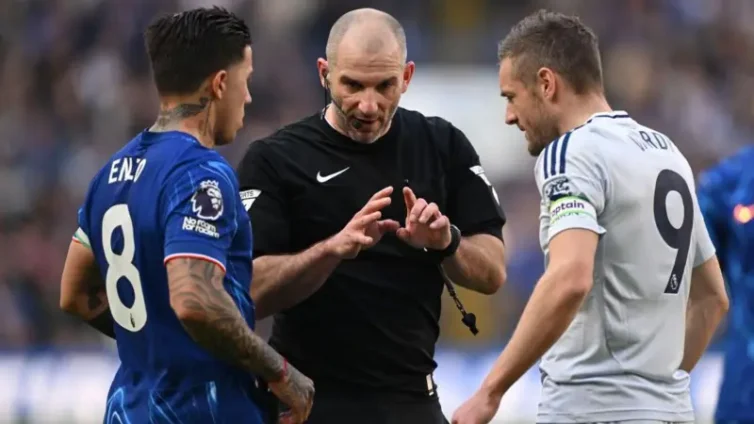
Only captains will be allowed to approach referees during Premier League matches from next season.
The top flight is set to adopt new guidelines - approved by the game's law-makers, the International Football Association Board (IFAB), in March - that state only one player from each team, usually the captain, is allowed the approach the match official.
Under the regulations, referees can instruct players not to approach them, and show yellow cards to those who do so without permission and behave in a disrespectful manner.
In the event that a team's captain is a goalkeeper, clubs will provide an alternative representative before kick-off.
This does not, though, prevent players from speaking to referees at other points during games.
The initiative has been used in all three Uefa club competitions this season as part of a trial process following its introduction at Euro 2024 last summer.
Although Premier League clubs are still being consulted, the rules are expected to be ratified at the Premier League annual general meeting next month and introduced at the start of the 2025-26 campaign.
IFAB will include the guidance in the 2025-26 Laws of the Game, effective from 1 July 2025.
An IFAB spokesperson told BBC Sport: "At this stage, they are not a compulsory part of the Laws of the Game, although Ifab strongly recommends their adoption at all levels following their successful implementation by Uefa and various national FAs and competitions."
The Women's Super League - controlled by Women's Super League Football (WSL Football) - could also adopt the guidance.
The English Football League (EFL) has guidance in place that two or more players surrounding a match official in a confrontational manner will result in a yellow card.
New hand signals and captain-only zones?
During Uefa competitions this season, the signal used to indicate the use of 'only the captain' guidelines is one arm extended, showing the flat of the hand.
"This signal may be adopted by other competitions, but currently there is no mandatory signal at the highest levels of the game, as different countries may have varying views on what signal best suits their football environment," added an IFAB spokesperson.
The governing body added it will review this further to determine whether a standard signal should be introduced in the future.
In junior, veterans, disability and grassroots football, referees will signal a captain-only zone by raising both arms above their head and crossing them at the wrists.
Uncrossing their arms and moving them in front of their body with their palms open in a forward pushing motion will indicate players must not approach them.
The zone will extend for four metres (four-and-a-half yards) around the official.
Under the guidance, referees have the power to initiate a captain-only zone at any stage during a match, although it is expected they will mainly do so following major decisions.
Why is this being introduced?
It's no secret referees and officials at all levels of the game are facing more abuse than ever before.
In 2023, the Premier League, the FA, EFL and the referees' governing body, PGMOL, introduced a new 'participant behaviour charter' which gave referees new powers to issue yellow and red cards where behaviour fell below expected standards.
Despite that, serious allegations relating to the assault and attempted assault of match officials in English grassroots football in 2023-24 increased by 32% from the previous season.
Trials of body cameras on referees are also being carried out.
In March, IFAB said the aim of the new guidance is to "prevent major confrontations" and reduce intimidation of officials by "creating a secure and calm zone around the referee".
IFAB added: "Creating a captain-only zone will focus responsibility on the captain to encourage their team-mates to behave appropriately. The captain must take responsibility for helping ensure that their team-mates respect the captain-only zone."
Latest Stories
-
Keta Port After the State of the Nation Address: President John Mahama Sets the Path to Redefine Ghana’s Blue Economy and Maritime Future
51 minutes -
Barker-Vormawor urges clearer rules and predictable framework for public-sector appointments
1 hour -
US-Israel-Iran war could affect Ghana’s gold and oil exports – Barker-Wormawor
1 hour -
Gov’t open to reviewing dismissals if affected workers were employed before December 7 – Kwakye Ofosu
1 hour -
NDC has spent more than any other gov’t in this fiscal year – Dr. Kabiru Mahama
2 hours -
US-Israel-Iran war: Walewale MP critiques Trump’s approach to foreign policy, calls for diplomacy
2 hours -
Gov’t rushing back to bond market despite spending concerns – Walewale MP
2 hours -
Domestic borrowing resumption will not lead to reckless spending – Kwakye Ofosu
3 hours -
Behind the Lens with Queen Liz explores evolving religious beliefs and questions of spiritual supremacy
3 hours -
IMANI-Africa questions credibility of UNIFIL contingent after attack on Ghanaian peacekeepers
3 hours -
Dialogue is the best path forward – Kwakye Ofosu on attack on Ghanaian UN peacekeepers
3 hours -
Preparing African children for the AI future – Why robotics is no longer optional in African schools
3 hours -
Gov’t defends scaled-down Independence Day celebration, cites cost and safety concerns
4 hours -
Peacekeepers attack: ‘No country should attack non-combatants with impunity’ – Kwakye Ofosu
4 hours -
Government condemns attack on Ghanaian peacekeepers in Lebanon, calls for UN investigation
4 hours