

Audio By Carbonatix
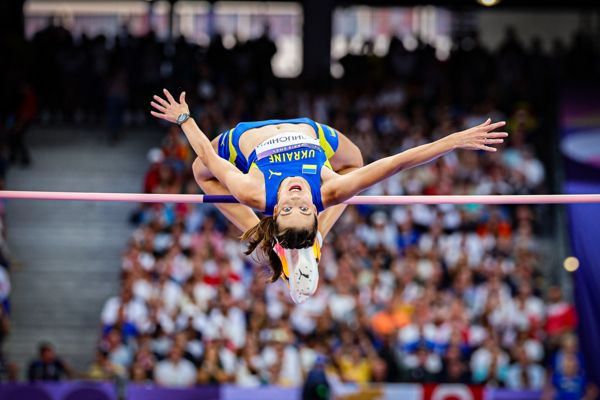
And then there were two. All year it has appeared that the women’s high jump gold medal at the Paris 2024 Olympic Games would become a showdown between world champion Yaroslava Mahuchikh of Ukraine and world indoor champion Nicola Olyslagers of Australia.
They were the only athletes to have consistently cleared two metres this year, Olyslagers setting the pace with a 2.03m clearance in January and her first global title in Glasgow, only to be eclipsed when Mahuchikh set a stunning world record of 2.10m at the Paris Diamond League meeting in early July.
The question was whether the 22-year-old Ukrainian could carry that stupendous form back to the Olympic host city for the Games, or whether Olyslagers would respond to the challenge.
But Mahuchikh, who has looked a future Olympic champion since she exploded on to the global scene as a 17-year-old World Championships medallist, proved irresistible on Sunday (4).
A clean sheet and first-time clearance at 2.00m was all she needed to complete her global set of titles, adding the Olympic gold medal to her world indoor and outdoor crowns, despite the ongoing turmoil in her native Ukraine.
Olyslagers kept herself in the contest with a third-time clearance at 2.00m but could go no higher and claimed her second consecutive Olympic silver medal.
The bronze medal was decided at 1.98m. Eleanor Patterson and Iryna Gerashchenko both had misses at the first attempt, leaving the two best jumpers of the year, Mahuchikh and Olyslagers, alone at the top.
There were still eight women in the competition at that stage, but six of them were unable to progress, leaving 2022 world champion Patterson and European medallist Gerashchenko tied for the bronze courtesy of first-time clearances at 1.95m.
Fittingly the podium ultimately comprised two Ukrainians and two Australians, the two nations that have dominated women’s high jumping since the Tokyo Olympic Games.
All four athletes gathered and jumped for joy on the landing mats in celebration.
Mahuchikh was just 20 and living in her hometown Dnipro, now a war zone, when the Russian invasion upended her life and turned her and many of Ukraine’s other athletes into wanderers far from home.
She has been a beacon of hope to her people in the worst of times and has borne that responsibility with grace and eloquence despite her tender years.
She won Ukraine’s second gold medal of the Paris Games, but the first in the main stadium.
“Finally, I got this gold medal,” she exclaimed.
Gerashchenko, who finished fourth at the last Olympic Games in Tokyo, said she was “so, so, so happy” to be leaving with a medal.
“It’s amazing for Ukraine. It’s our night. For Ukrainian people, the Ukrainian team. We did all that we can.
“Today, we have internet and light in Ukraine and YouTube channel. People watched us jump online. It’s very cool and amazing.”
The Australians have consistently supported and encouraged their Ukrainian counterparts over the years.
“It’s been wonderful to be able to see so much respect within the women’s high jump and to be able to hear what they’re going through, even though they didn’t have much family here today and they’re living on the road and away from home… and kind of appreciate that it’s not easy to rock up to the start line for these girls,” Patterson said.
This is the first time since the 1968 Mexico Olympics that two Australians have featured on the podium together in athletics.
Olyslagers had to overcome a disruption to her preparation when she developed a foot niggle in Europe in June and went home to Australia for a month for treatment. This was her first competition without the need for anti-inflammatories and she said she had full confidence in the foot.
“I had so much joy tonight. I have a following at home that were watching, maybe expecting a lot of things from me, but even under that pressure I saw that rather than shrink back from performing, on that two-metre jump I rose to the occasion.”
Patterson, 28, was a high jump prodigy as a teenager but she lost her way in her early 20s and retired briefly before she was drawn back by a sense of unfinished business.
Her long winding journey has now finally brought her to the Olympic podium, the dream she first had as an eight-year-old.
“I’m in a bit of disbelief,” she said. “It’ll take a while to sink in. I would’ve loved to jump higher, so it’s a bit of mixed emotions of feeling a little disappointed with my performances. But then you realise that it comes with a bronze medal, so I’m pretty proud.”
“Olympic bronze and being able to be on the podium with Nicola is very special, and then as well, to have both Ukraine and Australia there together.”
Latest Stories
-
VAST calls for urgent policy overhaul as air pollution kills thousands in Ghana
8 minutes -
Outcome to The Drama: 10 of the best films to watch this April
13 minutes -
Britain led the fight to end slavery; we shouldn’t be paying for a crime we helped eradicate – Kemi Badenoch
33 minutes -
“Who should compensate whom?” – Afenyo-Markin sparks heated Parliamentary debate over slavery reparations
1 hour -
Iran strikes injure US troops at Saudi base
1 hour -
NPP deploys regional heavyweights to oversee polling station and electoral area polls
2 hours -
Akufo-Addo to lead ECOWAS election observers for Benin’s high-stakes presidential transition
3 hours -
Iran war splits older and younger conservatives – as pressure builds for Trump to find exit ramp
3 hours -
Callistus Mahama writes on slavery reparation: ‘We cannot confuse participation with responsibility’
3 hours -
‘The gravest crime against humanity’: What does the UN vote on slavery mean?
4 hours -
Catholic Bishops back Mahama after US university rescinds honorary degree over LGBTQ stance
4 hours -
Ablakwa expresses disappointment over US ‘no’ vote on the UN Slavery Resolution
5 hours -
Luxury watches and cash theft: Joy Sports Editor Fentuo details what happened at the Black Stars camp before the Austria game
5 hours -
India grants ‘penalty-free’ exit window for overstayed Ghanaian nationals
6 hours -
Panic selling sweeps GSE: Market cap sheds GH¢44billion in two days
6 hours