

Audio By Carbonatix
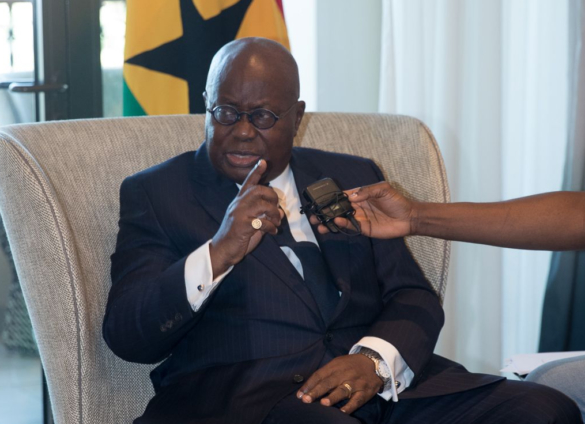
President Nana Akufo-Addo says the decision of the Supreme Court on the voting rights of Deputy Speakers cannot amount to judicial inference in the work of Parliament.
According to him, the suggestion that Parliament is beyond the scrutiny of the Supreme Court is to suggest that Parliament is a law unto itself.
“I’m not sure people who are saying this have actually taken the time to read the Constitution of our country. It says so in black and white. The legislative powers of the State, which is vested in Parliament, are subject to the Constitution's provisions.
"All organs of the Ghanaian State, including me as the Head of the Executive, we are all subject to the teachings of the Constitution,” the President said.
He continued, “There is nobody in the Ghanaian State that is above the fundamental law of the land. It will lead to the very matter that we have striven so long to avoid – the concentration of unregulated power in our state – we don’t want that. And we brought about this Constitution to allow that to not reoccur.”
President Akufo-Addo made this known in an interview with Charles Takyi Boadu of the Daily Guide Newspaper, on Thursday, 10th March 2022, on the sidelines of Dubai Expo 2020.
Astonished by the “public energy” dissipated in the debate, he was happy with the unanimity of the decision taken by the Supreme Court, especially as it is the most emphatic way in which the Court can pronounce.
Touching on suggestions that the Parliament is beyond the scrutiny of the Supreme Court regarding issues of interpretation, the President indicated that “the whole principle of judicial review was developed by the judges, both in America and England, to be able to check the activities of Parliament.”
Indeed, in Ghana, he stated that the first major constitutional case, which looked at the work of Parliament was in the case, Tuffuor vs Attorney-General, where the Act of Parliament, the decision of the Parliament to subject the then Chief Justice, the late Frederick Kwesi Apaloo, to a vetting process in Parliament had been expressly forbidden by the Constitution.
“And that is the reason why the late Dr Amoako Tuffuor took the matter to the Supreme Court, and the Supreme Court made it quite clear that all the activities of all the institutions of our Republic that impugn, that violate the Constitution are subject to the powers of the Court and to the Declarations of the Court,” he said.
President Akufo-Addo continued, “Me, I want to repeat it, as President, Head of the Executive, I am subject to the Constitution and to law. I cannot set myself above it.
"Everybody has his remit, but those remits are subject to the operations of the Constitution, and I am happy that the Constitution has been so declared in such an emphatic manner by the Supreme Court, I support the Supreme Court to continue to do its work.”
Latest Stories
-
Tyson Fury dominates Makhmudov, calls out Joshua next
7 minutes -
I have supported highway authority financially to fix roads in my constituency – A Plus
1 hour -
US, Iran fail to reach peace agreement after marathon talks in Pakistan
2 hours -
ECG kicks off Phase Two of transformer upgrades at Lashibi; brief outages expected
2 hours -
Port crises loom as 11,000 drivers threaten four-day strike
3 hours -
A source of excellence across generations – Vice President Opoku-Agyemang lauds Mfantsipim
4 hours -
(Photos) Mfantsipim School launches historic 150th anniversary
4 hours -
Knights and Ladies of Marshall group backs Catholic Bishops’ stance on anti-LGBTQ+
5 hours -
Bright Simons writes: All the Filla in the Ibrahim Mahama/E&P – Gold Fields Saga
6 hours -
Monetise Idiocy In Ghana
6 hours -
The Ghanaian prophet and the mysterious death of his scottish wife Charmain Speirs
6 hours -
Nearly 400 sentenced in Nigeria for links to militant Islamists
7 hours -
Ghana’s recovery supported by gold strength despite global oil price pressures – Standard Bank Research
7 hours -
Methodist Church hails Mfantsipim@150; calls for “fresh consecration” to excellence
7 hours -
‘Excellence is our inheritance’ – Nana Sam Brew-Butler hails Mfantsipim’s 150-year reign in leadership
7 hours