

Audio By Carbonatix
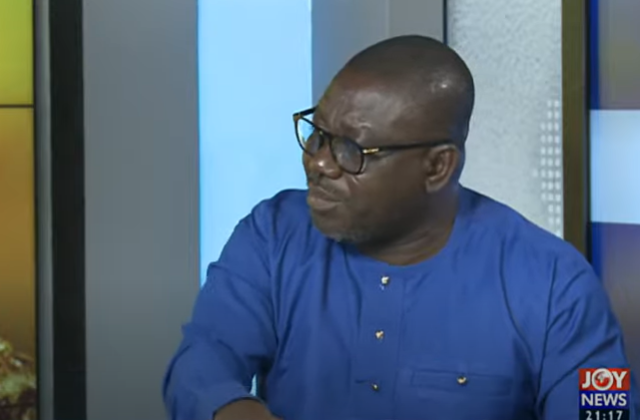
The Member of Parliament for Bolga Central, Isaac Adongo, has criticised the country's audit and accountability framework, declaring, "I've never had confidence in the kind of system we are operating."
Speaking on JoyNews’ Newsfile on Saturday, July 26, in response to the recent Auditor General's report, Mr Adongo characterised the current setup as a scheme that merely pretends to offer assurance without genuine prosecutorial powers.
Mr Adongo, a prominent voice on financial matters, articulated his deep frustration with a system he believes is fundamentally flawed.
"We are basically pretending to be exercising assurance, but the system that we are operating itself doesn't lend itself to proper assurance," he stated.
His core argument centres on the Auditor General's unique position as an employee of Parliament, which, he argues, is largely "toothless" when the audit reports are submitted.
"The parliament of Ghana is toothless when the auditor reports to it and simply engages in talk shows without prosecutorial powers," Mr Adongo asserted, directly referring to the Public Accounts Committee (PAC) sessions.
"They don't have those powers, and Parliament is the employer of the Auditor. So yes, there’s independence of the auditor away from the executive, but to what end? That is where the problem is."
A Cycle of Irregularities Without Consequences
Mr Adongo meticulously detailed the current audit process, highlighting its inherent weaknesses that lead to a cycle of repeated infractions.
He explained that irregularities are flagged by auditors, agencies are given opportunities to explain, and even after an "exit conference" and a formal "management letter" indicating unresolved issues, the process often culminates in mere directives to "go and implement these recommendations so that you don't see any more. You go and you go and sleep."
The MP pointed to the crucial role of internal auditors, often HND holders, who are expected to police sophisticated financial controllers, lawyers, and engineers, often in situations where they are poorly remunerated.
"At the end of the day, they are not able to do anything. The following year, it is repeated on a large scale," he lamented, describing the escalating figures of financial irregularities as "frightening".
This sentiment resonates with the Auditor General's 2024 report, which indicated significant financial irregularities amounting to over GHC 17.4 billion, underscoring the scale of financial mismanagement in public institutions.
The Need for "Bite" and Integrated Prosecution:
Mr Adongo stressed the urgent need for "a bite" – actual punitive actions – within the system.
He strongly advocated for reforms that would allow the Auditor General to collaborate with anti-corruption agencies like the Office of the Special Prosecutor (OSP) and the Economic and Organised Crime Office (EOCO) much earlier in the audit process.
"When I go to an audit and I start seeing issues immediately, I have to flag those issues and ask the anti-corruption agencies to now send a team to come and assist me on that audit because there's a possibility that this audit will end up in a prosecution," he proposed. This would ensure that "evidence gathering must start with my work as an auditor", preventing the tampering of evidence that often occurs when prosecution only begins years after an audit report is submitted to Parliament.
He argued that simple infractions, like unretired impress (advances given for official duties), should lead to immediate prosecution without waiting for a full audit cycle. "Some of these are not rocket science... you are waiting for an auditor to come a year later to validate that?"
Systemic Failures and Lack of Deterrent:
The MP also touched on issues like payroll-related irregularities, acknowledging a decrease in 2024, but questioning the effectiveness of validation exercises if heads of institutions are not held personally accountable through prosecution.
"If they become the target of prosecution, don't you think this will reduce?" he queried, emphasising the current lack of deterrence, "There is no deterrent because it's a cycle. I just have to play within the cycle for another cycle to begin, then they will turn their attention to the new cycle. And nobody comes back to what I did in the past."
Adongo concluded his incisive analysis with a call for serious systemic reform: "We need to be very serious with the way we implement these systems, and people must be held accountable to be honest with you. When I was being trained, I was told that trust is good, you know, but control is better."
Latest Stories
-
Mahama to review IMANI petition on insurance sector concerns – Kwakye Ofosu
17 minutes -
Road Safety Authority embarks on nationwide sensitisation ahead of Easter festivities
18 minutes -
Government reaffirms commitment to combat Human Trafficking at first 2026 HTMB meeting
38 minutes -
A/R: One injured, house torched at Penten as land dispute turns violent
38 minutes -
Delta Air Lines, AmCham Ghana honour women leaders at ‘Give to Gain’ High Tea event
57 minutes -
TaxForGalamsey: Awula Serwah slams ‘ignorance’ defence in levy scandal, demands sanctions for MMDCEs
1 hour -
Collecting levies from galamseyers is wrong; sanctions must be enforced – Kenneth Ashigbey
1 hour -
BeTechConnected launches Future of Work Africa Podcast to amplify African voices on jobs, innovation
1 hour -
Rejecting pesewa coins is illegal, fuels inflation – BoG warns traders
2 hours -
New Juabeng MP seeks details on GRA’s customs AI system
2 hours -
TaxForGalamsey: Levies were institutional, not personal – Kwakye Ofosu explains lack of sanctions
2 hours -
Feeding Hungry Pupils: 38-year-old female teacher initiates food bank to promote teaching and learning at Abankoro
2 hours -
Education Minister announces 2027 start date for Jomoro College project in Western Region
2 hours -
‘Sit us down and explain ‘it’—Customs agents raise alarm over new GRA AI system
2 hours -
Gov’t commits GH¢25m seed fund to Ghana Defence University project
2 hours