

Audio By Carbonatix
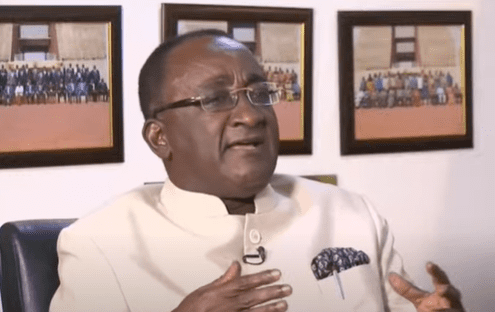
The Minister for Food and Agriculture has indicated that the Planting for Food and Jobs programme by the Akufo-Addo-led government continues to actively impact the lives of farmers in the country.
According to Dr Owusu Afriyie Akoto, aside from the programme still being strong, its contribution to the agric sector has exceeded projections made by the incumbent government.
Speaking to host of PM Express on JoyNews, Evans Mensah, he said: "the program is going very strong. In fact, I will say that looking back for years, it has gone much better than we thought."
This he explained is due to the willingness of farmers to respond to the incentives given by the government.
"A lot more farmers have come on board. Don't forget we started with a target of 200,000 and last year, we reached out to 1.7million farmers. That meant that the budget for the subsidies was just exploding because the farmers streamed in to join the programme because they have seen the impact, the improved seeds and fertilizer have had on yields - where an acre for their whole lives has been doing 3-5 bags of maize, for instance. Some are making about 15-40 bags for an acre in Sissala East.
"So it is a total transformation," he reiterated.
Dr Owusu Afriyie Akoto stated that the less endowed farmers are those who benefited from the programme the most.
"They have seen the transformation in their lives and this is something that the government of Akufo-Addo has always aspired to bring to the people of this country," he added.
Addressing the issue of increased prices of foodstuffs, the Agric Minister noted that the problem is not new as prices of farm produce have shot up every year.
He blamed the challenges on the unstable rainfall patterns experienced in the country.
"Prices have gone up and prices have always gone up in this period every year. Ghanaian agriculture is dependent on rainfall patterns and there are two of them. The Savannah region where it is just one rainfall season, May to September and the southern part of the country, where there are two seasons.
"The major seasons start in April and the minor season in September. We should understand that if you look at the records, going back 60 years or more, every four or five years there is a drought and we were lucky in 2017 to 2019. We were hit in 2020. In the southern part of the country, there was drought. So obviously, that is the underlying factor."
According to Dr Afriyie Akoto, the issue of increased prices should be resolved latest by January next year although the government is hopeful the problem would be rectified in the two-three months.
Latest Stories
-
Engage Now Africa to construct a 10-unit classroom block for struggling Navrongo Vocational Training Centre
4 minutes -
One digital financial breach could expose linked accounts to fraud – Financial Crimes Manager
9 minutes -
Ghana Russia Centre signs ICT cooperation agreement with Moscow University
13 minutes -
The powerhouses of the village: Honouring Ghana’s rural women on International Rural Women’s Day
13 minutes -
Vincent Assafuah petitions CHRAJ to investigate alleged irregularities in 2026 World Cup visa arrangements
14 minutes -
12-year-old boy found dead in muddy pit at Opeikuma
16 minutes -
GHS begins Yellow Fever vaccination campaign in three Upper West districts
17 minutes -
Organised Labour pushes for higher 2027 base pay despite slowing inflation
19 minutes -
Parliament’s Human Rights Committee demands swift justice in Obuasi SHTS sexual abuse case
29 minutes -
From Campaign Propaganda to Gov’t Accountability: When the message-makers demand a seat at the table
47 minutes -
Ashanti Region Security Coordinator warns sand winners to stay off Accra–Kumasi Expressway site
51 minutes -
PZ Cussons Ghana promotes hand washing among schoolchildren through Camel campaign
1 hour -
30 NDC aspirants file nominations in Upper West as regional election approaches
1 hour -
UPSA launches laptop assembly plant, requiring new students to assemble their own devices
2 hours -
UCC sociologist calls for action on gender inequality to end child marriage
2 hours