

Audio By Carbonatix
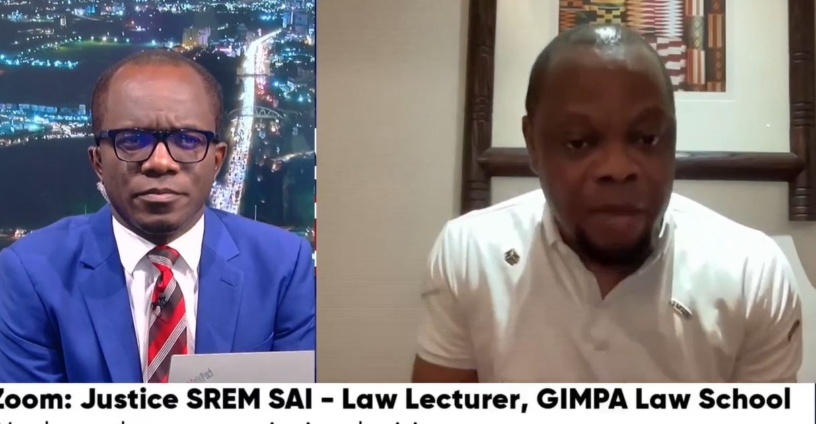
A law lecturer at the Ghana Institute of Management and Public Administration (GIMPA) Law School, has accused President Akufo-Addo of deliberately obstructing Private Member Bills from being passed into law.
Dr Justice Srem-Sai on JoyNews' PM Express criticised President Akufo-Addo's handling of such bills, noting instances where the President failed to follow proper procedures in dealing with bills passed by the legislature and required his assent.
Citing the Anti-Witchcraft Allegation Bill which was sponsored by the MP for Madina, Francis-Xavier Sosu, the law lecturer noted that the President's explanation for vetoing the bill was weak.
“There is a deliberate attempt from the Presidency to shut down this opportunity of Private Member Bills if you look at his previous refusal to sign or veto private member bills."
"For the first bill [the anti-witchcraft allegations Bill], he simply said he liked the bill but it was introduced by a private member so he doesn’t think he would sign it. That was his communique on it which is problematic because the person who is empowered to determine whether the bill imposes a financial burden on the country’s purse is the Speaker of Parliament.
"And if you have a problem with the Speaker’s discretion then you have to go to court. So it is not up to the President to sit in his office and sit in judgment over the Speaker’s decision," he said on Tuesday.
In the case of the Human Sexual Rights and Family Values Bill, commonly known as the anti-LGBTQ+ Bill, Dr Srem-Sai emphasised the seriousness of the situation, stating that the President's refusal to accept the bill poses significant challenges to communication between the two arms of government.
He indicated that the constitution provides mechanisms for resolving disputes between the Executive and Legislature, such as the power to veto or refer bills to the Council of State.
Thus, the President opting to refrain from accepting the bill, effectively stalls the legislative process.
The lecturer expressed concern over the communication breakdown and urged for a resolution to the impasse, emphasizing that the President's actions were holding the entire legislative process "to ransom."
Tensions between the Presidency and Parliament escalated following the Presidency's refusal to accept the recently passed Human Sexual Rights and Family Values Bill.
In what appears to be a form of retaliation, Parliament also did not approve the 24 ministerial appointees of the President before going on recess, with the excuse that a Member of parliament had also filed a suit that technically restrains parliament from approving the ministerial nominees.
Latest Stories
-
Philanthropist Alhaji FuZak donates Da’wah bus to Ambariya Sunni community
7 minutes -
GUTA calls for suspension of Publican AI system over trade disruptions, demands temporary halt in import activities
9 minutes -
TTAG raises alarm over proposed recruitment of 7,000 teachers, demands national posting roadmap
43 minutes -
Civilians feared killed after reports of air strike on Nigerian market
52 minutes -
Bishop Simon Kofi Appiah installed as new Jasikan Diocese Bishop
53 minutes -
Trump’s Strait of Hormuz blockade threat raises risks and leaves predicaments unchanged
56 minutes -
US Court backs extradiction of former MASLOC CEO Sedina Tamakloe-Attionu’s to Ghana
1 hour -
Seven arrested as NAIMOS dismantles illegal mining camp, seizes firearms at Boin River
1 hour -
Fire erupts at Madina Ritz Junction, destroys multiple wooden structures and containers
2 hours -
Daniel-Kofi Kyereh returns from long-term injury, registers assist for Freiburg U23
2 hours -
Knifeman calling himself ‘Lucifer’ slashes three at NYC’s Grand Central
2 hours -
Brands are built from within to without
2 hours -
Matriculants urged to pursue excellence as gov’t reaffirms support for Maritime education
2 hours -
See the areas that will be affected by ECG’s planned maintenance on Monday, April 13, 2026
2 hours -
GPL 2025/26: Salim Adams double fires Medeama back to summit after Kotoko rout
2 hours