

Audio By Carbonatix
Ghana possesses significant pools of domestic capital capable of financing major infrastructure projects, supporting businesses, and accelerating economic growth, but structural barriers continue to prevent those funds from reaching productive sectors of the economy, Board Chair of the Ghana Venture Capital and Private Equity Association (GVCA) Matthew Boadu Agyei has said.
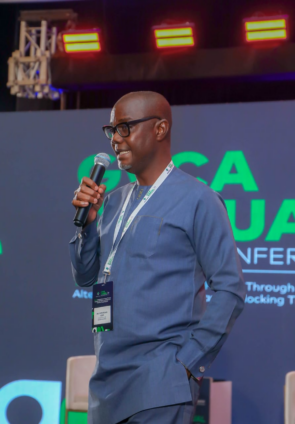
Speaking at the opening of the 2026 GVCA Annual Industry Conference in Accra, Mr. Agyei called for stronger collaboration among investors, policymakers, fund managers and entrepreneurs to unlock what he described as "trapped capital" within the country's financial system.
According to Mr. Agyei, Ghana's economic transformation will increasingly depend on the country's ability to mobilize and deploy domestic resources rather than relying solely on foreign investment.
"The reality is clear. While foreign capital remains important, the next phase of Ghana's economic transformation will be defined by how effectively we mobilise domestic capital and deploy it into productive, scalable, and resilient sectors of our economy," he said.
He noted that large amounts of capital remain underutilised within pension funds, insurance pools, family offices, and corporate balance sheets, despite growing opportunities in private markets and infrastructure development.
To illustrate the potential impact of domestic investment, Mr. Agyei pointed to the possibility of financing major national infrastructure projects through local capital.
"Imagine an ecosystem that can finance and build the Accra-Kumasi Expressway to international standards and then transfer ownership to Ghanaian pension funds. We would not only cut travel time dramatically but also create long-term value for our own people while building a more sustainable future," he said.
He observed that unlocking capital requires more than simply attracting investors. Rather, it demands deliberate efforts to strengthen confidence within the investment ecosystem.
He identified trust, innovation, and policy coordination as the three critical pillars needed to unlock domestic investment.
"We must build trust through strong governance, transparency, and performance. Track records matter because investors allocate capital where they have confidence that it will be managed responsibly and generate results," he stated.
Mr. Agyei further stressed the need for innovative investment structures capable of aligning investor expectations with long-term development objectives. He argued that creating appropriate investment vehicles would help channel more institutional capital into alternative asset classes.
He also urged closer collaboration among regulators, fund managers, institutional investors and entrepreneurs, warning that inconsistent policy measures could discourage long-term investment commitments.
"We need a predictable regulatory environment. Investors need certainty. Capital does not respond well to frequent shifts in tax policies and investment regulations," he said.
Throughout his address, Mr. Agyei emphasised the importance of moving beyond discussions to practical implementation.
He noted that while industry conversations have increasingly focused on expanding private capital participation, success would ultimately be measured by the volume of capital deployed and the quality of businesses and projects financed.
"The success of our initiatives will not be determined by announcements. It will be determined by execution. What matters is our ability to convert commitments into investments and investments into measurable economic impact," he said.
He expressed optimism about recent progress made through the GVCA 5 Percent Compact initiative, which seeks to encourage greater participation of institutional investors in alternative investments.
According to him, the initiative is already yielding results, with pension funds beginning to increase allocations to the private capital sector.
Mr. Agyei said Ghana has many of the ingredients required to build a thriving private capital ecosystem, including a growing institutional investor base, increasingly sophisticated fund managers, and entrepreneurs developing solutions across key sectors of the economy.
"The building blocks are already in place. We have capital, capable fund managers, innovative entrepreneurs, and partners who believe in Ghana's long-term future. The opportunity before us is to bring these elements together at scale," he said.
He challenged stakeholders attending the conference to focus on building stronger partnerships and creating practical solutions that will accelerate capital deployment into productive sectors.
"If we leave this conference with stronger partnerships, clearer strategies, and a renewed commitment to action, then we would have achieved something meaningful for Ghana's future," he added.
The conference, held under the theme “Fueling Ghana’s Future Through Domestic Alternative Investments and Unlocking Trapped Capital,” brought together more than 450 investors, entrepreneurs, development partners, and policymakers to discuss the future of venture capital and private equity in Ghana and across Africa.
The 2026 GVCA Annual Industry Conference featured high-level panel discussions, technical sessions, and masterclasses focused on fundraising, valuation, deal structuring, pension fund participation, and emerging investment opportunities within Ghana's evolving economy.
Latest Stories
-
MamaCare CEO warns unresolved conflicts among health workers could undermine maternal and neonatal care
5 minutes -
Health professionals urged to translate medical knowledge into practice to save mothers
11 minutes -
Conflicts among care providers linked to maternal, neonatal deaths – Expert
2 hours -
GIS marks 10th TIME conference, champions improved teaching practices
2 hours -
BRICS Or Balance? What Ghana’s bid really means
2 hours -
GPRTU wants full TRAFFITECH-GH implementation to start in 2027
3 hours -
Mahama announces plans to import electric wheelchairs for PWDs
3 hours -
KGL U17 Colts 2026: Western beat Prempeh Elite Academy to set up final final with Greater Accra Region
3 hours -
Late Solanke strike salvages 10-man Spurs draw at Man United
3 hours -
Gender Ministry to monitor welfare of Nana Akua Addo’s children amid domestic violence case
3 hours -
Benedict Okyere Yeboah: Ghana’s football problem goes beyond sacking a coach
3 hours -
GPL 2026/27: Darkwah Wiafe’s winner sees All Blacks beat Kotoko
4 hours -
ITF World Tour : Patel Wins Boys’ Singles Final at J100 Accra
4 hours -
Ghana must pursue BRICS partnership if it brings economic benefits – Kpebu
4 hours -
Success and Wright Claims J100 Accra Girls’ Doubles Championship
4 hours