

Audio By Carbonatix
An Environmental and Sustainability Science specialist, Professor Frederick Ato Armah, has proposed a comprehensive strategy centred on five elements to fight illegal mining.
The elements—vision, skills, incentives, resources and a coordinated action plan,he said, would address the root cause of illegal mining, including poverty, limited livelihood opportunities, weak governance structures and socio-cultural connections to land and mining, which had often been ignored by the political class trying to deal with the challenge, also known as galamsey.
“Without vision, we risk confusion.
Without skills, we invite anxiety.
Without incentives, we face inertia.
Without resources, there is frustration.
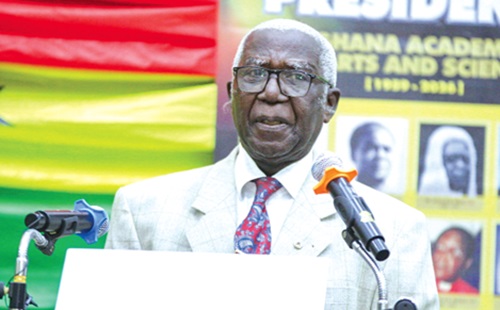
And without a practical plan, we misfire,” he said in his inaugural lecture at the Ghana Academy of Arts and Sciences (GAAS) last Thursday.
The lecture on the theme: “Fixes That Fail: A System Dynamics Archetype for Unpacking Illegal Artisanal and Small-Scale Gold Mining in Ghana”, Prof. Armah emphasised that illegal mining was not merely a law enforcement issue but a complex socio-economic and political problem requiring multifaceted solutions.
In attendance were the Vice-President of the Science Section of GAAS, Prof. Alfred Apau Oteng-Yeboah, students from Accra Academy, and other key stakeholders within the artisanal and small-scale mining (ASM) sector.
The environmental and sustainability science expert warned that the country’s approach to addressing illegal artisanal and small-scale gold mining (ASM) was fundamentally flawed and only reinforced the very problem it sought to eliminate.
Prof. Armah indicated that the country’s current strategies were classic examples of the “Fixes That Fail” systems archetype — where short-term solutions generated unintended consequences and worsened the long-term problem.
He critiqued the over-reliance on enforcement actions such as crackdowns and the burning of mining equipment, without addressing the underlying drivers of illegal mining.
“Such actions merely displace illegal miners into more remote and unregulated areas, where enforcement is weaker and environmental destruction continues unabated,” the environmental science professor said.
Explaining why most interventions failed because they did not confront the root cause of illegal mining, he pointed out that, “In some communities, mining is viewed as a heritage.
People believe it is their ancestral right to mine and so crackdowns often provoke resistance and in some cases, the weaponisation of communities. People take up arms not necessarily out of criminal intent but because they feel their way of life is being threatened.”
Models, misconceptions
Highlighting the importance of thinking through systems, Prof. Armah explained that how policymakers perceived and framed the problem of illegal mining largely determined the kinds of solutions they adopted, many of which were oversimplified and ineffective.

Prof. George Obeng-Adjei, FGA, Honorary Secretary of GAAS
He quoted American journalist, essayist and cultural critic, Henry Louis Mencken, who said that solving complex problems might have solutions that appeared clear, simple but wrong.
“If simplistic solutions were the answer, surely Ghana would have solved the galamsey problem decades ago,” Prof. Armah stated.
He added that cognitive biases, failure to learn from past efforts and the lack of community engagement further entrenched the crisis.
To break the illegal mining cycle, Prof. Armah also recommended the creation of a national vision for the mining sector, akin to the African Mining Vision but tailored to the country’s unique socio-political and environmental context.
Formalisation, livelihoods
Rather than suppressing illegal mining altogether, Prof. Armah called for the formalisation of the ASM sector.
That, he said, would involve licensing, registration, training, provision of safe equipment and the promotion of efficient, environmentally friendly mining technologies.
“Only 20 per cent of artisanal miners are formalised.
We need to recognise the scale of the challenge if we are to bring these actors into the legal framework,” he said.
Prof. Armah said complementary livelihoods must also be provided, stressing that alternatives must be culturally appropriate.
“If a fisherman is to be offered an alternative livelihood, it cannot be something foreign to their identity, like rearing grasscutters.
It has to resonate with their cultural background,” he stated.
Prof. Armah reiterated that illegal artisanal and small-scale gold mining in the country was not a problem that could be solved by force or technical fixes alone.
He urged academia, the government and civil society to work together and remain humble, open to learning and willing to reassess old models and methods.
Latest Stories
-
Dr. Nyaaba calls for sustainable transport and organic inputs to support farmers
10 minutes -
MTN Ghana to extend earnings into second-half of 2026; share price going for GH₵6.69
13 minutes -
Bono Region faces doctor shortage as only 7 of 20 posted doctors report – Deputy Health Minister
20 minutes -
Mahama to cut sod for 160-bed referral hospitals in Oti, Savannah and Western North
22 minutes -
Dr Kwame Nkrumah’s birthday celebration: Africa must heed Nkrumah’s vision of unity – Prof. Lumumba
24 minutes -
Dr Nyaaba calls for green financing to help farmers switch to solar-powered irrigation
25 minutes -
Investor sentiment towards banking stocks to remain positive
30 minutes -
Ghana’s happiness index averages 4.70 as study flags concerns over governance, environment
30 minutes -
Parents urged to seek early treatment for childhood cancer
31 minutes -
AngloGold Ashanti Obuasi mine promotes inclusion through neurodiversity awareness programme
32 minutes -
TVET Service warns institutions against unauthorised fees during admissions
35 minutes -
Paramount settles lawsuit with US states, clearing way for $110bn merger with Warner Bros
35 minutes -
GIRSAL calls for affordable financing and technical support for Ghana’s smallholder farmers
35 minutes -
Kwame Danso 24-hour economy market project five percent complete – Minister demands improvement
36 minutes -
Ghana’s maternal mortality rate three times above SDG target – Mahama
38 minutes