

Audio By Carbonatix
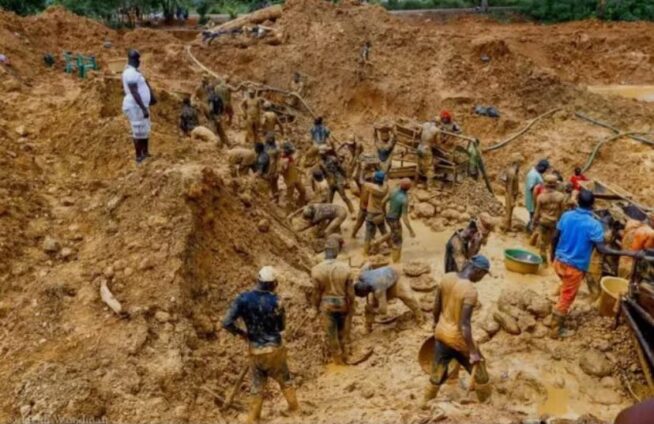
Ghana's illegal mining crisis is no longer only about polluted rivers and destroyed forests. Agricultural advocates say the activities of galamsey operators are now threatening the country's food supply chain by reducing farmland, cutting production, and pushing up the prices consumers pay at markets.
The Chief Executive Officer of The Ghanaian Farmer, Enyonam Manye, says the destruction of fertile agricultural lands is creating a supply challenge that is gradually translating into higher food prices for households.
"When people hear the word galamsey, they immediately think about polluted rivers, destroyed forests and illegal mining. While those who are serious or those who are concerned, there's another consequence that affects every Ghanaian every single day, is the rising cost of food," she said.
According to her, farms that once produced essential crops including vegetables, maize, cassava, plantain, and cocoa are being lost to illegal mining activities, reducing the amount of food available for the local market.
"Across many parts of Ghana, productive farms that are used to grow cocoa, vegetables, maize, cassava, plantain have been excavated by illegal miners," Enyonam Manye stated.
She explained that the reduction in farmland means farmers are unable to maintain previous levels of production, creating shortages that eventually affect prices.
"Every acre of farmland lost means food entering our markets. When supplies fall down, that means that the demand of food will become high and it will have shot the price because more lands have been destroyed," she added.
The agricultural advocate said many farmers are also losing access to land because some landowners are choosing financial gains from illegal mining over farming activities.
"When your family gets big money and they decide to let go of their land to Galamsey people… whatever you use to farm on, if it's a five acre or 10 acre, you will be left with either half or quarter of that," she said.
For consumers, she noted that the impact is eventually felt at markets where traders factor in additional costs before setting prices.
"The market will be forced to charge for transportation and charge for many other things. So at the end of the day, we the consumers end up paying higher because of the distraction that is being caused to our farmlands," she explained.
JoyNews Data and Research Analyst, Maxwell Aklorbortu, said the relationship between illegal mining and rising food prices can be explained through the basic economics of supply and demand.
He noted that contamination of farmland and water sources forces farmers to reduce production, abandon farms, or spend more resources to continue farming elsewhere.
"Once the farmland and irrigation water becomes contaminated, farmers either harvest less, abandon their farms altogether, or incur additional costs just to move production elsewhere," Maxwell said.
"Reduced food production means lower supply. And we know these are simple economies. If supply is less and the demand is high, prices are forced to push up," he added.
The Ghana Youth Environmental Movement (GEM) also highlighted how galamsey is affecting farming communities, citing the example of Isiakwa in the Eastern Region.
National Coordinator of GEM, Glory Emmanuella Appiah, said the community once produced much of its own food but has now become dependent on supplies from elsewhere after farmlands were converted into mining sites.
"Isiakwa used to be a farming community where they grew their own food. So they grew their cassava, their plantains. But because of the rising interest in Galamsey by some of the young people, some of the young people were selling their farmlands," she said.
She added that once food has to be brought in from other communities, prices often rise because sellers take advantage of the increased demand.
"People were no longer growing their food themselves. And so if other people from other towns brought in the foodstuff, they mentioned the prices that they wanted for the foodstuff," she explained.
The speakers warned that without urgent measures to protect agricultural lands and address illegal mining, Ghana risks worsening food affordability challenges and weakening its long-term food security.
The government has previously announced various interventions to combat illegal mining, including Operation Halt and the deployment of military personnel to mining sites. However, advocates argue that more comprehensive action is needed to protect farmlands and prevent the destruction of agricultural livelihoods.
The Ministry of Food and Agriculture is yet to respond to the concerns raised by agricultural advocates regarding the impact of galamsey on food production and prices.
Latest Stories
-
GRA blames system failure for delay in issuing receipt over passenger’s customs duty
7 minutes -
Livestream: Newsfile discusses World Cup visa scandal, beach demolitions, education strikes, BRICS bid
11 minutes -
NC-PTAs welcomes end of teachers’ strike, urges parents to prepare children for Monday
21 minutes -
Government procures over 2,000 transformers as Ghana’s electricity access hits 89.13% – Energy Minister
47 minutes -
UTAG-UG threatens strike on October 19 over unpaid allowance
56 minutes -
Let The Constitution direct Chieftaincy to deliver “All Development Is Local”
2 hours -
John Jinapor outlines renewable energy, nuclear power priorities for 2027
3 hours -
Ghana explores centre of excellence for hearing, communication and cochlear implant care
3 hours -
Schizophrenia-related disorders lead mental health cases recorded in Ghana
4 hours -
Dutch authorities enlist Ghana in hunt for fugitive drug lord Bolle Jos
4 hours -
Ghana housing finance conference adopts communiqué to improve affordable housing access
9 hours -
Special Initiatives Minister urges Wa Technical Institute to enrol more girls as EU-backed solar training lab opens
9 hours -
In the matter of my first year at the Bar
9 hours -
ActionAid Ghana calls for an end to child marriage, greater investment in girls’ rights
9 hours -
Newsfile to tackle World Cup visa scandal, beach demolitions, education strikes, BRICS bid
10 hours