

Audio By Carbonatix
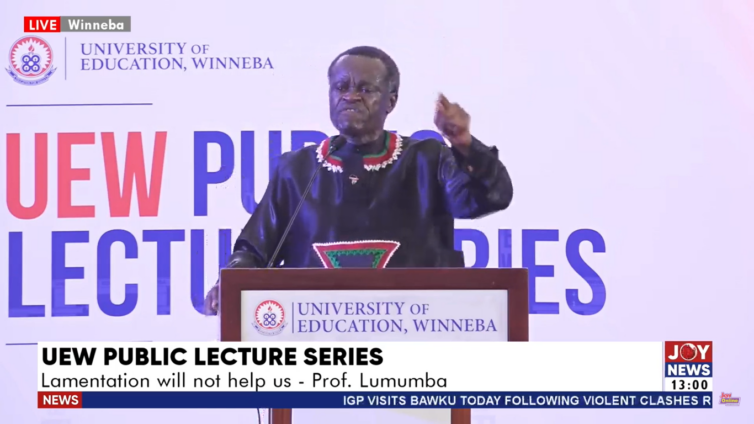
Pan-Africanist, legal practitioner and governance expert, Prof Patrick Loch Otieno Lumumba, has attributed the persistence of illegal small-scale mining, popularly known as galamsey, to failures in governance.
He cautioned that delays in addressing the issue are intensifying both environmental and human costs.
Speaking at a virtual environmental conference organised by the Institute of Governance Ethics and Religion (IGER-AFRICA) on Friday, December 5, Prof Lumumba highlighted the extensive damage galamsey is causing to water bodies, farmlands, and livelihoods, emphasising the need for urgent, emergency-level interventions.
The conference, held under the theme, “Navigating the Challenges of Illegal Mining in Ghana: Impact on Individuals, Communities, Health and Policy,” explored the societal and ecological consequences of unregulated mining practices.
Prof Lumumba noted that the lure of quick money has driven many away from productive employment and into illegal mining, with serious long-term repercussions for society.
He warned that unrestrained exploitation is degrading soil quality and the food chain, ultimately leaving everyone worse off.
“The time is now for us to do the right thing,” he said, stressing that delays only exacerbate the crisis.
He further urged governments to move beyond rhetoric, insisting that “results, not intentions, must be used to judge policies and laws.” He added that governments elected on promises to combat illegal mining must be held accountable for delivering measurable outcomes.
“This problem needs to be treated as an emergency,” he noted, asserting that effective implementation, rather than policy pronouncements, constitutes the true test of leadership.
Prof Lumumba also framed the discussion within the broader African mining sector, arguing that foreign dominance has left many countries without control over their natural resources.
“If you come to Ghana, the top mining companies are not Ghanaians. The same is true in the DRC, Botswana, Namibia, South Africa and Nigeria,” he said, emphasising the limited local influence over mining agendas.
He questioned why illegal mining continues to thrive despite ostensibly robust legal frameworks and policy commitments, pointing out that environmental destruction linked to galamsey persists in Ghana despite laws designed to regulate the sector.
“The question we must ask is: what is the problem?” he said.
IGER-AFRICA, the organisers of the conference, promote ethical leadership, good governance, and interfaith dialogue to advance peace, social justice, and sustainable development across Africa
Latest Stories
-
Planet One announces TVET projects worth $327m in three West African countries
7 minutes -
UN Chief condemns attack on Ghanaian peacekeepers in Lebanon, demands accountability
13 minutes -
US-Israeli air campaign hits hundreds of military targets in new wave of Iran strikes
17 minutes -
Ghana must lead Africa in criminalising environmental destruction – Annoh-Dompreh
18 minutes -
US-Israeli war against Iran enters new phase with rise of hardline successor Mojtaba Khamenei
23 minutes -
Kofi Adu Domfeh honoured with Excellence in Climate Journalism and Advocacy Award
25 minutes -
WPL 2025/26: Hasaacas, Ampem Darkoa Ladies close in on another final
26 minutes -
Bole MP donates GHS200,000 to support teacher training college establishment
41 minutes -
Danyame Old Town residents face eviction on a land occupied for 200 years
44 minutes -
60% of our water bodies are polluted – Minority Chief Whip pushes Ecocide Law
45 minutes -
Gov’t distributes seized ‘galamsey’ water pumps to farmers to boost irrigation – Dumelo
51 minutes -
MC Abeiku Sarkcess ignites Sarkodie’s Rapperholic UK with high-energy command
56 minutes -
Photos: Jonina Ladies record 3-0 win over Halifax Queens
57 minutes -
Government to establish over 250 Farm Service Centres in four years – John Dumelo
1 hour -
Full text: Statement by Frank Annoh-Dompreh, Minority Chief Whip and Nsawam-Adoagyiri MP on Legislation on Ecocide in Ghana
1 hour