

Audio By Carbonatix
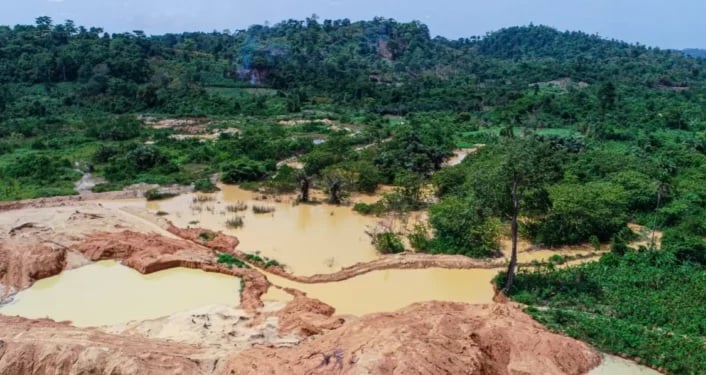
Illegal mining, widely known as galamsey, has destroyed nearly 9,000 hectares of Ghana’s forest reserves, according to the Forestry Commission of Ghana, raising fresh concerns about the growing environmental damage caused by the activity.
The Commission says the scale of destruction has intensified in recent years, with more than 5,200 hectares of forest lost between 2021 and 2024 alone.
A recent survey conducted by the Commission shows that illegal mining activities increased the total degraded area in forest reserves by 5,252.9 hectares within the three years, pushing the overall land affected to 8,923.8 hectares as of 31 December 2024.
Speaking to journalists on Wednesday, 4 March, the Chief Executive Officer of the Forestry Commission, Hugh Brown, said the situation worsened partly due to operational challenges faced by the Commission in recent months.
He explained that the withdrawal of military personnel from anti-galamsey operations left the Commission with limited capacity to respond swiftly to illegal mining activities within protected forest areas.
“The military was withdrawn on the 1st of November, and we were left to our own devices. We had to strengthen our rapid response teams quickly, sometimes putting them in situations where they were not well-equipped,” Dr Brown said.
The report also highlighted regional disparities in the extent of destruction, with the Ashanti Region recording the highest level of forest degradation, followed by the Western North Region.
According to Dr Brown, beyond enforcement challenges, Ghana’s forest protection strategies require urgent modernisation to effectively combat illegal mining.
“We cannot continue protecting forests as we did in the 1920s and 1930s, when forest guards held cutlasses and patrolled boundaries to detect offences. There has been insufficient investment in modern protection measures,” he noted.
Illegal mining remains one of the most pressing environmental challenges in Ghana, contributing to widespread deforestation, pollution of water bodies and loss of biodiversity.
Officials say addressing the problem will require stronger logistics for forest guards, improved surveillance systems, and closer collaboration between security agencies and environmental authorities to protect the country’s remaining forest reserves.
Latest Stories
-
COCOBOD raises GH¢3.4bn as Cocoa Capital PLC lists inaugural commercial paper on GFIM
15 minutes -
No Party Card, just a Party Microphone! A Ghanaian story of Elections, Referees and Convenient Amnesia
17 minutes -
Minority welcomes suspension of teachers’ strike, demands timely payment of promotion arrears
27 minutes -
Customary ownership accounts for 80% of land; it complicates land administration – Lands Commission
28 minutes -
NRSA to auction vehicles of non-subscribers who fail to pay towing charges within 21 days
34 minutes -
WAFU B U17: Black Starlets target AFCON slot after booking semi-final place
39 minutes -
Ghana faces $6.1bn debt-service burden from 2027 to 2029 due to Akufo-Addo’s DDEP – Haruna Iddrisu
46 minutes -
GoldBod targets 150 hectares of forest reclamation in 2027
55 minutes -
Despite substantial accommodation capacity, room demand still weakens – GSS report
1 hour -
No amount of foreign exchange is worth a lost forest – GoldBod
1 hour -
Chelsea’s defensive crisis: Alonso’s system, missing pieces, or individual errors?
1 hour -
Digital VAT collection to cover mobile payments, not just bank cards – GRA
1 hour -
John Darko denies role in SIC settlement after EOCO interrogation
2 hours -
GRA identifies about 100 additional foreign digital service providers for VAT collection
2 hours -
Digital VAT collection system will not add another 20% to existing charges – GRA clarifies
2 hours