

Audio By Carbonatix
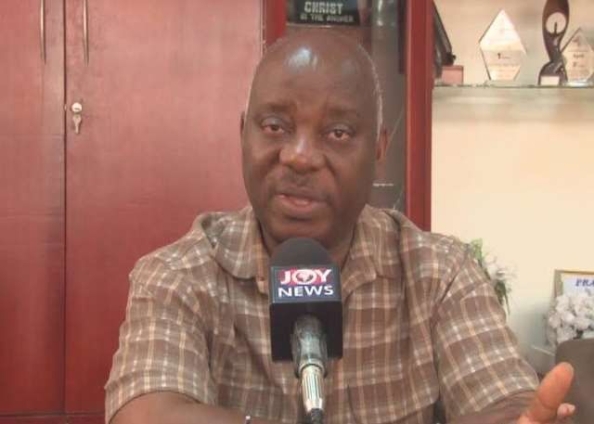
A former General Secretary of the Christian Council of Ghana Rev. Dr. Fred Degbe has called on Ghanaians to end the growing trend of vote buying and selling, a practice fuelling political corruption and hindering national progress.
He highlighted the troubling trend where people seeking elective positions purchase votes to secure their positions. He explained that these candidates often seek to recoup their investments through corrupt practices, thereby stalling the country's development.
The former General Secretary of the National Peace Council made the statement during a public lecture at the University of Education in Winneba at the 10th anniversary of the political science Education department of the school, on the theme, ‘Towards a peaceful 2024 election in Ghana: collaborations among stakeholders in the context of emerging technologies.’
According to the 2021 Population and Housing Census data, 7,317,555 people, or 24.3% of the household population, were identified as multidimensionally poor. Among this group, 43.8% faced severe poverty, experiencing deprivation across multiple dimensions simultaneously.
Rev. Fred Degbe admitted the fact that poverty was one of the reasons for such an act but emphasized the importance of integrity in the voting process, stating that, “no amount of monetary inducement should sway voters from exercising their civic duty with integrity.”
Vote buying typically involves offering gifts, money, or other incentives in exchange for votes during elections. Mr Degbe cited recent instances during the parliamentary and presidential primaries of both the New Patriotic Party (NPP) and the National Democratic Congress (NDC), where this unethical practice was prevalent.
The practice is not only unethical but also illegal. The Representation of the People Act, 1992 (Act 284) explicitly prohibits vote buying, with violators subject to legal penalties. The Criminal Offences Act, of 1960 (Act 29) also criminalizes bribery in elections, underscoring the serious legal consequences of such actions.
Rev. Degbe urged all stakeholders including students at the political science department of the University of Education to be ambassadors of change to curb the canker.
He also urged the media to avoid giving a platform to politicians who use their influence to insult opponents or incite violence, especially as the December elections draw near.
He identified the culture of insults, misinformation, vote-buying, and ethnic divisive campaigning as significant threats to democracy in Ghana. He encouraged the students and all stakeholders to do their part towards a peaceful 2024 elections in Ghana.
Latest Stories
-
At least 30 feared dead in crush at Haitian tourist site
57 minutes -
Four arrested over murder of Scottish businessman in Kenya
1 hour -
New Mainoo deal closer, says Man Utd boss Carrick
1 hour -
Sinner beats Alcaraz to return to world top spot
1 hour -
An inappropriate joke nearly ended his career. Now he’s back with more humour
2 hours -
GPL 2025/26: Dreams FC stage stunning comeback to hammer Eleven Wonders
3 hours -
Livestream: The Probe examines Kumasi’s looming water crisis
3 hours -
MTN Ghana gears up to lead Africa’s AI revolution
3 hours -
Philanthropist Alhaji FuZak donates Da’wah bus to Ambariya Sunni community
3 hours -
GUTA calls for suspension of Publican AI system over trade disruptions
3 hours -
TTAG raises alarm over proposed recruitment of 7,000 teachers, demands national posting roadmap
4 hours -
Civilians feared killed after reports of air strike on Nigerian market
4 hours -
Bishop Simon Kofi Appiah installed as new Jasikan Diocese Bishop
4 hours -
Trump’s Strait of Hormuz blockade threat raises risks and leaves predicaments unchanged
4 hours -
US Court backs extradition of former MASLOC CEO Sedina Tamakloe-Attionu to Ghana
4 hours