

Audio By Carbonatix
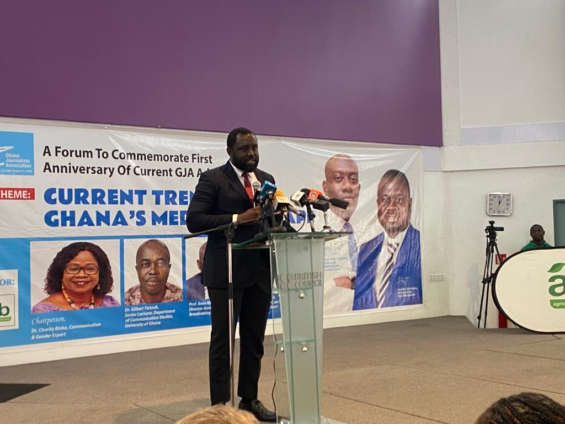
A Law Lecturer at the University of Professional Studies (UPSA), Albert Quarshigah, has urged the Government to repeal or amend all laws which impede media freedom.
That, he said, was necessary to ensure that journalists effectively delivered on their constitutional mandates for the betterment of the country.
He was speaking at a forum to commemorate the first anniversary of the new administration of the Ghana Journalists Association (GJA), in Accra, on Tuesday, on the theme: “Current Trends In Ghana's Media Landscape.”
The forum, among other things, was to enable the current administration of the Association to evaluate its performance a year after assuming office.
Mr Quarshigah, who was speaking on the topic: “An Assessment of the Criminal Law on False News and Its Application Against Media Practitioners In Ghana,” noted that, over the years, Ghana had taken steps to make the environment conducive for journalists to work.

One of such steps, he said, was the repeal of the Criminal Libel Law in 2001, which had improved the practice of journalism and strengthened the country's democracy.
Despite that, he noted that many laws existed in the country’s books, which deterred journalists from delivering on their mandates assigned by the Constitution.
For instance, Mr Quarshigah noted that “Section 208 of the Criminal Code which states that a person who knowingly give false or misleading information can face a fine of not more than one thousand penalty units or to a term of imprisonment of not more than three years or to both,” remained in the books of the country.
Mr Quarshigah raised questions about the existence of the State Secret Act, indicating that, the Act, al though not primarily targeted at journalists, could still be used to prosecute journalists if the State so desired.
The Law Lecturer said the media's role in the country's development could not be underestimated, so any law which prevented media practitioners from effectively delivering on their constitutional mandate must not be entertained.
“Most journalists report information from government circles. Sometimes it is difficult to get information in government circles, so you let the story go anywhere and then it turns out that if you have done a check you would not have published it.
“With all these challenges, why should the journalist go to jail for instance, because he published a story and then because of certain failure to search. Sometimes, when you put the story out, it gives story makers the opportunity to actually come out to respond and to clarify,” he said.
He added that: “We have done it before, we have repealed laws in this country. If you look at Article 12 of the Constitution the responsibility that is imposed on journalists is a very serious one. Journalists are supposed to hold government accountable and responsible to the people of Ghana.”
Mr Quarshigah also urged the GJA and the National Media Commission to take steps to strengthen issues of ethics among journalists.
Mr Yaw Sarpong Boateng, Executive Secretary, Right To Information Commission, said the passage of the RTI law has improved the work of journalists in the country.
However, he noted that non-compliance by public institutions remained a major challenge to the implementation of the RTI law.
Madam Fatimatu Abubakar, Deputy Minister of Information,said the Ministry was implementing programmes to improve the work of Ghanaian journalists.
Key amongst them include capacity building of journalists, campaigns on negative effects of mis/disinformation, making information accessible to all and prioritising the safety of journalists.
Latest Stories
-
MTN Ghana to spend $1.1bn in 3 years, build 500 new sites as MoMo hits 44% Growth
2 minutes -
I have no regrets joining Assemblies of God – Mahama
2 minutes -
Starlink restrictions in Ukraine war linked to political situation, Zelensky aide says
5 minutes -
Furniture boost for Techiman North schools as MP donates to 20 institutions
6 minutes -
Assemblies of God to loan 10,000-seater dome for Ghana@70 celebrations
6 minutes -
Government to audit 2,016 community network sites – Communications Minister
6 minutes -
Heritage Series notes: BoG promises more inclusive cedi with improved sizes, tactile features
23 minutes -
‘We want answers’ – Family seeks probe into 14-year-old’s death 12 days after starting SHS
34 minutes -
No preacher has the right to impose beliefs on bus passengers – Kwesi Pratt Jr backs preaching ban
38 minutes -
Africa Maritime Security Forum opens in Accra with call for stronger continental cooperation
38 minutes -
Techiman North MP fulfills promise with new CHPS Compound in Kokoago
49 minutes -
Enterprise Trustees, Sinapi Aba launch ‘Asetenapa Plan’ to promote retirement savings among informal workers
51 minutes -
Gov’t working to ensure GAUA strike is called off by October 16 – Haruna Iddrisu
56 minutes -
KAIPTC Commandant calls for continent-wide strategy to tackle Africa’s maritime security threats
1 hour -
GRIDCo investigates Mallam substation fire as power restoration continues in Accra
1 hour