

Audio By Carbonatix
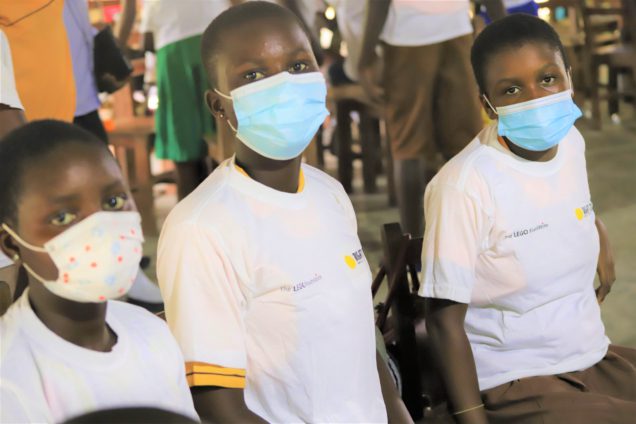
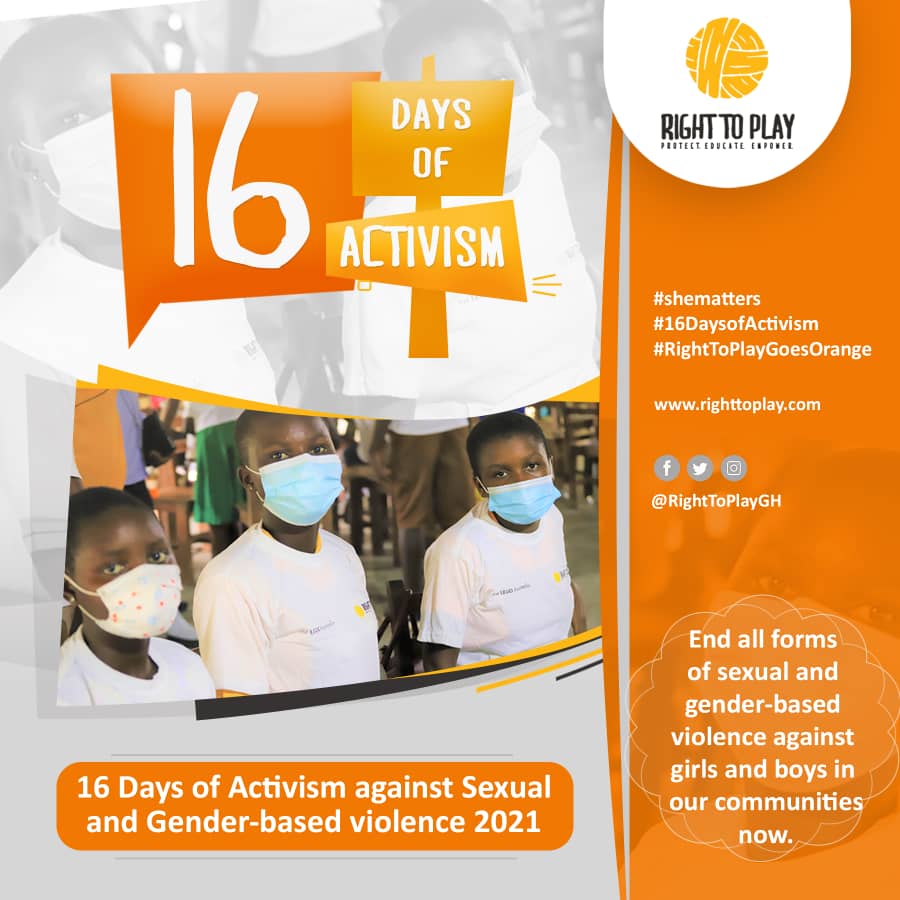
Right To Play is appealing to the government, district education officials, parents, and caregivers to eliminate all forms of violence against girls and boys in Ghana as it joins the world to mark the 16 days of activism against Sexual and Gender-based Violence (SGBV).
The international organization has asked Ghanaian law enforcement authorities to visit the ultimate consequences on perpetrators of sexual and gender-based violence across the country without fear or favour.
“One of the ways to address this issue [SGBV] is to ensure that perpetrators of sexual and gender-based violence are made to face the full wrath of the law without any cover-up which will serve as a deterrent to others,” the Gender Specialist at Right To Play Ghana, Fouzia Tua Alhassan has said.
Girls and women in Ghana continue to face multiple forms of sexual and gender-based violence, including domestic violence.
An estimated 27.7% of women in Ghana had experienced at least one form of domestic violence, the Ghana 2016 Survey on Domestic Violence has said.
These forms of sexual and gender-based violence according to the United Nations (UN) would increase during this period of the COVID-19.
The United Nations Population Fund (UNFP) has said that victims of violence suffer sexual and reproductive health consequences such as forced and unwanted pregnancies, unsafe abortions, sexually transmitted infections, including HIV, and even death.
Similarly, the report of a Gender Analysis conducted by Right To Play under the Gender-Responsive Education And Transformation (GREAT) Project in five districts across Ghana has shown that household workload given to girls negatively affect their learning outcome.
But Right To Play is rallying consensus against all forms of discrimination and violence against girls and boys.
“Girls need to have unimpeded access to education because access to quality education has been identified as one of the effective tools to empowering young girls and building their confidence for soft skills that can help them through adolescence,” Right To Play has said.
“Access to information and education on SGBV should be situated in the context of human rights with deliberate efforts to consider the culture and consultative approach to designing interventions.
"There is, therefore, the need to have gender-focused interventions with key stakeholders understanding and appreciating the reality behind such interventions and the crucial role they can play in realising this objective,” the Gender Specialist at Right To Play has noted.
As part of activities earmarked for the 16 days of Activism against sexual and gender-based violence, Right To Play will train parents/caregivers, opinion leaders, teachers and children about SGBV and the support mechanisms available in Ghana to help survivors and bring the perpetrators to justice.
There will also be a procession in selected communities, a multimedia campaign on Right To Play Ghana’s social media handles, and radio discussions on SGBV.
The 16 days of Activism against sexual and Gender-based violence starts from November 25 to December 10.
Latest Stories
-
La Beach demolition: Senyo Hosi condemns lack of consultation
1 minute -
Russian glide bomb attack on Zaporizhzhia kills at least 15 people
16 minutes -
Jinapor warns underperforming energy sector CEOs of consequences, says no protection for failure
18 minutes -
Fire destroys head of tipper truck on Lower Volta Bridge
22 minutes -
Palmer signs new Chelsea contract until 2034
24 minutes -
World Cup visa scandal: Mahama will act on corruption allegations – Abass Nurudeen
25 minutes -
Abass Nurudeen accuses Minority of ‘scandal scavenging’ over World Cup visa controversy
27 minutes -
US Embassy recognised NSA, GFA and GTA as separate entities for visa applications – Sports Minister’s aide
33 minutes -
Only 30% of Ghanaian teachers satisfied with their jobs – CAPCOE data reveals
44 minutes -
Communities affected by construction of Akosombo Dam urge government to speed up compensation process
1 hour -
World Cup visa scandal: Sports Ministry not shielding anyone – Sports Minister’s special aide
1 hour -
World Cup visa scandal: Over 30 people misrepresented as GTA board members to US Embassy – Vincent Assafuah alleges
1 hour -
Fire destroys wooden structure near Yesu Mo Villa at Bush Road
1 hour -
NDC threatens sanctions over oversized campaign posters, gives aspirants 5 days to comply
2 hours -
Star Oil paid GH¢2.7bn in taxes, levies in nine months of 2026
3 hours